
Domestic Violence Defense in Florida
How Self-Defense May Apply in a Florida Domestic Violence Case
Patrick David Wilson explains how self-defense may be raised in domestic violence charges, and why the facts of each case shape the result.
By Patrick David Wilson · Published October 12, 2026
Stand Your Ground Law Florida: How It Works in Court
This page explains how self-defense can come up in a domestic violence charge, one of the criminal matters Patrick David Wilson handles. It does not restate the self-defense statutes, so check their current text before relying on any point below. Every case turns on its own facts.

Why the Facts Matter in Self-Defense Claims
Self-defense is a question of facts. The same event can read very differently in a police report, a witness statement, and a sworn court petition. Details like the time, the place, any injuries, and the history between the people involved all carry weight. A claim that sounds strong in conversation may look different once the full record is in front of you.
Immunity is one way the law can reach a case before trial. Immunity under section 776.032 may be raised in a pretrial defense motion, depending on the facts and applicable law. Whether any defense succeeds depends on the facts and applicable law, and no summary can predict that result.
Where the Law Applies: Home and Family Relationships
In a domestic violence case, the relationship between the people involved can matter as much as the location. Florida defines domestic violence to include listed offenses, such as assault, battery, stalking, and kidnapping, when one family or household member commits them against another. Fla. Stat. § 741.28
The statute defines family or household members broadly. It includes spouses, former spouses, relatives by blood or marriage, people who live or have lived together as a family, and parents of a child in common. Except for parents of a child in common, those people must currently live, or have lived in the past, in the same single dwelling unit.
That single-dwelling rule has a real effect. Under Fla. Stat. § 741.28, persons who are parents of a child in common are an exception to the requirement that family or household members be currently residing or have in the past resided together in the same single dwelling unit. Living arrangements also change over time, so a past home can matter as well as a current one. Whether either situation fits depends on the facts and the statute’s exact wording, and the offense itself must also be one the statute lists.
What Counts as Assault or Battery in a Domestic Violence Charge
Assault and battery are among the offenses listed in the domestic violence definition in Fla. Stat. § 741.28. An assault, under Fla. Stat. § 784.011, is an intentional, unlawful threat by word or act to do violence to another person. The threat must come with an apparent ability to carry it out and create a well-founded fear that violence is imminent. Assault is a second-degree misdemeanor under that section, except for a riot-related assault described in its subsection (3).
Battery is different. Under Fla. Stat. § 784.03, battery occurs when a person actually and intentionally touches or strikes another person against that person’s will, or intentionally causes bodily harm. Battery is a first-degree misdemeanor, except in the cases the statute describes separately.
The statute also describes a higher-level charge. A later battery may be charged as a third-degree felony for a person with a prior conviction for battery, aggravated battery, or felony battery, depending on the facts and applicable law. The statute counts a plea or trial result as a conviction even when adjudication is withheld. Whether that applies depends on a person’s record and the facts of the case. The exact charge on the paperwork is the starting point for any review.
Primary Aggressor and Arrest Decisions
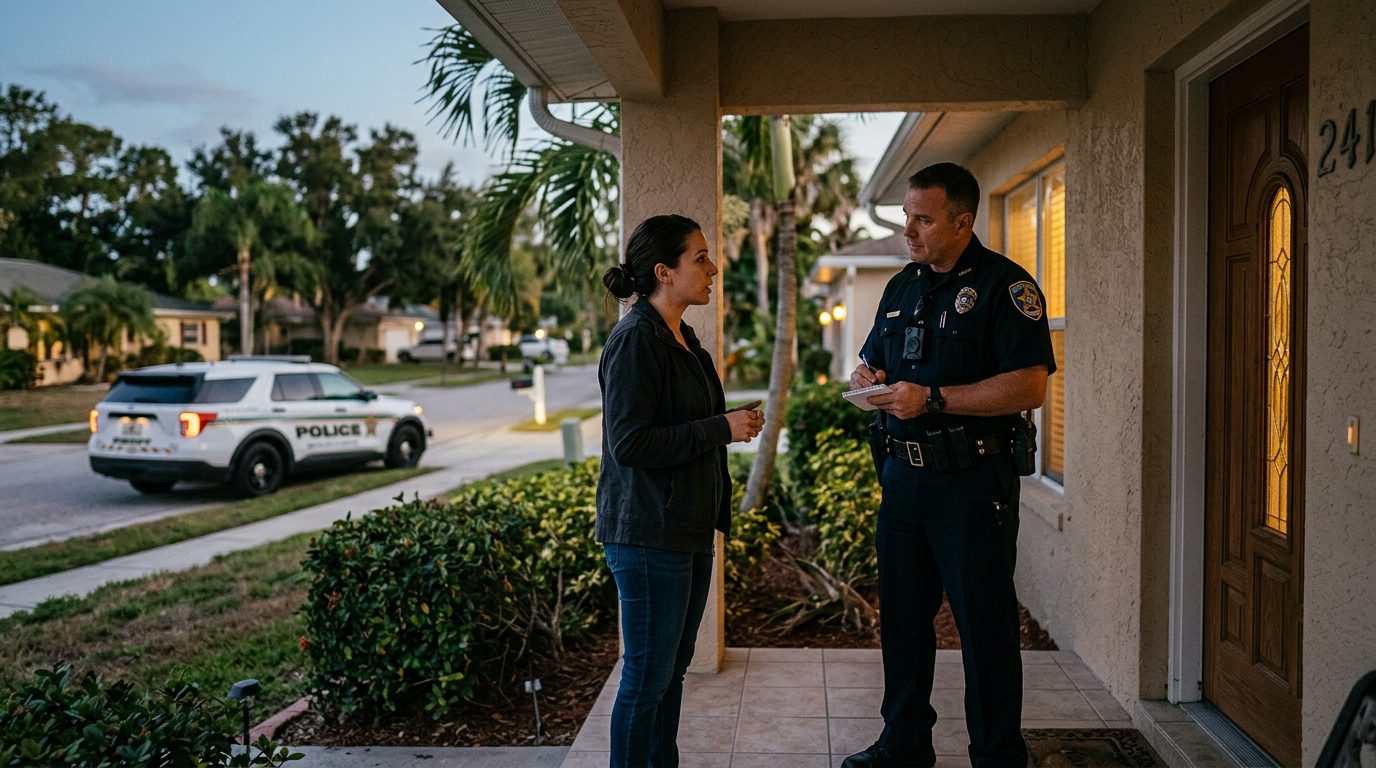
When two people each report a domestic violence incident, the officer must try to determine who was the primary aggressor. The statute applies this step when an officer has probable cause that two or more people committed a misdemeanor or felony, or when two or more people make complaints. Fla. Stat. § 741.29
The statute also addresses arrest. It calls arrest the preferred response only for the primary aggressor, and not the preferred response for a person who acts in a reasonable manner to protect or defend themselves or another family or household member. Preferred is not the same as required. How the rule applies depends on what the officer learns at the scene.
A scene assessment is a starting point, not the final word. Later evidence, such as witness accounts, messages, or photos, can change how the facts look. If you were the person who called for help, your account still matters, and so does the account of the other person. Ask what the officer wrote down and what each person said, because those details can shape the next steps.
Requesting Stand Your Ground Immunity
A request for immunity is raised through a pretrial motion, and whether the court grants it depends on the facts and applicable law. Rule 3.190 requires every motion to state the grounds it is based on.
Timing is one of the first practical questions after a charge. Because the motion must state its grounds, the facts that support it need to be set out clearly in writing. Any deadline the court sets in your own order should be read closely.
This page does not describe the hearing, the burden of proof, or the standard a court applies. Immunity, if raised, is not a promise of dismissal. It is one possible path that depends on the facts, the record, and the law.
Common Questions About Self-Defense in Domestic Violence Cases
Self-defense can be raised in a domestic violence case, and whether it applies depends on the facts and applicable law. The answers below cover related questions that come up in this area. Check your own court papers, since any order in your case controls what applies to you.
Is self-defense a defense to a domestic violence charge in Florida?
Self-defense may be raised in a domestic violence case. Whether it applies depends on the facts and applicable law.
Can a domestic violence injunction affect gun ownership?
A final injunction for protection against domestic violence can bar possession of firearms and ammunition while it remains in force. Fla. Stat. § 790.233 Whether this applies depends on whether the injunction is final, currently in force, and covers that person. A violation of that section is a first-degree misdemeanor.
What is the battered-spouse syndrome notice?
A defendant who wants to use the battered-spouse syndrome defense must give advance written notice. The timing for that notice is set by Fla. R. Crim. P. 3.201, and the applicable deadline depends on the current text of the rule and the facts of the case. The notice must include the defense’s particulars and the witnesses’ names and addresses, as far as possible. Whether this defense is available depends on the facts of the case.
What happens after an injunction is violated?
What follows depends on the facts and the law.
How Self-Defense Can Matter in a Domestic Violence Case
Self-defense can become central when the two accounts of an incident conflict. Injunction papers are one place where those accounts first appear in writing. Under Fla. Stat. § 741.30, a victim of domestic violence, or a person with reasonable cause to believe they face imminent danger of becoming one, may file a verified petition in circuit court. The petition must include a sworn statement under penalty of perjury. It must also describe incidents, including when and where they occurred.
That sworn account can matter as much as what a person told police. Details in a petition can later be compared with the police report and other evidence. That is why a careful review of every written statement matters early.
Early steps matter too. Keep copies of anything you receive, write down dates and locations while memory is fresh, and be cautious about posting about the incident online. Useful records may include police reports, injunction papers, messages, photos, and medical records, where they exist. A summary cannot show how the evidence will be weighed in any particular case, and results depend on the facts and applicable law.

Talk With Patrick David Wilson About Your Situation
If someone you care about was arrested after an argument, or if you are facing a charge yourself, the next steps can feel urgent and confusing. You do not need every answer before you reach out. A first conversation can focus on the facts you already know.
Patrick David Wilson is the responsible lawyer at Patrick Wilson Law, PLLC, a criminal defense practice based in Miami. The practice focuses on domestic violence defense among its criminal defense areas, and it serves clients across South Florida, from Broward County to the Florida Keys. Results depend on the facts of each case and applicable law.
If you want to talk through what happened and what a charge could mean, contact Patrick David Wilson for a free consultation through the contact page, call 786-761-1719, or leave a message.
About This Page
Focused Criminal Defense Practice
Patrick Wilson Law focuses on criminal defense, including domestic violence, DUI and sexual battery charges.
Serving South Florida
Patrick David Wilson represents clients from Miami and Miami-Dade County to Broward County and the Florida Keys.
General Information Only
This page explains general concepts. Whether any defense applies to your situation depends on the facts and applicable law.
Important
Statements you make to police or to others about an incident may be used later. How they are used depends on the facts of your case and applicable law. Speak with Patrick David Wilson before making a statement.
Practical Steps to Discuss With Your Lawyer
Write Down the Facts
Record what happened, when, where, and who was present while the details are still clear. Your lawyer can use these notes when evaluating possible defenses.
Keep Any Evidence
Save texts, photos, messages, and records that relate to the incident. Whether they support a self-defense claim depends on the facts of your case.
Read Any Court Order Carefully
If you have received an injunction or other order, read its terms closely. What it requires or prohibits depends on the specific order and applicable law.
Be Careful About Statements
Speaking with police, the other party, or others can affect your case. Patrick David Wilson can advise you on how to respond to questions.

