
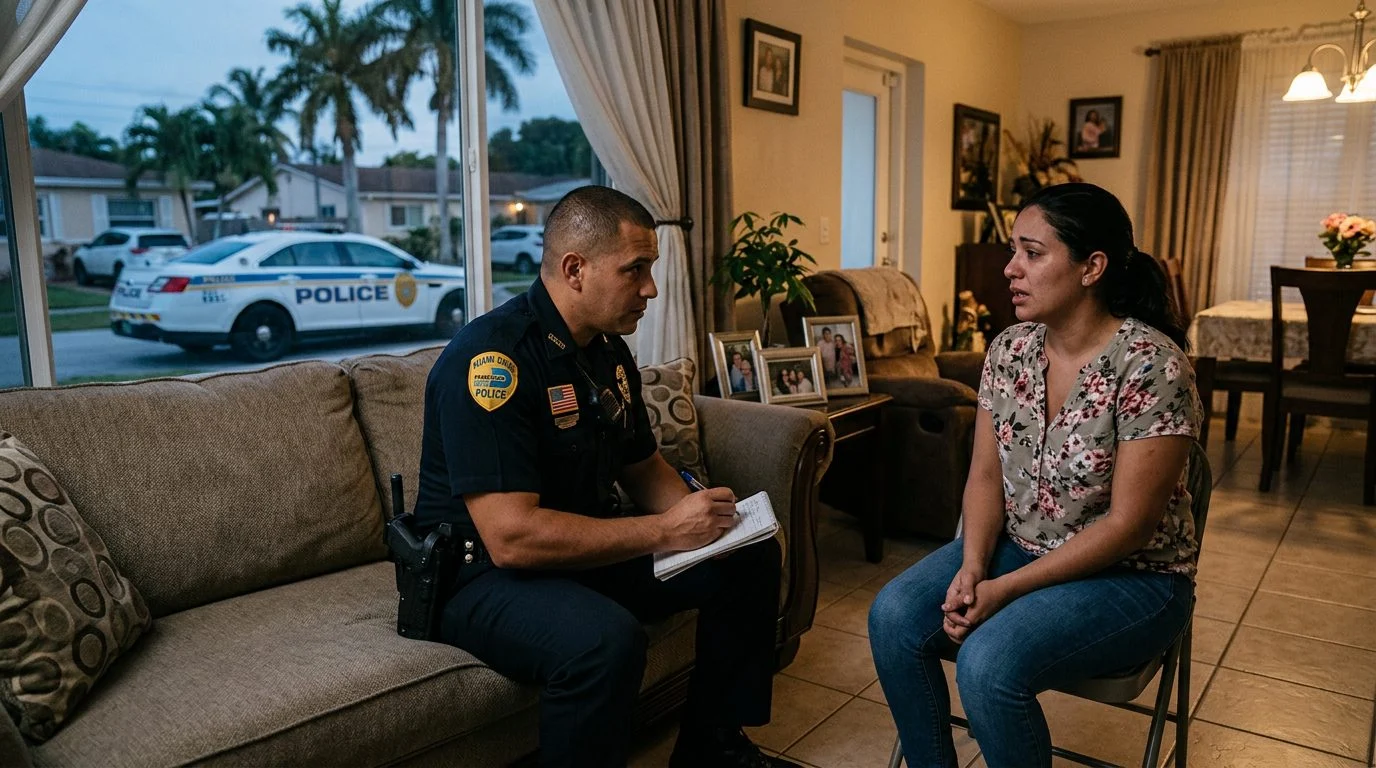
Domestic Violence Defense | Miami & South Florida
Worried About a Domestic Violence Arrest on Your Background Check?
Patrick Wilson Law, PLLC helps clients from Miami-Dade and Broward to the Florida Keys understand their options and plan their next steps with a clear head.
Working With Patrick Wilson Law
Free
First consultation, confidential and without obligation to continue
Miami
Criminal defense based in Miami-Dade County
Keys
Serving clients from Broward County to the Florida Keys
By Patrick David Wilson · Published November 15, 2026
A domestic violence arrest can stay on a background check even when the case never led to a conviction. That is why many people ask whether it can be removed.
In some cases, yes. Under Florida law, a court may order a criminal justice agency to seal or expunge a criminal history record only for a person who complies with the statutory requirements, and only after that person has applied for and received a certificate of eligibility. This page explains how those rules work for readers across South Florida.
What a Domestic Violence Arrest on Your Florida Record Means
A domestic violence arrest is a police record of an accusation, and it can appear even when no conviction followed.
Florida’s definition covers assault, battery, stalking, sexual battery and related offenses committed by one family or household member against another, under Fla. Stat. § 741.28. Physical injury is not always required.
The law also defines who counts as a family or household member. That includes spouses, former spouses, persons related by blood or marriage, persons who live or have lived together as a family, and parents of a child in common whether or not they have been married; except for parents of a child in common, they must live or have lived together in the same single dwelling unit.
This page is written for three kinds of readers:
- The person who was arrested.
- A family member helping them through it.
- A licensed professional or job applicant whose employer or licensing board may see the arrest.
An arrest is not a conviction. Whether the record can be removed turns on how the case ended, so the final disposition is the first thing to check.
If a domestic violence arrest has surfaced on a job, license, or housing check, we can walk through how the case ended and what it means for you. Talk it through with our team — the first consultation is free, confidential, and carries no obligation.
Sealing or Expunction: Which Is Better?
Neither option is better in every case, because eligibility decides which one is open to you.
Expunction removes the record from public view by destroying it. Under Fla. Stat. § 943.0585, a criminal justice agency with custody of the record must destroy or obliterate it. The Florida Department of Law Enforcement must keep the record in all cases, and the record stays confidential and is not available to any person or entity except upon order of a court of competent jurisdiction.
Sealing hides the record from the general public. Under Fla. Stat. § 943.059, a sealed record is confidential and available only to listed people, starting with the subject of the record.
Sealing is not invisible to everyone. The same statute lets the department disclose a sealed record to certain licensing, access authorization and employment entities. Fla. Stat. § 943.059 reads: “An employee of an entity set forth in subparagraph (b)1., subparagraph (b)4., subparagraph (b)5., subparagraph (b)6., subparagraph (b)8., subparagraph (b)9., subparagraph (b)10., or subparagraph (b)11. may not disclose information relating to the existence of a sealed criminal history record of a person seeking employment, access authorization, or licensure with such entity or contractor, except to the person to whom the criminal history record relates or to persons having direct responsibility for employment, access authorization, or licensure decisions.” For a job or license question, that detail matters.
Both paths need a court order. Fla. R. Crim. P. 3.692 sets out the written petition, the certificate of eligibility and the sworn statement that every request needs.
Which Domestic Violence Arrests Can Be Sealed or Expunged?
Arrests that ended without a conviction are the usual starting point for review. Several outcomes matter:
- No charging document filed. Under Fla. Stat. § 943.0584, a criminal history record is ineligible for expunction or sealing if the record is a conviction for any of the following offenses, such as sexual misconduct, any offense defined in chapter 794, or drug trafficking.
- Dismissal, nolle prosequi, not-guilty verdict or acquittal. Some of these outcomes qualify for automatic sealing under Fla. Stat. § 943.0595, with listed exclusions.
- Withhold of adjudication. This still counts as a conviction. Under Fla. Stat. § 943.0584, a conviction includes a guilty or no contest plea, even when adjudication is withheld.
A conviction for assault or battery of one family or household member by another is ineligible for sealing or expunction under the same statute. Prior history matters too. Section 784.011 defines assault as an intentional, unlawful threat by word or act to do violence to the person of another, coupled with an apparent ability to do so, and doing some act which creates a well-founded fear in such other person that such violence is imminent. Under § 943.0585, a person who was ever adjudicated guilty in this state of any criminal offense, or adjudicated delinquent in this state for any felony or listed misdemeanors such as assault, is not eligible for expunction, unless the record of that adjudication of delinquency has been expunged under s. 943.0515.
A protective injunction is a separate civil matter. An injunction for protection against domestic violence is a separate cause of action filed in circuit court, so it is reviewed on its own.
Steps to Remove a DV Arrest From a Florida Background Check
The process runs in a fixed order: confirm eligibility, get a certificate from FDLE, file the petition, serve it, and wait for the court.
- Gather the case file. Collect the arrest report number, case number, county, final disposition and all court paperwork.
- Check eligibility. Compare the case against the statutes and any prior sealing, expunction or conviction.
- Get a certificate of eligibility. The Florida Department of Law Enforcement issues it, and Rule 3.692 requires it before the petition is filed.
- File the written petition with the clerk. Include the certificate and a sworn statement that you meet the eligibility requirements.
- Serve the prosecutor and arresting agency. A copy of the completed petition to expunge must be served on the state attorney or statewide prosecutor and on the arresting agency.
- Confirm the order. If the court grants it, the order names the agencies that must act. Then check your background record.
The court may deny a request at its sole discretion. Timing varies by county and agency, so the consultation covers what to expect in your case.
What Sealing and Expunction Cost
Court and agency costs are separate from the attorney fee, and all of them should be laid out in writing before work begins.
Government charges include the FDLE certificate of eligibility and copies of court records. Under Fla. R. Crim. P. 3.692, the petitioner bears the cost of certified copies unless the petitioner is indigent.
Attorney fees usually cover case review, the eligibility analysis, drafting and filing the petition, and communication with the prosecutor and the agencies. Paying for a petition does not help if the record is not eligible, which is why the review comes first.
The first consultation is free, confidential, and carries no obligation to continue. At that meeting, the fee and cost breakdown is reviewed in writing before you agree to any engagement.
Why Patrick Wilson Law Handles These Cases
Patrick Wilson Law is a Miami criminal defense firm that handles domestic violence matters and the sealing and expunction of criminal records for clients across South Florida, including Miami-Dade, Broward and the Florida Keys.
The firm concentrates in DUI, domestic violence, sexual battery, traffic homicide and related criminal defense. Sealing and expunction of criminal records are among the services it offers.
Patrick David Wilson is the responsible lawyer for this page. Sahara Fonseca is also one of the firm’s lawyers. Our team, including support staff, helps with paperwork and client communication.
The firm works with first-time offenders and licensed professionals, for whom a single record can affect a career. Every case turns on its own documents, so the consultation starts with the court file.
Not sure what your next step is?
Talk it through with our team — the first consultation is free, confidential, and carries no obligation.
Common Questions About Removing a DV Arrest, and Your Next Step
A dismissed charge may qualify for automatic sealing, or for a petition, depending on the case.
Does a dismissed domestic violence charge come off automatically?
Some non-conviction outcomes qualify for automatic sealing under Fla. Stat. § 943.0595.
Who can still see a sealed record?
The subject of the record can see it. Certain licensing and employment entities can also see it for those purposes, under Fla. Stat. § 943.059.
Does removing the arrest also remove a protective injunction?
No. An injunction for protection against domestic violence is a separate cause of action filed in circuit court.
Can a family member start the process?
The petition is filed by the petitioner, who signs the sworn statement. A family member can call to set up the consultation and bring the case paperwork.
If a domestic violence arrest from an older case has surfaced on a job, license or housing check, call 786-761-1719 or schedule your free consultation to review how the case ended and what eligibility questions remain.
How We Help You Move Forward
Review the Record
We look at what a background check actually shows, including the arrest, the charge and how the case was resolved.
Understand the Outcome
We explain what the court result means for your record and which steps may be available under Florida law.
Discuss Sealing or Expungement
We walk you through whether sealing or expungement may be an option for your situation and what the process involves.
Plan the Next Step
We help you decide how to respond to employers, licensing boards and other requests so you are prepared.
Why Clients Call Patrick Wilson Law
Criminal Defense Focus
Our firm focuses on criminal defense, including domestic violence matters across South Florida.
Plain-Language Guidance
We explain your options clearly so you understand what comes next before you make a decision.
Confidential Conversations
Your first consultation is confidential, so you can discuss sensitive details openly.
Support for Your Future
Our team keeps your long-term goals, such as jobs and professional licenses, in mind.
Check Before You Answer Background Questions
Do not guess how an arrest will appear on a job, housing or licensing application. Speak with a lawyer first so you know how the record is listed and how to answer truthfully.

