

Seal and Expunge Records | Miami-Dade and Broward
Miami Seal and Expunge Record Process Timeline: Know Each Stage Before You Start
Patrick Wilson Law focuses on criminal defense across South Florida. Here is how the sealing and expungement process moves from eligibility review to a final court order, and where we can help at each step.
By Patrick David Wilson · Published October 21, 2026
Most people with an old Florida charge want one answer first: how long until the record is cleared? This guide walks through the seal expunge record process timeline stage by stage, so you know what happens and what can slow it down.
How long does the full sealing or expungement process take, from the FDLE application through the court order and agency compliance?
The full process runs in four stages, one after another. No stage starts until the one before it is finished. It begins with an eligibility check, moves to an FDLE certificate, then a court petition, and ends when each agency carries out the order. How long each stage runs depends on the facts of the record, the county, and how complete the filing is.
The path, in order:
- Check eligibility and gather court records.
- Apply to the Florida Department of Law Enforcement (FDLE) for a certificate of eligibility.
- File the petition with the clerk and serve the prosecutor and arresting agency.
- Get the court order and confirm each agency carries it out.
Florida law sets out the conditions a person must meet before a court can seal a criminal history record. Florida law sets out the conditions a person must meet before a court can expunge a criminal history record. Picking the wrong path at the start wastes time, so confirm which one fits before you file anything.
Not sure what your next step is?
Talk it through with our team — the first consultation is free, confidential, and carries no obligation.
Phase 1: Check Eligibility and Gather Your Records
Start by checking whether your case fits expunction or sealing.
Some cases clear on their own. Under § 943.0595, FDLE seals certain records automatically after the clerk sends the disposition. That covers certain cases with no charge filed, or with all counts dismissed, found not guilty, or acquitted. Automatic sealing doesn’t cover every case, so check your record first.
Some convictions block both paths. Under § 943.0584, a record is ineligible when it is a conviction for listed offenses. Those include chapter 794 offenses, homicide under section 782.071, and felony battery. The statute counts a withheld adjudication as a conviction.
For sealing, you’ll need a certified copy of the disposition of the charge. Gather that first, along with your court paperwork. This stage is your own work, and it moves quickly when every record is in hand. It slows when files sit in another county or with another agency.
Phase 2: Apply to FDLE for a Certificate of Eligibility
The FDLE certificate of eligibility comes before any court petition. A court may not order sealing until you have applied for and received it, under § 943.059. Fla. Stat. § 943.059 reads: “(c) The court may order the sealing of a criminal history record pertaining to one arrest or one incident of alleged criminal activity only, except the court may order the sealing of a criminal history record pertaining to more than one arrest if the additional arrests directly relate to the original arrest.” The petition is not complete without a valid certificate attached. Fla. Stat. § 943.059 reads: “(3) PETITION.—Each petition to a court to seal a criminal history record is complete only when accompanied by: (a) A valid certificate of eligibility issued by the department pursuant to this section.”
Check that before you apply, because a missing document holds up the application. The FDLE certificate of eligibility instructions list what to submit.
Watch the details too. Names, dates, and case numbers should match your court records exactly. Check every entry before you submit.
Remember who makes the final call. FDLE issues the certificate, but the court decides the petition. The FDLE frequently asked questions page explains that point.
Phase 3: File the Petition and Serve the Prosecutor
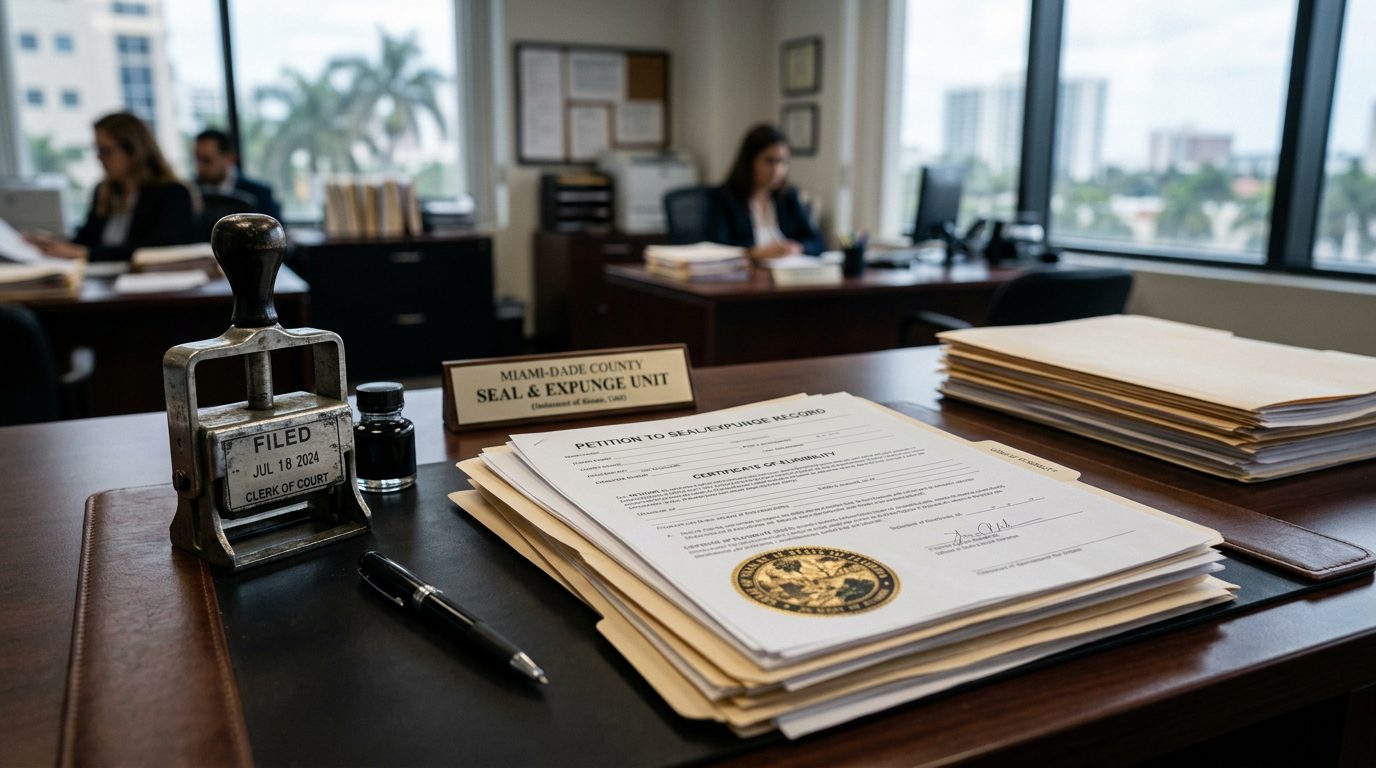
Once you have the certificate, file a written petition with the clerk. Fla. R. Crim. P. 3.692 sets out requirements for a written petition filed with the clerk. The petition must be accompanied by a valid certificate of eligibility issued by the Florida Department of Law Enforcement and a sworn statement that the petitioner satisfies the eligibility requirement in section 943.0585(1), Florida Statutes, for relief sought under section 943.0585, or in section 943.059(1), Florida Statutes, for relief sought under section 943.059. You need the valid certificate, a sworn statement that you meet the eligibility rules, and a statement that no other petition to seal or expunge is pending before any court.
You must also serve the completed petition, sworn statement, and certificate on the prosecuting attorney and the arresting agency. Those parties may respond. The court may hear evidence on any fact it needs to decide the petition. A clean, complete filing helps keep the case moving, because an objection can slow things down.
Expect some costs. You pay for certified copies unless you are indigent. The court may deny any request at its sole discretion, so a filed petition is not an automatic win. This stage moves on the court’s and the prosecutor’s schedules.
Phase 4: Get the Court Order and Confirm Agency Compliance
Once the judge grants the petition, the court enters a written order. The clerk then sends certified copies to those agencies, under the same rule, Fla. R. Crim. P. 3.692.
The order’s scope matters. A court may cover one arrest or one incident. It may cover more than one arrest only when those arrests directly relate to the original one, and the order must say so, per § 943.0585.
After an expunction order, agencies must physically destroy or obliterate the record. Under Fla. Stat. § 943.0585, any criminal history record of a minor or an adult that is ordered expunged must be physically destroyed or obliterated by any criminal justice agency having custody of it, except that a record in the custody of the Florida Department of Law Enforcement must be retained in all cases. A record ordered expunged that the department retains is confidential and is not available to any person or entity except upon order of a court of competent jurisdiction, but the department must still disclose that the expunged record exists to certain listed entities for their licensing, access authorization, and employment purposes, and to criminal justice agencies for their criminal justice purposes.
Keep a certified copy of the signed order. It is your proof that the court acted.
Talk With Patrick Wilson Law About Your Record Timeline
If you’re waiting on an old Florida charge to clear before a job start, a license renewal, or a background check, the wait can feel open-ended. Some people are also helping a family member through the paperwork from another city.
Patrick Wilson Law is a Miami criminal defense firm. It focuses its practice on sealing and expunging criminal records, along with DUI, domestic violence, and other criminal defense matters. Patrick David Wilson is the responsible lawyer for this page. Call 786-761-1719, leave a message, or request a consultation. The first consultation is free, confidential, and carries no obligation to continue.
How long does the seal expunge record process timeline take in Florida?
It runs in four stages: eligibility, the FDLE certificate, the court petition, and the court order with agency compliance. Each stage has to finish before the next one starts.
Can a record be sealed automatically in Florida?
Some records are.
Does the FDLE certificate mean the court will grant sealing?
No. The certificate lets you file, but the court decides the petition and may deny it.
Who pays for the process?
You pay for certified copies of records unless you are indigent.
The Four Stages of the Process
1. Eligibility Review
We review the charges and court dispositions on the record to see whether sealing or expungement may be available. This stage sets the direction for everything that follows.
2. FDLE Certificate
Where the process requires it, the Florida Department of Law Enforcement certificate is obtained as part of the paperwork. Accurate records and complete information help this stage run smoothly.
3. Court Petition
We prepare and file the petition with the court and handle the supporting documents. Each filing is reviewed carefully before it goes in.
4. Court Order and Agency Compliance
After the court issues its order, the order must be delivered to the agencies that hold the record. We follow up to confirm that compliance is completed.
What Clients Can Expect From Our Team
Clear Paperwork
Our team organizes each document in the file so you know what is being filed and why.
Stage-by-Stage Updates
We explain where your case stands at each step of the timeline, so nothing is a surprise.
Confidential Handling
Your information stays private from the first call through the final court order.
South Florida Focus
Patrick Wilson Law is based in Miami and represents people across Miami-Dade, Broward County, Fort Lauderdale, Hialeah, Homestead, Miami Beach and the Florida Keys.
Keep the Timeline Moving
Each stage has to finish before the next one starts. Missing paperwork or unanswered questions can slow the whole process, so gather your records early and talk with us before making any filings on your own.

