
Domestic Violence Defense in South Florida
Understanding the Stages of a Domestic Violence Case in Florida
A plain-language guide to what may happen from arrest through resolution. Every case depends on its own facts and the applicable law.
By Patrick David Wilson · Published October 15, 2026
What Are the Stages of a Domestic Violence Case in Florida?
A domestic violence case in Florida moves through several distinct stages, from arrest through trial or resolution. Each stage presents different legal issues, opportunities to challenge the case, and consequences. Understanding where you are in the process—and what comes next—helps you make informed decisions about your defense and your future.
If you're facing a domestic violence charge in South Florida or unsure what stage your case is in, understanding your rights at each step matters—reach out to discuss your situation. Talk it through with our team — the first consultation is free, confidential, and carries no obligation.

Overview: How Florida Domestic Violence Cases Move Through the System
Domestic violence cases follow Florida’s criminal justice process, but with unique procedural requirements. Domestic violence in Florida is defined as any assault, aggravated assault, battery, aggravated battery, sexual assault, sexual battery, stalking, aggravated stalking, kidnapping, false imprisonment, or any criminal offense resulting in physical injury or death of one family or household member by another family or household member. The case typically spans from arrest through trial or negotiated resolution, with critical decision points at each stage. Understanding the process helps you know what to expect and when legal guidance matters most.
Stage 1: Arrest and Initial Detention
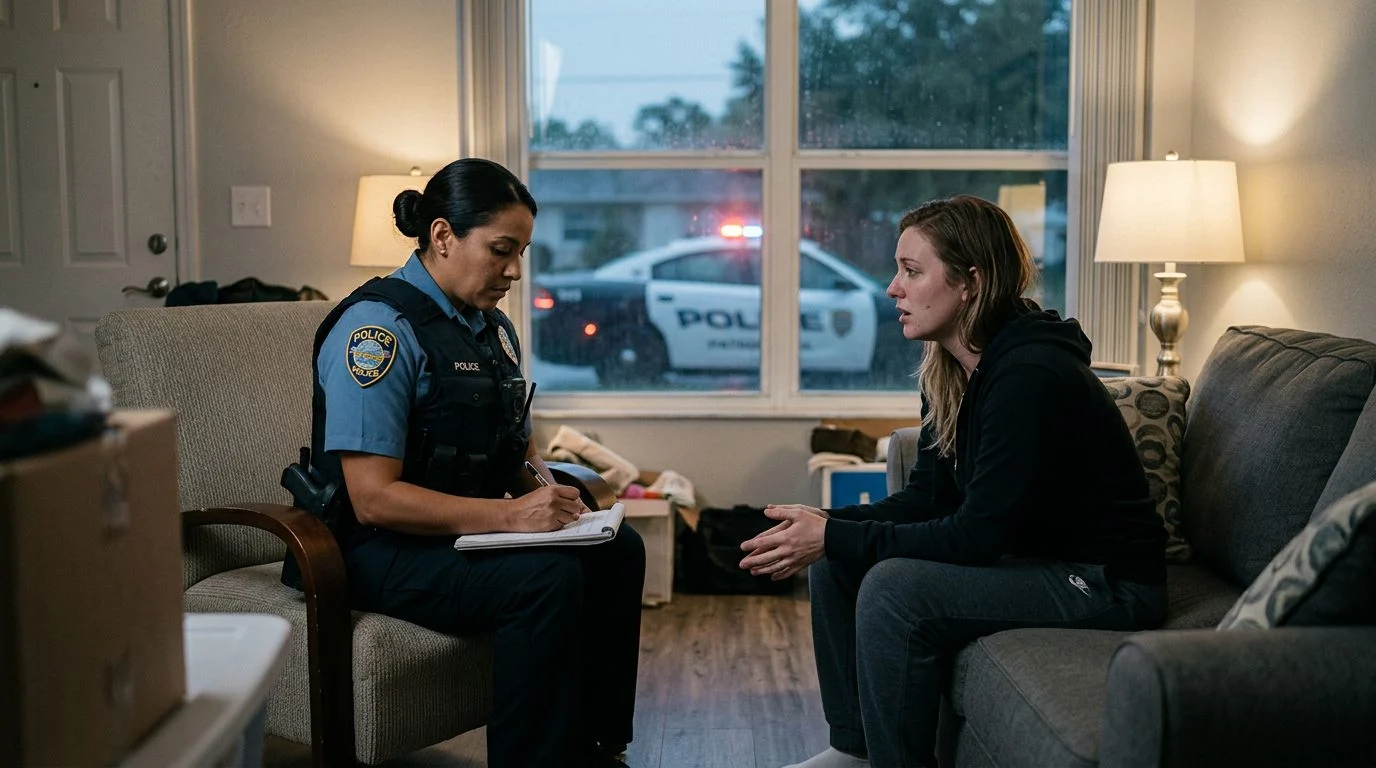
Police respond to a domestic violence call and make an arrest based on probable cause—meaning they believe a crime occurred. Under Florida law, an officer’s decision to arrest does not require the alleged victim’s consent, and an agency’s arrest policies may apply depending on the facts of the case. The arrested person is taken into custody, booked, and held pending a bail hearing.
For first-time offenders and licensed professionals, arrest itself creates immediate concerns: employment, professional licenses, custody of children, and public record. You may be held in jail overnight or longer depending on bail availability and the severity of the charge. This stage is stressful, but it is not the time to discuss the allegations with police without an attorney present.
Stage 2: First Appearance and Bail Hearing
The judge informs you of the charges, your rights, and bail conditions. Bail may be set, or you may be released on your own recognizance (ROR)—meaning your promise to return to court without paying bail.
At this hearing, a protective order (restraining order) is often issued. In the event of a violation of an injunction for protection against domestic violence when there has not been an arrest, the petitioner may contact the clerk of the circuit court of the county where the violation is alleged to have occurred. The clerk shall either assist the petitioner in preparing an affidavit in support of the violation or direct the petitioner to the office designated by the chief judge of that circuit as the central intake point for injunction violations. Violating the protective order is a separate criminal offense.
This hearing is not about guilt or innocence—it is about bail and release conditions. Your attorney can argue for lower bail or fewer restrictions, especially if you have ties to the community, employment, or family obligations.
Stage 3: Charging Decision and Probable Cause Review
The prosecutor decides whether to file formal charges and what level—misdemeanor or felony. Battery occurs when a person actually and intentionally touches or strikes another person against the will of the other, or intentionally causes bodily harm to another person. Charges can range from simple battery (misdemeanor) to aggravated battery, which occurs when a person, in committing battery, intentionally or knowingly causes great bodily harm, permanent disability, or permanent disfigurement, or uses a deadly weapon.
You have the right to challenge whether probable cause exists—meaning whether the evidence reasonably supports the charges. This is an early opportunity to contest the strength of the prosecution’s case. If probable cause is found lacking, charges may be dismissed.
Stage 4: Arraignment
At arraignment, you are formally informed of the charges and enter a plea: guilty, not guilty, or no contest. Most defendants plead not guilty at this stage to preserve their rights and allow time for investigation and negotiation. The court confirms bail conditions and protective order terms.
This is when your defense attorney begins raising procedural issues, requesting discovery (evidence from the prosecution), and laying the groundwork for your defense. Arraignment is typically brief, but it is a critical step that sets the tone for the case.
Not sure what your next step is?
Talk it through with our team — the first consultation is free, confidential, and carries no obligation.
Stage 5: Discovery and Investigation
Both sides exchange evidence: police reports, witness statements, photographs, medical records, body camera footage, and 911 calls. Your attorney investigates the allegations, interviews witnesses, and identifies weaknesses in the state’s case. Domestic violence cases often hinge on credibility, the nature and extent of injuries, and whether the alleged victim’s account is consistent with the evidence.
Your attorney may discover that the alleged victim has a history of false allegations, that injuries are inconsistent with the alleged incident, or that police violated your rights during arrest or questioning. These findings can significantly strengthen your defense.
Stage 6: Pretrial Motions and Negotiations
Your attorney may file motions to suppress evidence (if police violated your rights), dismiss charges, or challenge the protective order. Plea negotiations often occur during this phase. The prosecutor may offer a reduced charge or sentence in exchange for a guilty plea.
Under section 948.08, Florida Statutes, a pretrial intervention program may be available to certain persons charged with a misdemeanor or felony of the third degree who are first offenders or who have no more than one prior nonviolent misdemeanor conviction, and it requires approval of the program administrator and the consent of the victim, state attorney, and judge. Eligibility depends on the facts and applicable law. If the program is granted, completing counseling and other conditions may lead to dismissal of the charges, depending on the program’s requirements. For licensed professionals, negotiated resolutions may preserve employment or professional standing.
How a domestic violence case is resolved at this stage depends on the facts of the case and applicable law, and Patrick David Wilson will review the possible options with you.
Stage 7: Trial (If the Case Is Not Resolved)
Your attorney cross-examines the alleged victim and other prosecution witnesses and presents your defense.
Domestic violence trials often turn on credibility. The alleged victim’s testimony is typically the prosecution’s strongest evidence. Your attorney challenges inconsistencies, bias, or motive to fabricate. You have the right to testify or remain silent; your attorney advises you on the best strategy based on the evidence and your circumstances.
Stage 8: Sentencing or Acquittal
If you are acquitted, the case is dismissed and you are free. If you are convicted or plead guilty, the judge imposes a sentence. Except as provided in paragraph (b), if a person is adjudicated guilty of a crime of domestic violence, as defined in s. 741.28, and the person has intentionally caused bodily harm to another person, the court shall order the person to serve a minimum of 10 days in the county jail for a first offense, 15 days for a second offense, and 20 days for a third or subsequent offense as part of the sentence imposed, unless the court sentences the person to a nonsuspended period of incarceration in a state correctional facility.
Sentencing also considers your criminal history, employment, family circumstances, and the severity of the alleged conduct. A court may place a defendant on probation or into community control if it appears that the defendant is not likely again to engage in a criminal course of conduct and that the ends of justice and the welfare of society do not require that the defendant presently suffer the penalty imposed by law.
Protective Orders: A Parallel Track
A protective order is often issued at the first appearance and may remain in place throughout the case (Miami-Dade injunction process). Any person who is the victim of domestic violence or has reasonable cause to believe he or she is in imminent danger of becoming the victim of any act of domestic violence has standing in the circuit court to file a verified petition for an injunction for protection against domestic violence. Violating a protective order is a separate criminal offense. Even if charges are dismissed or you are acquitted, a protective order may remain unless specifically dissolved. Your attorney can challenge the protective order or seek its modification if it is overly broad or based on insufficient evidence.
If you're facing a domestic violence charge in South Florida or unsure what stage your case is in, understanding your rights at each step matters—reach out to discuss your situation. Talk it through with our team — the first consultation is free, confidential, and carries no obligation.
How Most Domestic Violence Cases End
Many cases are resolved through plea agreements rather than trial. Some cases are dismissed due to insufficient evidence, witness credibility issues, or procedural violations. Cases may also be resolved through diversion programs for first-time offenders or deferred prosecution agreements. Trial outcomes depend on the strength of evidence, witness credibility, and the defense strategy.
Special Concerns for First-Time Offenders and Licensed Professionals
First-time offenders may be eligible for diversion programs that allow charges to be dismissed if you complete counseling and other conditions. Licensed professionals, including doctors, lawyers, nurses, and teachers, may face additional consequences, which can include professional license suspension or revocation, even if criminal charges are dismissed or reduced. Whether any licensing action occurs depends on the facts, the licensing board, and applicable law.
Early intervention and negotiation are especially important to minimize collateral damage to your career and professional standing. For licensed professionals, the criminal case is only one part of the battle; protecting your professional license requires a coordinated defense strategy.
Sealing and Expungement: Clearing the Record
If charges are dismissed or you are acquitted, you may be eligible to seal or expunge the arrest record. Sealing or expunging removes the record from public view and allows you to legally state that the arrest did not occur (with limited exceptions). For licensed professionals, clearing the record can be essential to protecting your career and reputation.
The process requires a petition to the court and is not automatic. An attorney can guide you through the eligibility requirements, the application process, and the petition to the court.
Frequently Asked Questions
How long does a domestic violence case take in Florida?
Cases can range from a few months to over a year, depending on complexity, discovery disputes, and whether the case goes to trial or is resolved through negotiation.
Can I go home after arrest?
Bail and release conditions are determined at the first appearance. A protective order may prevent you from returning home or going near the alleged victim’s residence.
What if I can’t afford an attorney?
To learn how the charge, the possible penalties, and your financial circumstances apply under applicable law, contact Patrick Wilson Law for a free, confidential initial consultation with no obligation to continue. To discuss your case, contact Patrick David Wilson for a free, confidential initial consultation, with no obligation to continue.
Can a domestic violence charge be dismissed?
Yes. Charges may be dismissed due to insufficient evidence, witness credibility issues, procedural violations, or negotiated agreements. An attorney can identify opportunities to challenge the case.
What happens if I violate the protective order?
Violating a protective order is a separate criminal offense, typically a misdemeanor of the first degree. It can result in arrest and additional charges.

Understanding Your Rights at Each Stage
Each stage of a domestic violence case presents opportunities to challenge the evidence, negotiate a favorable resolution, or prepare for trial. Early legal intervention—at arrest or the first appearance—can affect bail conditions, protective order terms, and the trajectory of the entire case.
If you’re facing a domestic violence charge in Miami-Dade, Broward, or surrounding South Florida counties, understanding where you are in the process and what your rights are at each stage is critical. Patrick Wilson Law focuses on domestic violence defense for first-time offenders, licensed professionals, and individuals navigating the criminal justice system in South Florida.
If you’re unsure what stage your case is in, what the charges mean, or what your options are, a free consultation can help clarify your situation and outline the path forward. Contact Patrick Wilson Law to discuss your case and understand what to expect next.
The Stages of a Domestic Violence Case
1. Arrest and First Appearance
A case may begin with an arrest. What applies depends on the facts of the case and the applicable law.
2. Protective Orders
A protective order may be requested, and a temporary order may be entered before the case is resolved. Its terms depend on the order itself, so read yours carefully and ask what it requires of you.
3. Arraignment and Discovery
Discovery is the exchange of evidence, such as police reports, witness statements and recordings, and it can take time.
4. Motions, Negotiation and Trial
Pretrial motions may challenge evidence or the charge itself. Some cases are resolved through negotiation, while others proceed to trial. Each path depends on the facts and applicable law, and no particular result can be predicted.
Why Speak With Patrick David Wilson Early
Confidential Consultation
The first consultation is free, confidential and carries no obligation to continue.
Focused Criminal Defense Practice
Patrick David Wilson focuses on criminal defense, including domestic violence matters across South Florida.
Clear Explanation of Each Step
Understanding the process, deadlines set by the court and your paperwork can help you make informed decisions about your case.
Important: Be Careful What You Say
Statements made to police, to the complaining person, or on social media may be used in your case. Avoid discussing the allegations or contacting the other person in ways that could violate an order. Consult a lawyer before making any statement about the case.

