By Patrick David Wilson · Published October 01, 2026
Felony Probation Violation Defense in Miami
A felony probation violation occurs when you breach any condition the court imposed on your probation—from missing a probation officer appointment to failing a drug test to being arrested for a new crime. The consequences can range from modified probation terms to jail time or full revocation, and the outcome depends on the facts of the case and applicable law. If you’re accused of a violation, understanding what happens next can help you and your attorney weigh your options, depending on the facts of your case and applicable law.
Not sure what your next step is?
Talk it through with our team — the first consultation is free, confidential, and carries no obligation.
A felony probation violation is a breach of any condition set by the court as part of your felony probation agreement. Violations fall into two categories: technical and substantive.
Technical violations don’t involve a new crime. They include:
– Missed probation officer appointments or check-ins
– Failed drug or alcohol tests
– Curfew violations
– Unauthorized travel outside the county or state
– Contact with co-defendants or victims
– Failure to pay court-ordered fines or restitution
– Failure to complete required programs (counseling, community service, education)
Substantive violations involve a new criminal charge—an arrest for a new felony or misdemeanor while on probation.
The distinction matters because the consequences of a violation depend on the facts of the case and applicable law, and technical and substantive violations can be treated differently.
What Happens When You’re Accused of a Probation Violation
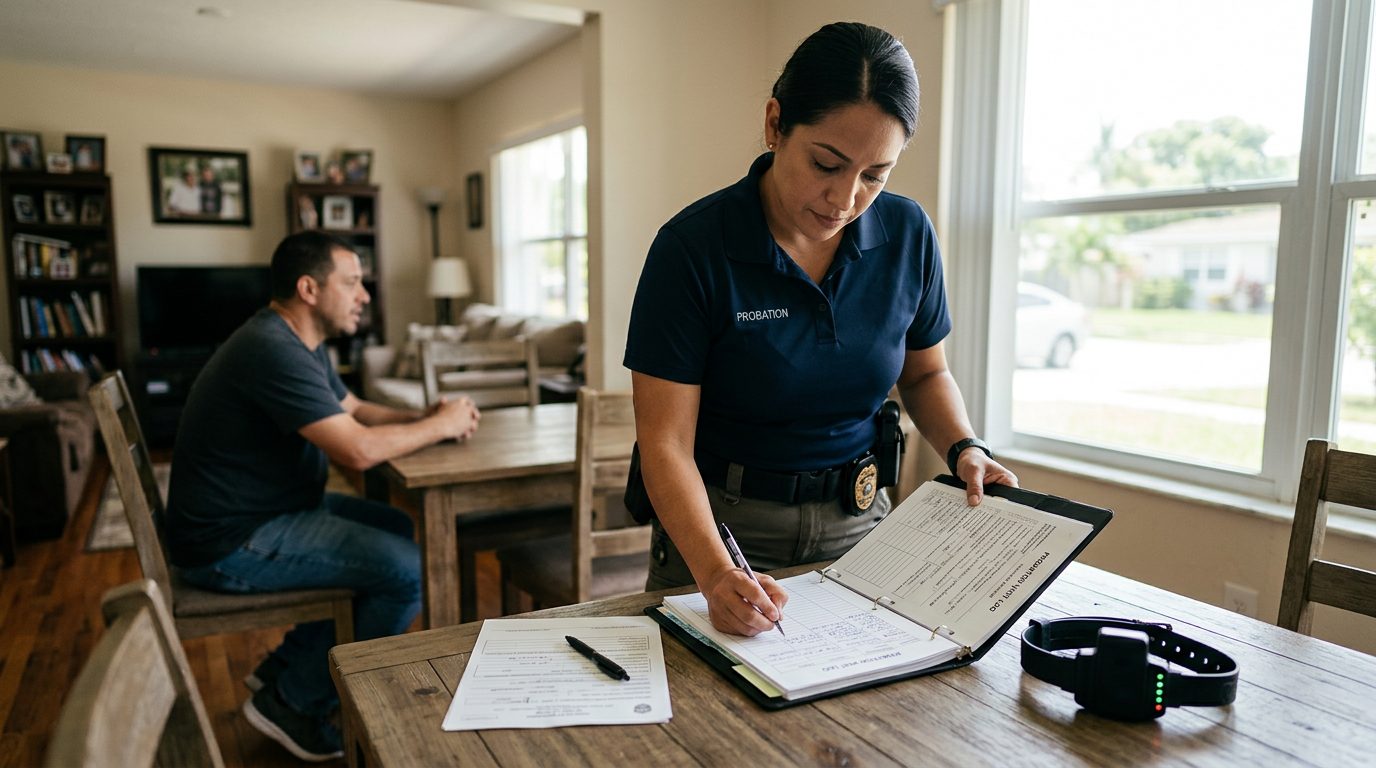
Step 1: The violation report. Your probation officer files a violation report with the court alleging you breached a condition of probation.
Step 2: Notice and arrest. You receive notice of the alleged violation and a court date. An arrest warrant may be issued; you may be taken into custody and held pending a hearing.
Step 3: Your right to a hearing. You have the right to a probation violation hearing before a judge. The timing of the hearing depends on the facts of your case and applicable law.
Step 4: The burden of proof. Unlike a criminal trial, where the state must prove guilt “beyond a reasonable doubt,” the state only needs to prove the violation by a “preponderance of the evidence”—meaning it’s more likely than not that you violated probation. This lower standard means the state needs less proof than in a criminal trial, and a defense attorney may be able to challenge the state’s evidence, depending on the facts of the case.
Step 5: The hearing. The judge hears evidence from the probation officer, prosecutors, and you or your attorney. You have the right to cross-examine witnesses and present your own evidence.
Step 6: The outcome. The judge decides whether the violation occurred and, if so, what penalty to impose.
How Much Jail Time for a Probation Violation in Florida?
Possible Penalties for a Probation Violation
Penalties depend on the nature of the violation, the underlying felony, and your criminal history.
Technical violations may result in:
– A warning or reprimand
– Modification of probation terms (stricter curfew, more frequent check-ins, additional conditions)
– Extension of probation
– Brief jail time, depending on the facts of the case and applicable law
– Combination of the above
Substantive violations (new criminal charges) may result in, depending on the facts of the case and applicable law:
– Prosecution for the new charge
– Revocation of probation
– Service of the remainder of your original sentence in prison
First-time offenders often receive more lenient outcomes than repeat violators, especially if they can show rehabilitation efforts, stable employment, or completion of treatment programs.
Licensed professionals face additional consequences: a probation violation conviction can trigger discipline by your professional licensing board, including license suspension or revocation—consequences that occur independently of the criminal court’s decision.
What a Felony Probation Violation Defense Attorney Does
A probation violation defense attorney works to minimize penalties, preserve your freedom, and protect collateral consequences.
Case investigation. We obtain your probation agreement, the violation report, court records, and any evidence the state plans to use. We identify procedural defects, factual errors, or weaknesses in their case.
Challenging the evidence. At the hearing, we cross-examine the probation officer and other state witnesses. We challenge the accuracy of their allegations, the reliability of any tests (drug screens, for example), and whether the alleged conduct actually violated your probation terms.
Negotiation. We contact the state attorney before the hearing to explore whether the violation can be dismissed, reduced, or resolved without revocation.
Presenting mitigation. We present evidence of your rehabilitation efforts, stable employment, family ties, mental health or substance abuse treatment, and compliance with other probation terms. For licensed professionals, we coordinate with licensing counsel to protect your career.
Advocating for alternatives. We argue for probation continuation, modification of terms, or minimal jail time rather than full revocation.
Protecting your rights. We ensure the court follows proper procedure, that you’re not questioned without counsel, and that the state meets its burden of proof.
Not sure what your next step is?
Talk it through with our team — the first consultation is free, confidential, and carries no obligation.
Initial consultation (free). You describe your probation terms, the alleged violation, and your circumstances. We explain your rights and outline defense options.
Investigation (1–2 weeks). We obtain all relevant documents and evidence from the court and probation department.
Strategy development. We determine whether to challenge the violation, negotiate with prosecutors, present mitigating evidence, or pursue a combination of these approaches.
Pre-hearing negotiation (1–3 weeks). We contact the state attorney to explore resolution options before the hearing.
Probation violation hearing (typically 4–12 weeks from initial contact). We present your defense, cross-examine witnesses, and argue for the least severe outcome.
Post-hearing. If revocation occurs, we explore appeal options or file motions for modification.
Common Defenses to Felony Probation Violations
Willfulness. The violation was not intentional or was beyond your control (illness prevented an appointment; medication caused a positive drug test).
Factual error. The probation officer’s report contains mistakes or misinterprets your conduct.
No violation occurred. The alleged breach did not actually happen (lab error on a drug test, for example).
Procedural defect. The hearing was not held within the required 33-day window, or your rights were violated.
Minimal violation. The breach was technical and minor; you’ve otherwise complied with probation and made genuine rehabilitation efforts.
Defensible new charge. If the violation is based on a new arrest, we may be able to defend or negotiate that charge.
Probation Violations and Licensed Professionals
A probation violation conviction can trigger disciplinary action by your professional licensing board—separate from and in addition to criminal court penalties. Medical doctors, attorneys, nurses, financial advisors, and law enforcement officers face heightened scrutiny.
Early legal intervention is critical. A skilled defense can sometimes prevent conviction or negotiate an outcome that minimizes licensing board consequences. We coordinate with licensing counsel to ensure your criminal defense strategy protects your career.
Probation Violations and Non-Citizens
A probation violation conviction can have serious immigration consequences: deportation proceedings, denial of asylum or green card applications, or ineligibility for cancellation of removal. Even a technical violation can trigger immigration consequences depending on the underlying felony.
Early legal intervention is essential. We coordinate with immigration counsel to ensure your defense strategy protects your immigration status while defending the criminal case. Non-citizens have the same right to vigorous defense as citizens; we treat your case with the urgency it deserves.
Frequently Asked Questions
Q: What is the 33-day rule in Florida?
A: Florida Rule of Criminal Procedure 3.134 requires that if you’re in custody on a probation violation, your hearing must occur within 33 days of arrest. If the court fails to hold the hearing within this window, you may file a motion to dismiss the violation.
Q: Do I have to prove I didn’t violate probation?
A: No. The state must prove the violation by a preponderance of the evidence. You have the right to challenge their evidence and present your own.
Q: Can probation be modified instead of revoked?
A: Yes. A judge may modify probation terms, extend the probation period, or add conditions instead of revoking probation entirely.
Q: Can I be arrested for a probation violation?
A: Yes. If a probation officer files a violation report, an arrest warrant may be issued and you may be taken into custody pending a hearing.
Q: What should I do if I’m accused of a probation violation?
A: Contact a probation violation defense attorney immediately. Do not ignore the allegation or fail to appear in court. Early legal intervention improves your options and may prevent arrest or jail time.
Q: How does a probation violation affect my professional license?
A: A conviction can trigger disciplinary action by your licensing board, including suspension or revocation. Early defense intervention can sometimes prevent these collateral consequences.
Q: Can a probation violation lead to deportation?
A: Yes, for non-citizens. A probation violation conviction can trigger deportation proceedings or denial of immigration benefits. Early legal intervention is critical to protect your immigration status.
If you’re facing a probation violation allegation in Miami-Dade or Broward County, the decisions you make now—including whether to get legal help immediately—can mean the difference between keeping your freedom and serving time. People in your situation reach out regularly.
Call 786-761-1719
to speak with a probation violation defense attorney. Or schedule a free consultation to discuss your case and learn your options. Leave a message with your name, phone number, and a brief description of your situation; we return calls within 24 hours.
How We Defend Probation Violations
Challenge the Evidence
We examine whether the state has sufficient proof of the alleged violation and whether proper procedures were followed.
Motion Practice
We file motions to suppress illegally obtained evidence, challenge arrest procedures, and enforce your constitutional rights.
Negotiation & Advocacy
We work with prosecutors and the court to resolve violations without incarceration when possible, or to minimize penalties.
Procedural Deadlines
We know the rules that govern probation violation hearings and ensure the court complies with all timing requirements.
Common Probation Violation Charges We Defend
Failed Drug Test
Positive or diluted test results, contamination claims, and testing procedure errors.
Missed Appointment or Curfew
Failure to report, missed court dates, or curfew violations—including circumstances beyond your control.
New Criminal Charge
Arrest on a new offense while on probation, with defense at both the violation and underlying charge level.
Restitution or Fee Non-Payment
Inability to pay court-ordered amounts; we argue financial hardship and negotiate payment plans.
Act Quickly
If you've been arrested or accused of a probation violation, the clock is running. Early intervention can protect your rights and improve your options.