
Criminal Defense | Miami & South Florida
Understanding Probation Basics
Understand what constitutes a probation violation and what happens next.
By Patrick David Wilson · Published October 01, 2026
What Counts as a Probation Violation in Florida?
A probation violation occurs when you fail to comply with the conditions imposed by the court during your probation period. Florida law recognizes two broad categories: technical violations (administrative breaches like missing an appointment) and substantive violations (new criminal conduct). Understanding the difference matters because the consequences—and your defense options—depend on which type you’re facing.
If you’re on probation and unsure whether something you’ve done, or something you’ve been accused of, crosses the line, or if you’re facing a violation hearing, you may want to talk with an attorney about your options. Talk it through with Patrick Wilson. The first consultation is free, confidential, and carries no obligation.
Probation: Key Terms and Conditions
Probation is a court-ordered period of community supervision as an alternative to or instead of incarceration. When a judge sentences you to probation, the court sets specific conditions you must follow. These conditions are legally binding. Florida Statutes § 948.06 governs probation revocation proceedings and defines what constitutes a violation.
A probation violation is any breach of those court-ordered terms. It doesn’t have to be a new crime. It can be something as straightforward as missing a meeting with your probation officer or failing to pay a fine on time. The violation is reported to the court, which then decides whether to hold a hearing and whether to revoke your probation.
What Does It Mean to Have a Probation Violation?
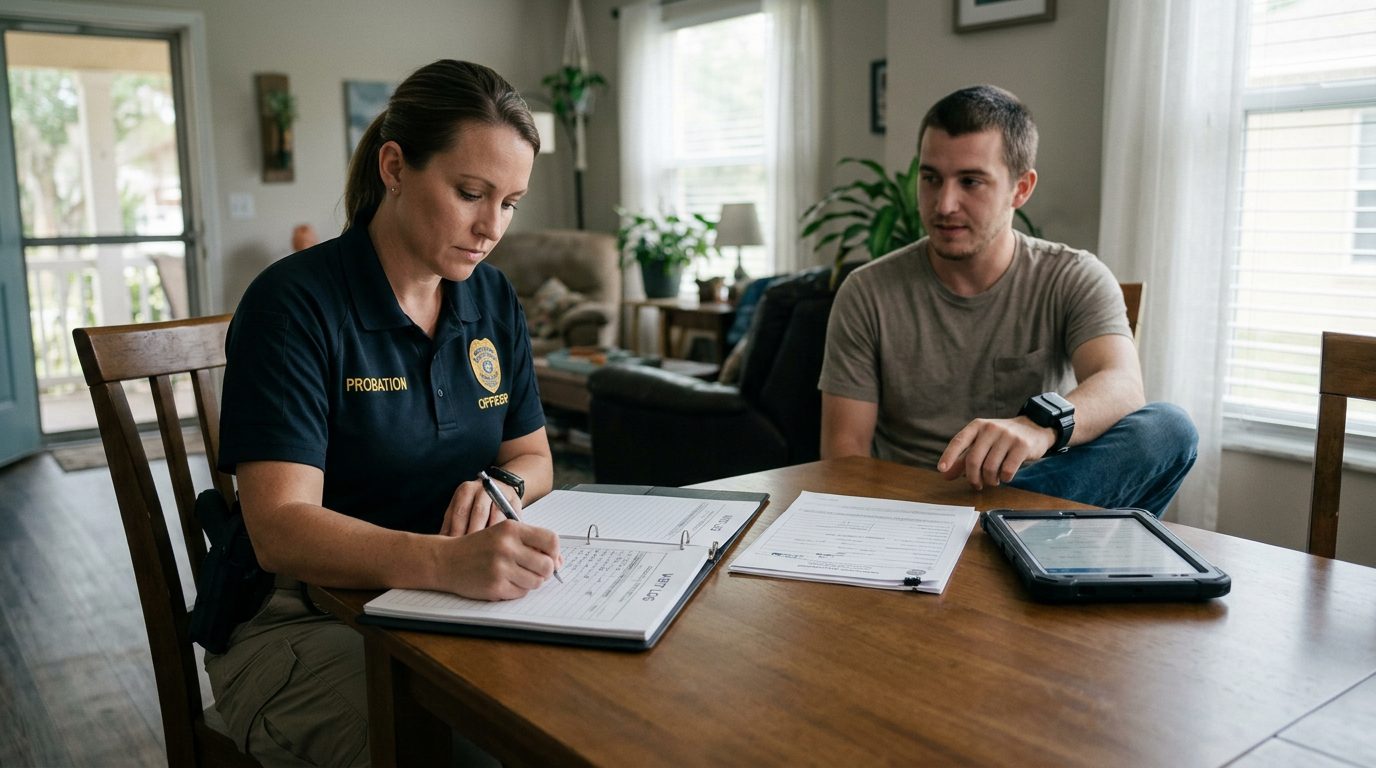
Having a probation violation means you’ve broken at least one rule the judge set for your supervision. The probation officer—the state official who monitors your compliance—typically initiates the process by filing a report with the court. Not every violation results in immediate arrest or revocation. The court considers the nature of the violation, your history, and other circumstances before deciding what happens next.
In Miami-Dade County and across South Florida, probation violations are handled through the Eleventh Judicial Circuit. The court has discretion to warn you, modify your probation terms, extend your probation period, or revoke probation entirely and send you to jail or prison.
Technical Probation Violations
Technical violations involve failure to comply with administrative or procedural conditions of probation—not new criminal conduct. These are the most common type of violation.
Common examples include:
- Missing a scheduled meeting with your probation officer
- Failing a drug or alcohol test
- Changing your residence without permission from your probation officer
- Failing to pay restitution, fines, or probation fees on schedule
- Violating curfew restrictions
- Leaving the county without approval
- Failing to maintain employment or attend required programs
- Associating with people your probation conditions prohibit
Technical violations are often viewed as less serious than substantive violations, but they can still result in probation revocation and incarceration. A single technical violation may be handled with a warning or a modification of your terms. Multiple violations, or a pattern of non-compliance, increase the likelihood that the court will revoke your probation.
Substantive Probation Violations
Substantive violations involve the commission of a new crime while on probation. These violations are treated more seriously because they show a return to criminal conduct.
Examples include:
- Arrest for DUI (driving under the influence)
- Arrest for domestic violence
- Arrest for sexual battery
- Arrest for leaving the scene of an accident
- Arrest for any felony or misdemeanor offense
When you’re arrested for a new crime while on probation, that arrest itself often triggers a probation violation. You may face two separate legal proceedings: one for the new criminal charge and one for the probation violation. Depending on the facts and applicable law, a substantive violation may lead to arrest and revocation of probation, even before the new criminal case is resolved.
Burden of Proof at a Violation Hearing
In Florida probation violation hearings, the burden of proof is lower than in a criminal trial. The state must prove the violation by a preponderance of the evidence—meaning it is more likely than not that the violation occurred. This is significantly lower than the “beyond a reasonable doubt” standard required to convict you of a crime.
Because the burden is lower, the state’s evidence doesn’t have to be as strong. However, you still have the right to contest the allegations and present your own evidence and witnesses.
Not sure what your next step is?
Talk it through with Patrick Wilson. The first consultation is free, confidential, and carries no obligation.
Rights You Have at a Probation Violation Hearing
You have important legal rights at a probation violation hearing, even though the burden of proof is lower:
- Right to notice: You must be informed of the alleged violation and given reasonable notice of the hearing date.
- Right to be present: You have the right to attend the hearing in person.
- Right to an attorney: You can be represented by a criminal defense attorney.
- Right to present evidence: You can introduce documents, testimony, and witnesses on your behalf.
- Right to cross-examine: You can question the state’s witnesses and challenge their testimony.
- Right to challenge evidence: You can object to evidence presented against you.
- Right to appeal: In certain circumstances, you may appeal an adverse decision.
Does a Probation Violation Go on Your Record?
A probation violation itself does not automatically create a separate criminal record entry. However, the impact on your record depends on the type of violation:
Technical violations are typically recorded in your probation file but may not appear on your public criminal history. However, the violation and the hearing outcome are part of your court file, which may be accessed by employers, licensing boards, and others conducting background checks.
Substantive violations involving a new criminal charge will appear on your record as a new charge. If you’re convicted of that new offense, it will be a separate conviction on your criminal history.
If your probation is revoked, the original conviction remains on your record. Any new sentence imposed after revocation will be documented. For licensed professionals—doctors, nurses, attorneys, real estate agents, and others whose careers depend on a clean record—a probation violation can have serious consequences for licensure and employment.
Common Questions About Probation Violations
How long do you sit in jail for a probation violation?
There is no fixed jail time for a probation violation. The judge has discretion. You might receive a warning, have your probation terms modified, serve additional jail time, or have your probation revoked and be required to serve your original sentence or a new sentence.
Can a probation violation be dismissed?
Yes. If the state cannot prove the violation by a preponderance of the evidence, the court may dismiss it. An attorney can challenge the evidence, identify procedural errors, or present a defense on your behalf.
What happens if I admit to a probation violation?
If you admit to a violation, the court may proceed directly to sentencing without a hearing. This can sometimes result in a more lenient outcome if you take responsibility, but it depends on the circumstances and the judge’s discretion.
Can I appeal a probation violation decision?
Yes, in certain circumstances. If you believe the court made an error in finding a violation or in the sentence imposed, you may have grounds to appeal. An attorney can advise whether an appeal is appropriate in your situation.
Next Steps If You’re Facing a Probation Violation
If you’ve been accused of a probation violation or are uncertain whether your conduct may breach your probation terms, understanding your options is critical. Many people in this situation—whether they committed a technical misstep or face a more serious allegation—benefit from speaking with someone who understands Florida probation law and the hearing process.
An attorney can review the allegations against you, explain your rights, help you prepare a response or defense, and represent you at the hearing. If you’re a licensed professional, the stakes are even higher: a violation can jeopardize your career and licensure.
If you’re in Miami-Dade County, Broward County, or elsewhere across South Florida and facing a probation violation hearing, or if you’re unsure whether something you’ve done violates your probation, reach out to discuss your situation. You can contact Patrick Wilson about it. You don’t have to navigate it alone.
Contact Patrick Wilson to discuss what you’re facing and what your options are. Call 786-761-1719 or leave a message, and Patrick Wilson will get back to you.
Act quickly if you're facing a probation violation charge.
A probation violation can result in jail time, modified terms, or revocation of probation. The sooner you contact a criminal defense attorney, the sooner you can begin building your defense.
What Happens After a Probation Violation Allegation
Arrest or Summons
You may be arrested or summoned to appear in court. If arrested, you may be held pending a probation violation hearing.
The Violation Hearing
The state must present evidence that you violated a term of your probation. You have the right to contest the allegations and present your own evidence.
Judge's Discretion
If a violation is found, the judge may issue a warning, modify your probation terms, impose jail time, or revoke probation and order you to serve your original sentence or a new one.
Your Defense Matters
An attorney can challenge the evidence, argue for leniency, or show that the alleged violation did not occur. Your response at this stage shapes the outcome.
How Patrick Wilson Law Can Help
Defend Against the Violation Allegation
Patrick Wilson examines the evidence the state presents and can challenge violations that lack a factual or legal basis.
Protect Your Rights at Hearing
You have rights during a probation violation hearing. Patrick Wilson works to protect those rights and advocates for a fair process.
Negotiate with the State
Depending on the facts and applicable law, Patrick Wilson may explore alternatives to revocation with the prosecution, including modified terms or reduced consequences.
How Patrick Wilson Reviews Each Case
Patrick Wilson reviews probation violation allegations with people facing them, and each case depends on its own facts and the applicable law.
Don't face a probation violation alone.
Related practice areas
- Probation Violation Jail Time in Florida | Patrick Wilson

