
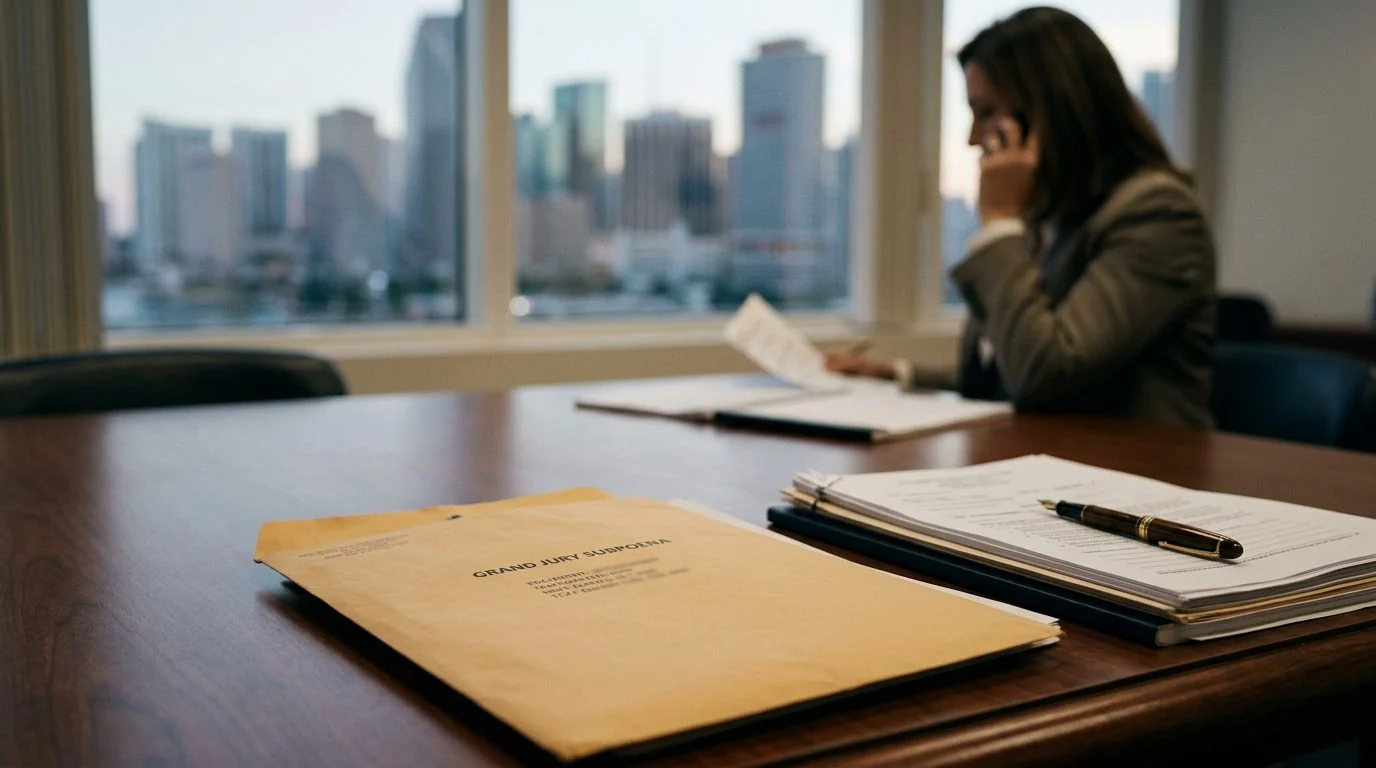
White Collar Crime Defense · Miami, Florida
Received a Federal Grand Jury Subpoena? Start With a Clear Plan
A federal grand jury subpoena is serious, but it is not the same as being charged. Patrick Wilson Law represents people across Miami-Dade, Broward County and the Florida Keys facing federal investigations. Get your questions answered before you respond.
How Patrick Wilson Law Can Help
Protecting Your Rights Early
Your first conversations with investigators and prosecutors can shape the case. We help you understand your options before you say or produce anything.
Reviewing the Subpoena
We examine what the subpoena asks for, whether it seeks testimony or records, and what it may mean for you, your business or your employees.
Handling Communications
We manage contact with federal agents and prosecutors so you are not left to answer questions on your own.
Planning Your Response
We build a practical strategy around your goals, your records and the facts as they are known at this stage.
Important: Do Not Ignore the Subpoena
Ignoring a federal grand jury subpoena can create serious problems of its own.
By Patrick David Wilson · Published October 19, 2026
If you have received a federal grand jury subpoena in Miami, the document is a legal order. A subpoena does not, by itself, mean you have been charged with a crime. What it means for you depends on its exact terms, your role in the investigation, and the applicable law.
You may have received this subpoena yourself. It may also be addressed to a family member or to a business you own or work for. This guide explains the document, the steps to take now, and what to avoid while you decide on next steps. It is general information, not legal advice about your situation.
What a Federal Grand Jury Subpoena Is
A grand jury hears evidence and decides whether to return an indictment, which is a formal written charge.
There are two common forms. One orders a person to appear and testify. Lawyers call this a subpoena ad testificandum. The other orders the production of documents or other items. That is a subpoena duces tecum, meaning “bring with you.”
Receiving one does not mean a charge has been filed. An investigation can cover many people and many facts. The scope, deadlines, and demands depend on the wording of your document.
Florida has its own subpoena rules. Florida Rule of Criminal Procedure 3.361 covers subpoenas in state court. It does not set out federal grand jury procedure, so don’t apply its rules to a federal subpoena.
Not sure what your next step is?
Talk it through with our team — the first consultation is free, confidential, and carries no obligation.

Witness, Subject, or Target: Why Your Status Matters
Your status in an investigation is not always clear from the subpoena alone. Federal investigations often use the labels witness, subject, and target to describe a person’s role. These labels describe how a person relates to the investigation. They are not a finding of guilt.
A witness is someone investigators expect to know something useful. A subject is someone whose conduct falls within the investigation. A target is someone prosecutors view as a likely focus of the case. What each label means in your situation depends on the investigation.
Labels can change as facts develop. A person who starts out as a witness may later be treated differently.
A subpoena to a company may point to a different role than one addressed to you personally. A records request to a business may be answered by a person who holds the records. Don’t assume your label from the document alone. Ask a lawyer to review what the document shows and what it leaves out.
Immediate Steps to Take After Receiving the Subpoena
The first step is to read the whole document. Write down every date, time, and place it lists. Look for the return date, the place of appearance, the list of requested records, and the name of the person or company it names.
Missing a return date can have consequences. Those consequences depend on the facts and applicable law. Treat every listed date as important.
Put the dates on a calendar with reminders. If a date looks impossible to meet, don’t ignore it. Contact the office named on the subpoena in writing and ask about timing.
Keep the original. Keep the envelope, cover letters, emails, and any notes about phone calls. Write down who called, when, and what was said while it is fresh.
What to Avoid Doing While a Subpoena Is Pending
Avoid anything that could look like hiding or changing evidence. Don’t destroy, alter, or delete documents, emails, texts, or files that may match the subpoena.
Be careful about talking with people who may also be witnesses. Co-workers, business partners, and family members may receive their own subpoenas. Discussing the facts with them, or lining up accounts, can look like an attempt to influence testimony. Ask a lawyer before you discuss the matter with them.
Think before you talk to investigators. Anything you say may be used in later proceedings, and a casual conversation can be hard to take back. Whether you must answer questions depends on the type of request, the facts, and applicable law.
Don’t assume that informal cooperation is the right move. That decision depends on your role, your records, and the applicable law.
Rights and Protections for Grand Jury Witnesses
Witnesses may have protections. How they apply depends on the facts, so avoid assuming any right applies to you automatically.
Whether it applies to a particular question depends on the facts.
A subpoena may be challenged. Florida’s state rule lets a person ordered to produce records move to quash or modify the subpoena before the compliance date. The court may quash or modify it if it is unreasonable and oppressive. That is a state court standard, Florida Rule of Criminal Procedure 3.361. Federal challenges follow different rules, and the outcome depends on the court’s ruling.
Whether a specific document or conversation is protected depends on the facts.
Ignoring a subpoena can have consequences. Florida’s rule says a witness who refuses to obey, or leaves without being excused, may be held in contempt. Whether contempt could apply to a federal subpoena depends on the facts and applicable law.
Consulting a lawyer before you testify can help you understand which protections may apply to you.
Grand Jury Secrecy: What It Does and Does Not Mean for You
They do not automatically answer what you may say.
Whether a witness may discuss their own testimony or documents depends on the circumstances and the applicable rules.
Ask before you share details with co-workers, clients, reporters, or on social media. A careless post can create problems that are hard to undo.
Conversations with your own lawyer are a different matter. Whether a particular communication or record is protected depends on the facts. Getting advice early can help you understand what you may and may not share.
Not sure what your next step is?
Talk it through with our team — the first consultation is free, confidential, and carries no obligation.
Common Questions: Indictment, Jail, and Florida’s 33-Day Rule
Being subpoenaed is not the same as being indicted. An indictment is a formal charge, and whether one exists depends on the investigation.
Is a federal grand jury subpoena the same as being charged?
No. A subpoena asks for testimony or records. Florida Rule of Criminal Procedure 3.140 describes state indictments, which state that the defendant is charged by the grand jury. That rule does not describe federal charging documents.
Does a person go to jail if indicted?
Not automatically. Whether custody or release conditions apply depends on the charges, the facts, and the court’s decisions.
What is the 33-day rule in Florida?
It is a state court procedure for people held in custody. Florida Rule of Criminal Procedure 3.134 requires the state to file formal charges within 30 days of arrest or service of a capias. If the defendant remains uncharged, the court must order automatic release on the 33rd day unless charges are filed. If the state shows good cause, that date can move to the 40th day.
This rule applies to Florida state prosecutions. Whether any of it applies to a given case depends on the facts and applicable law.

Talking to a Miami White Collar Defense Attorney
A criminal defense lawyer can review your subpoena, its deadlines, and the records it requests. Then the lawyer can explain possible responses based on your facts.
Patrick David Wilson focuses on criminal defense, including white collar crime defense. The practice is based in Miami and serves clients across South Florida, from Broward County to the Florida Keys.
The first consultation is free, confidential, and carries no obligation to continue. If a matter falls outside the practice areas, it may be referred to another lawyer or firm.
If a subpoena has reached your desk, or one was addressed to a family member or a business you work for, you don’t have to sort out the deadlines alone. Call 786-761-1719 or leave a message to schedule your free consultation. You can also use the contact page.
What to Do Now
1. Read the Subpoena Closely
Note what it asks for, who issued it and any dates or instructions it contains. Bring a copy to your consultation.
2. Preserve Everything
Keep all relevant emails, texts, financial records and files. Do not delete, edit or discard anything connected to the subject of the investigation.
3. Limit Who You Speak With
Avoid discussing the investigation with coworkers, business partners or others. Direct any contact from investigators to your lawyer.
4. Contact a Criminal Defense Lawyer
A lawyer can explain your position, handle communications and help you decide how to respond to the subpoena.

