
Florida Certificate of Eligibility to Seal a Record
Patrick Wilson Law helps clients across South Florida prepare the paperwork that comes before a sealing order, so the next step is clear.
By Patrick David Wilson · Published November 11, 2026
An old arrest can follow you into a job interview, a license renewal or a family court hearing. If you want that record sealed, the first document you need is a certificate of eligibility from the Florida Department of Law Enforcement (FDLE).
This page explains what the certificate is, who usually needs one, how the application works and what can slow it down. Patrick Wilson Law, PLLC is a criminal defense firm based in Miami, and it handles sealing and expunging criminal records for clients in Miami-Dade, Broward and the Florida Keys.
What Is a Florida Certificate of Eligibility?
A certificate of eligibility is a document from FDLE that confirms your record meets the state’s sealing requirements. Florida law requires you to apply for one before you petition a court to seal a criminal history record (Fla. Stat. § 943.059).
The certificate isn’t a court order, and it doesn’t seal anything by itself. A judge must still sign a sealing order after you file your petition.
Sealing is also different from expunction. An expunction order requires criminal justice agencies to physically destroy or obliterate the record, while FDLE keeps its copy as confidential (Fla. Stat. § 943.0585).
A certificate stays valid for 12 months from the date stamped on it. After that, you must reapply, and the law in effect at renewal decides your eligibility (Fla. Stat. § 943.059). Think of the certificate as a gate, not the finish line.
If an old arrest is holding up a job, a license or a family matter, we can review your record with you before anything is filed. Call or leave a message for a free, confidential consultation. Talk it through with our team — the first consultation is free, confidential, and carries no obligation.
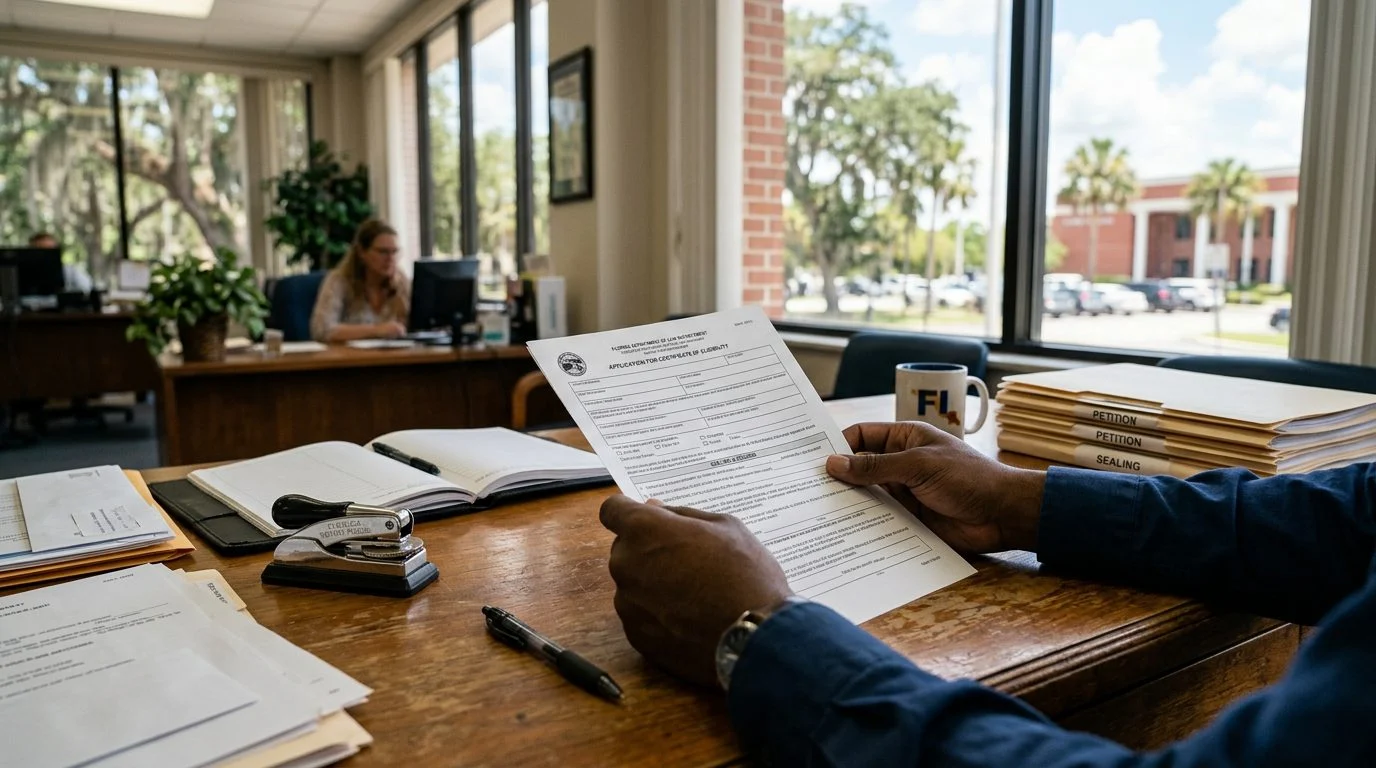
Who Usually Needs a Certificate of Eligibility?
Anyone who wants a record sealed through a court must first apply to the department for a certificate of eligibility for sealing.
- First-time offenders whose only record is an arrest or charge that never ended in a conviction.
- Licensed professionals who need a cleared record for a licensing board or an employer.
- Non-citizens who need to understand how a record affects their status. Review immigration questions with an attorney before you file.
- People with dismissed cases. Under this statute, a person may petition a court to seal a criminal history record only when the eligibility conditions are met; sealing is not automatic.
- People who acted in lawful self-defense. If charges were dropped on a documented finding of lawful self-defense, you may apply for an expunction certificate, notwithstanding the eligibility requirements in s. 943.0585(1) or (2) (Fla. Stat. § 776.09).
What the Application Covers
Your eligibility turns on how each case ended, so every arrest and charge has to be accounted for. A gap in that history can slow the process.
- The final outcome. Dismissals, nolle prosequi (the state drops the charge), not guilty verdicts and judgments of acquittal each affect eligibility.
- The court filing. A sealing petition goes to the clerk with your certificate and a sworn statement (Fla. R. Crim. P. 3.692).
- Copy costs. You pay for certified copies unless you’re indigent (Fla. R. Crim. P. 3.692).
Step-by-Step: From FDLE to the Court
You apply to FDLE first, file a petition with the clerk, and then a judge decides. The usual order looks like this:
- Review your record. Collect arrest dates, case numbers, the county of arrest and how each case ended.
- Apply to FDLE for a certificate of eligibility for sealing.
- Receive the certificate. It stays valid for 12 months.
- File the petition with the clerk. Attach the certificate and a sworn statement that you meet the eligibility requirements and have no other petition pending.
- Serve the state. The prosecuting attorney and arresting agency may respond, and the court can receive evidence on any factual issue.
- Wait for the ruling. The court may deny the request at its sole discretion. If it grants the petition, it enters a written order naming the agencies that must act.
Timing varies from one record to the next. It depends on how complete the record is and how quickly each agency responds. FDLE publishes its sealing and expungement process, and its sealing FAQs confirm that a court, not FDLE, decides the petition.
What Delays or Blocks an Application
Most delays come from a few problems you can check early. Knowing them before you apply saves time.
- Ineligible offenses. A conviction for certain offenses blocks sealing. Manslaughter under Fla. Stat. § 943.0584 makes a record ineligible for sealing. Section 782.07 defines manslaughter as a felony of the second degree. Causing a death by culpable negligence is aggravated manslaughter, a felony of the first degree, when the person who dies is an elderly person or disabled adult, a child under 18, or an officer, firefighter, EMT or paramedic who is performing duties within the course of his or her employment. The list also includes chapter 794 sex offenses, felony battery, and assault or battery of a family or household member.
- Withheld adjudication. Many people assume a withheld adjudication means no conviction.
- A pending petition. Your sworn statement must say no other petition to seal or expunge is pending before any court (Fla. R. Crim. P. 3.692).
- A noncompliant order. FDLE and other agencies don’t have to act on an order that fails to follow the statute. If a sealing order does not comply with the requirements of the statute, the Florida Department of Law Enforcement must notify the issuing court, the appropriate state attorney or statewide prosecutor, the petitioner or the petitioner’s attorney, and the arresting agency of the reason for noncompliance.
- An expired certificate. Once 12 months pass, you must reapply. Waiting for a court date can cost you that certificate’s window.
How Patrick Wilson Law Reviews a Record Before Filing
Patrick Wilson Law starts with a full review of your arrest and disposition history before any application goes in. Patrick David Wilson is the lawyer responsible for this page. The firm has more than one lawyer, including Sahara Fonseca, plus support staff who organize case numbers, court papers and identifying documents.
Our team checks each case against the statute’s criteria. We look at how each charge ended, whether a plea or withheld adjudication is involved and whether any ineligible offense appears. Bring any court papers, dispositions or old certificates you have, since each one helps match the case to the record.
The firm focuses on criminal defense across Miami-Dade, Broward and the Florida Keys. That work includes DUI, domestic violence and sexual battery charges, as well as sealing and expunging criminal records.
Not sure what your next step is?
Talk it through with our team — the first consultation is free, confidential, and carries no obligation.
Common Questions About the Florida Certificate of Eligibility
Is a certificate of eligibility the same as a sealed record?
No. It confirms eligibility, and a judge must still sign a sealing order.
Does a sealed record disappear from view?
Sealed records become confidential. FDLE can still share them with certain licensing and employment entities (Fla. Stat. § 943.059).
Can I seal a case that was dismissed?
Sealing is not automatic: a certificate of eligibility and a petition are required before a court can seal a record. Others may need a petition, so the case outcome is checked first.
What happens if my application is denied?
A court cannot order sealing until you receive a certificate.
How long does the certificate last?
It is valid for 12 months from the date stamped on it.
Next Step: Get Your Record Reviewed Before You File
If an old arrest is standing between you and a job, a license or a family court matter, the certificate is likely your first step. Before anything is filed, it helps to know which records qualify, which must be included and what could slow the application. Call 786-761-1719 or leave a message through our contact page to set up a free, confidential initial consultation, with no obligation to continue.
How Patrick Wilson Law Approaches Your Sealing Matter
Review Your Record
We look at the charges, the court dispositions and the rest of your file to understand what the application will need to show.
Prepare Your Application
We help you assemble the documents and information for the certificate of eligibility request so it is complete before it is submitted.
Explain Each Step
You will know what comes next, including the court filing that follows the certificate, and what to expect along the way.
Plan Around Your Career
For licensed professionals, non-citizens and first-time offenders, we consider how a record may affect work, licensing and immigration.
Important: A Certificate Is Not a Sealed Record
A certificate of eligibility confirms a step in the sealing process. It does not seal a record by itself. Do not assume your record is confidential until a judge has signed a sealing order.
What the Process Generally Involves
Step 1: Confirm Your Records
Obtain the court and arrest records tied to your case so the information in your application matches the official file.
Step 2: Submit the Certificate Request
The certificate of eligibility is requested through the Florida Department of Law Enforcement, with the required fees and documents.
Step 3: File with the Court
After receiving the certificate, the sealing petition is filed with the court that handled the case, along with supporting materials.
Step 4: Follow the Court's Order
Once a judge signs the sealing order, we explain what changes and what remains visible to certain agencies.

