
Criminal Record Relief | Miami-Dade County
Your Case Was Dismissed or Nolle Prossed. Your Record May Still Need Attention.
Patrick Wilson Law helps Miami-Dade residents ask the court to seal or expunge records from cases that ended without a conviction.
By Patrick David Wilson · Published November 21, 2026
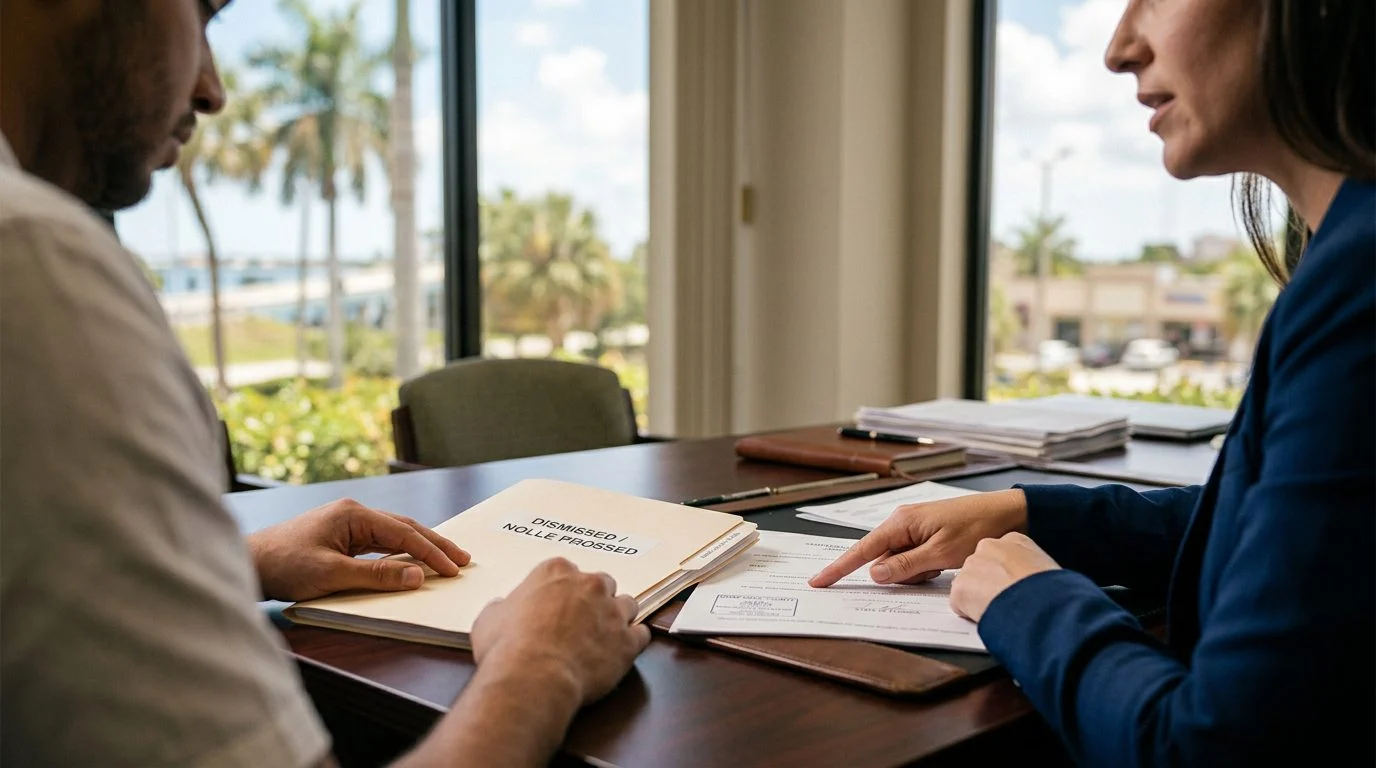
Your case was dismissed, or the prosecutor dropped it with a nolle prosequi, but the arrest may still show up on your record. Florida law lets a person ask a court to expunge a record when a case ends this way, as long as the record meets the statute’s conditions. This page explains how that works, what can block it, and what happens after a court signs an order.
What a Nolle Prossed Case Means for Your Record
A nolle prossed case ends the state’s case without a trial verdict, and it is not a conviction. A nolle prosequi, often called a “nolle pros,” is the prosecutor’s formal decision to drop the charge. Florida defines a conviction as a finding of guilt from a trial or a guilty or nolo contendere plea, whether or not adjudication is withheld (Fla. Stat. § 943.0584). A case ended by nolle prosequi does not fit that definition.
People also say “nolle prossed,” “charges nolle,” or just “nolle.” These names describe the same ending. The arrest and the charge still create a record, even though the case ended without a conviction.
Can you expunge a nolle prosequi? Yes. A nolle prosequi entered by the state attorney is one of the endings that can make a person eligible to petition a court for expunction (Fla. Stat. § 943.0585). A dismissal by a court, a judgment of acquittal, or a not guilty verdict can also qualify, when a charging document was filed. If no charging document was ever filed, the same statute provides a separate path.
Your case ended without a conviction, but the arrest may still follow you, and our team can talk through whether your Florida record can be sealed or expunged. Talk it through with our team — the first consultation is free, confidential, and carries no obligation.

Who Qualifies and What Can Disqualify a Record
Eligibility depends on how the case ended and what your prior record shows, not on why the prosecutor dropped it. The statute sets several conditions you need to meet.
- The case ended in a listed way, such as a nolle prosequi or a dismissal.
- You have never been adjudicated guilty of a criminal offense in Florida, as of the day you file.
- You have no other sealing or expunction petition pending before any court.
- You have never secured a prior sealing or expunction of a criminal history record, unless the earlier record was sealed for at least 10 years. The statute may require a record to stay sealed for at least 10 years first, when the earlier sealing was because adjudication was withheld or charges were not dismissed before trial. That 10-year requirement does not apply if no plea was entered, all charges were dismissed before trial, or a judgment of acquittal or a verdict of not guilty was rendered.
Some records can never qualify. A person is not eligible to expunge a criminal history record that is ineligible for court-ordered expunction under s. 943.0584, which bars records of convictions such as any offense in chapter 794. So does a conviction for offenses such as felony battery, or assault or battery against a family or household member (Fla. Stat. § 943.0584). Those rules apply to convictions, so they matter most when a case ended with a plea.
Sealing vs. Expunction in Florida
Sealing closes a record to the public, while expunction removes it from criminal justice files, except for one confidential copy the state keeps. The two paths use different statutes and different steps.
- Sealing keeps the record on file but restricts access. You first need a certificate of eligibility, and the state forwards a sealing order to the FBI (Fla. Stat. § 943.059).
- Expunction requires criminal justice agencies to physically destroy or obliterate the record. Fla. Stat. § 943.0585(6)(a) reads: “Any criminal history record of a minor or an adult which is ordered expunged by a court of competent jurisdiction pursuant to this section must be physically destroyed or obliterated by any criminal justice agency having custody of such record, except that any criminal history record in the custody of the department must be retained in all cases.” Under section 943.0585(6)(a), Florida Statutes, the Florida Department of Law Enforcement must still retain its record after expunction, and that retained record is confidential and not available to any person or entity except upon order of a court of competent jurisdiction.
Some records seal without a petition. Under the automatic sealing statute, the state must seal certain records, including some cases where every count was dismissed or nolle prossed. Exceptions and conditions apply (Fla. Stat. § 943.0595). If you want both kinds of relief, ask about both paths during your review.
Felony Cases and Withholds of Adjudication
Whether a withhold of adjudication applies to a particular case is a question for a lawyer who reviews the file. Automatic sealing under this section covers records that do not result from a charging document for a forcible felony or an enumerated offense, but only if no charging document was filed, the charges were dismissed or nolle prossed as to all counts, a not guilty verdict was entered, or a judgment of acquittal was entered, and the person is not ineligible under the statute’s exceptions. Under § 943.0584(1), a conviction is a determination of guilt regardless of whether adjudication is withheld, so a plea with a withhold can count as a conviction. That’s the point many people miss.
Judges also have limited power to withhold adjudication on some felonies. A court may not withhold adjudication for a capital, life, or first-degree felony. A second-degree felony generally needs a written request from the state attorney or written findings by the court (Fla. Stat. § 775.08435), and no adjudication can be withheld for one if the defendant has a prior withholding for a felony from a different transaction.
Can you expunge a withhold of adjudication in Florida? The answer turns on the plea and the offense. Pull the full court file before you assume either way.
The Step-by-Step Process and Timeline
The process runs in order. You get the certificate first, then file a sworn petition with the clerk. Each step should finish before the next one starts.
- Gather the records. Collect the arrest record and the court paperwork that shows the nolle prosequi or dismissal.
- Apply to the Florida Department of Law Enforcement (FDLE). FDLE issues a certificate of eligibility. Florida requires it with a petition to seal or expunge (Florida Rule of Criminal Procedure 3.692).
- File the petition with the clerk. Attach the certificate and a sworn statement that you meet the eligibility rules (Rule 3.692).
- Serve the prosecutor and the arresting agency. Both receive the completed petition, sworn statement, and certificate.
- Let the state respond. The prosecutor and arresting agency may respond, and the court may receive evidence on any fact it needs.
- Receive the written order. The court can deny a request at its sole discretion. If granted, the clerk certifies copies of the order to the appropriate state attorney or the statewide prosecutor and the arresting agency, and to any other agency the court’s records show received the criminal history record.
You pay for certified copies unless you are indigent (Rule 3.692). No single timeline fits every case, because each agency and court moves at its own pace.
What Stays Visible After Relief
Relief shrinks what the public can see, but it doesn’t erase every trace. An expunged record still leaves a confidential state copy. Under the automatic sealing rules, a sealed record also stays with the state and other criminal justice agencies.
Keep these steps in mind after an order:
- Keep certified copies of the signed order for your records and future forms.
- Confirm that the agencies named in the order received it.
- Before you answer a licensing, job, or immigration question about an arrest, compare the question with the order’s exact terms.
Not sure what your next step is?
Talk it through with our team — the first consultation is free, confidential, and carries no obligation.
Why Patrick Wilson Law for This Work
Patrick Wilson Law, PLLC is a criminal defense firm in Miami, Florida. It focuses on DUI, domestic violence, sexual battery, vehicular homicide, and related charges. It also handles requests to seal and expunge criminal records. The firm defends people across South Florida, from Broward County to the Florida Keys.
Patrick David Wilson is the responsible lawyer for this page. The firm’s lawyers include Patrick David Wilson and Sahara Fonseca, and the firm has support staff. The firm focuses on first-time offenders and licensed professionals. For a licensed professional, a dismissed case can still raise questions about the license, so the full record deserves review. The firm serves Miami-Dade, Broward, Fort Lauderdale, Miami Beach, Hialeah, Kendall, Homestead, and the Florida Keys.
Frequently Asked Questions
Most of these questions turn on how the case ended and whether a certificate of eligibility is in hand.
Is a nolle prossed case a conviction?
No. Florida defines a conviction as a trial result or a guilty or nolo contendere plea.
Do you need a certificate of eligibility?
Yes. A petition must be accompanied by a valid certificate issued by FDLE.
Can you expunge a withhold of adjudication?
The answer turns on the plea and the offense, because the statute counts some withheld pleas as convictions.

Talk With Our Team About Your Miami-Dade Record
A case that ended without a conviction can still follow you into jobs, licensing, and everyday paperwork. If you’re trying to figure out whether that record can be sealed or expunged, you can discuss it with our team. The first consultation is free, confidential, and carries no obligation to continue. Call 786-761-1719 or leave us a message through our contact page.
Don't assume the record is gone
Ending a case without a conviction does not always mean the arrest or charge has been cleared from public records. Speak with a lawyer before you assume your record is clean.
How we approach your case
Careful file review
We review the charging documents, court dispositions and records together to understand what the court has on file.
Focused on criminal record relief
Patrick Wilson Law focuses on criminal defense across South Florida, including sealing and expunging criminal records.
Clear explanations
We explain the process in plain language, so you know what to expect before any filing is made.
Confidential first step
The first consultation is free, confidential and comes with no obligation to continue.
Common case endings we review
Dismissed charges
When the state or court drops a charge, the record of the arrest and case may still appear in court and public databases.
Nolle prosequi
A nolle prosequi ends the prosecution, but it is not a trial verdict. Its effect on your record depends on the details of your case.
Withhold of adjudication
A withhold can raise different questions than a dismissal, so the path to sealing or expunging may differ.

