
Still Carrying a Florida Felony Years Later? Find Out Where You Stand
Old charges can keep following you into jobs, licenses and housing. Here is how Florida handles them and what to ask before deciding on a next step.
By Patrick David Wilson · Published November 12, 2026
If a felony from years ago is now getting in the way of a job, a license, a lease, or a visa, you probably want a straight answer. Does it ever go away?
A record changes only when a court orders it, and only when the case meets the statute’s conditions.
Time alone does not clear a Florida felony record
Time alone does not clear a Florida felony. Clearing a record takes a court process, and the case has to qualify.
Two terms matter here. A conviction is a finding of guilt, whether it comes from a trial or from a guilty or no contest plea. Florida’s definition counts that finding even when the judge withholds adjudication. Fla. Stat. § 943.0584 sets that definition.
A criminal history record is the state’s file on an arrest and its outcome. Under Fla. Stat. § 943.0585, a person who meets the statute’s eligibility requirements may petition a court to expunge a criminal history record, and before petitioning must apply to the department for a certificate of eligibility for expunction.
Not sure what your next step is?
Talk it through with our team — the first consultation is free, confidential, and carries no obligation.
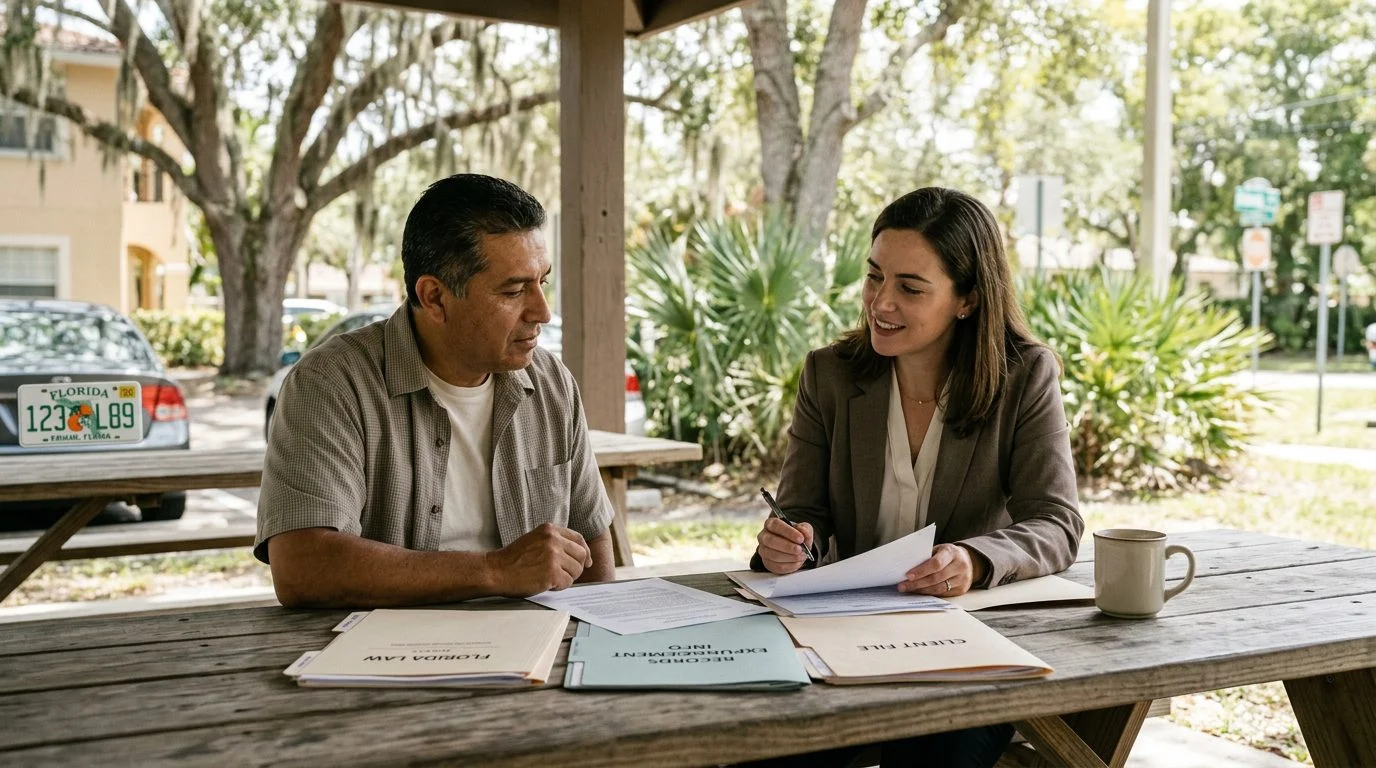
A conviction can still appear on a background check after a decade
Many background checks look at the full record, not only recent years, so an old felony can still show up.
Two areas follow their own federal rules. Under 18 U.S.C. § 921, a conviction that has been expunged or set aside does not count as a conviction for federal firearms purposes, unless the order says the person may not have firearms. For non-citizens, the stakes are higher. Under 8 U.S.C. § 1227, a non-citizen convicted of a crime of domestic violence after admission is deportable.
A common mistake is thinking that finishing probation or paying fines makes the record disappear. Completing a sentence does not change the record by itself.
Sealing and expunction are court-ordered and depend on the case
Florida allows sealing or expunction only through a written petition, and only when the case meets the statute’s conditions. The petition goes to the clerk of the court with a valid certificate of eligibility from the Florida Department of Law Enforcement and a sworn statement. Fla. R. Crim. P. 3.692 sets out those steps. The court may deny the request at its sole discretion.
Eligibility depends on conditions in Fla. Stat. § 943.0585. Those include whether a charging document was filed and whether the person was ever adjudicated guilty of a criminal offense in Florida. It is one condition in a specific situation, not a general removal date.
Some convictions can never be sealed or expunged. Under Fla. Stat. § 943.0584, a conviction for manslaughter or homicide as defined in s. 782.07, s. 782.071, or s. 782.072, for felony battery, or for any offense defined in chapter 794 makes a criminal history record ineligible for sealing or expunction. If the record is a conviction for any offense on the list in s. 943.0584, no petition to seal or expunge it is available, and that list is longer than the offenses named here.
Judges also face limits on withholding adjudication. Under Fla. Stat. § 775.08435, a court may not withhold adjudication for any capital, life, or first degree felony.
A felony can still be on file after 20 years
Older records stay in the state’s files. A court order is what changes how they are shown.
Automatic sealing is limited. Even then, other criminal justice agencies keep their own copies of the record.
Whether a particular record qualifies depends on the facts.
Restoring civil rights is not the same as clearing the record
Restoring civil rights and clearing a criminal record are separate tracks with separate rules. Clemency, the state process for restoring certain rights, is a different path from a sealing or expunction petition.
Gun rights show the difference most clearly. Federal firearm rules treat an expunged or set-aside conviction differently, unless the order says otherwise. Licensing boards and employers apply their own standards. Those standards can differ from a court’s sealing or expunction order.

What to gather before you talk with a Florida criminal defense lawyer
Gather the final court papers and sentencing records before you reach out. They shape the first conversation.
- Certified or final court documents showing the charge, case number, county, and final outcome.
- Sentencing papers, probation discharge records, and proof that fines, restitution, or conditions were finished.
- A list of each place that needs the record cleared, such as a job, license, lease, or immigration filing, with any deadline you know.
Copies cost money. Under Fla. R. Crim. P. 3.692, the petitioner pays for certified copies unless the petitioner is indigent.
Patrick David Wilson is the responsible lawyer for this page. Patrick Wilson Law, PLLC is a criminal defense firm in Miami that defends people across South Florida, from Broward County to the Florida Keys. The firm offers a free first consultation that is confidential and carries no obligation to continue.
Can a felony be sealed in Florida?
Some can, through a court petition, if the case meets the statute’s conditions.
What is a certificate of eligibility?
It is a certificate of eligibility the Florida Department of Law Enforcement issues. Each petition to expunge a criminal history record must be accompanied by a valid one. A sealing or expunction petition must include one.
Does an expunged felony still count for federal gun purposes?
A felony from years ago can feel like it follows you into every application and interview. If you are looking into this for yourself or someone you love, a confidential conversation about that specific record is a good next step. Call 786-761-1719 or leave us a message.
Why Clients Start with Patrick Wilson Law
Criminal defense focus
Patrick Wilson Law focuses on criminal defense, including sealing and expunging criminal records for people across South Florida.
Serving South Florida
Our Miami office works with clients from Miami-Dade and Broward counties to the Florida Keys.
Free first consultation
Your first consultation is free, confidential and without obligation to continue.
Attorneys who handle your matter
Our attorneys, including Patrick David Wilson and Sahara Fonseca, are supported by our team of assistants and office staff.
Do not assume your record is cleared
Review your record before you apply for a job, license or visa.
Questions to Bring to Your Consultation
What is on my record?
Bring any charging documents, court papers and dispositions so we can review exactly what appears on your record.
Sealing or expunging?
Sealing and expunging are different processes with different effects. We will explain which, if either, may apply to your case.
How does this affect my career?
Licensed professionals, students and job seekers often need to know how a record will appear to employers and licensing boards.
What about immigration?
For non-citizens, a criminal record can carry consequences beyond the courtroom. Tell us your full history so we can discuss those risks.

