

Criminal Defense in Miami-Dade and Broward Counties
A Florida Expunction Doesn't Automatically Clear Your FBI Record
Employers, licensing boards, firearm dealers and immigration authorities may each run a different check. Learn what can still appear and how to plan around it.
By Patrick David Wilson · Published November 18, 2026
You had an arrest or charge in Florida. Now a job, professional license, gun purchase, or immigration matter calls for a background check, and you want to know whether it will still show.
Short answer: no, not by itself. A Florida expunction is a court order that state agencies carry out, and it must reach the FBI. Until that happens, the federal entry can still appear.
The Short Answer: A Florida Expunction Does Not Automatically Clear the FBI Record
A Florida expunction does not, on its own, settle the federal record. The order moves through a chain of agencies. Under Fla. Stat. § 943.0585, the clerk certifies the order to the prosecutor and the arresting agency. The Florida Department of Law Enforcement (FDLE) then forwards it to the FBI.
Whether an entry still shows depends on which agency holds it and which type of check runs. Eligibility comes first, too. Eligibility depends on the facts, so have Patrick David Wilson, the responsible lawyer for this page, review yours first.
If an old Florida arrest could still show up on a federal check you're facing, we can review your record and court order with you. Talk it through with our team — the first consultation is free, confidential, and carries no obligation.
Why State and Federal Records Are Kept Separately
Florida and the FBI each keep their own copy, so each copy has to be handled. State records sit with the clerk, the arresting agency, and FDLE. The FBI keeps its own identification record, built from fingerprints and case outcomes that agencies send in.
Florida’s rule for its own copies is strict. Under Fla. Stat. § 943.0585(6)(a), any criminal history record ordered expunged by a court must be physically destroyed or obliterated by any criminal justice agency having custody of it, except that the department must retain such a record in all cases. FDLE is the exception.
So a Florida order cleans up state copies first. The federal copy depends on the forwarding step. That’s why you should confirm it, not assume it.
What an FBI Fingerprint Background Check Draws From
A fingerprint-based FBI check draws from fingerprint records. A name-based screen draws from commercial databases and court files. The two can return different results for the same person.
Private screening companies often search by name and may not match an FBI entry the same way. A record that looks gone in one search can still appear in another.
Firearm purchases show why check type matters. Under 18 U.S.C. § 922, a licensed dealer may not transfer a firearm to an unlicensed buyer unless certain conditions are met. One condition is that three business days have passed after the dealer contacts the national background check system, and the system has not notified the dealer that the buyer’s receipt of a firearm would violate subsection (g) or (n) of this section, or State, local, or Tribal law.
Find out which check is being run before you plan around it.
How to Request and Review Your Own FBI Record
You can review your own FBI record and see how each entry appears. This copy shows what the FBI holds on you now. That makes it the right place to start.
Look for three things: the arrest, the charge, and the disposition. The disposition is the outcome, such as a dismissal or a conviction. Note whether each Florida entry shows as expunged, sealed, or still open.
Write down every line that matches your Florida case, including dates and agency names. Those lines are what you will ask agencies to correct. Keep the copy with your court papers.
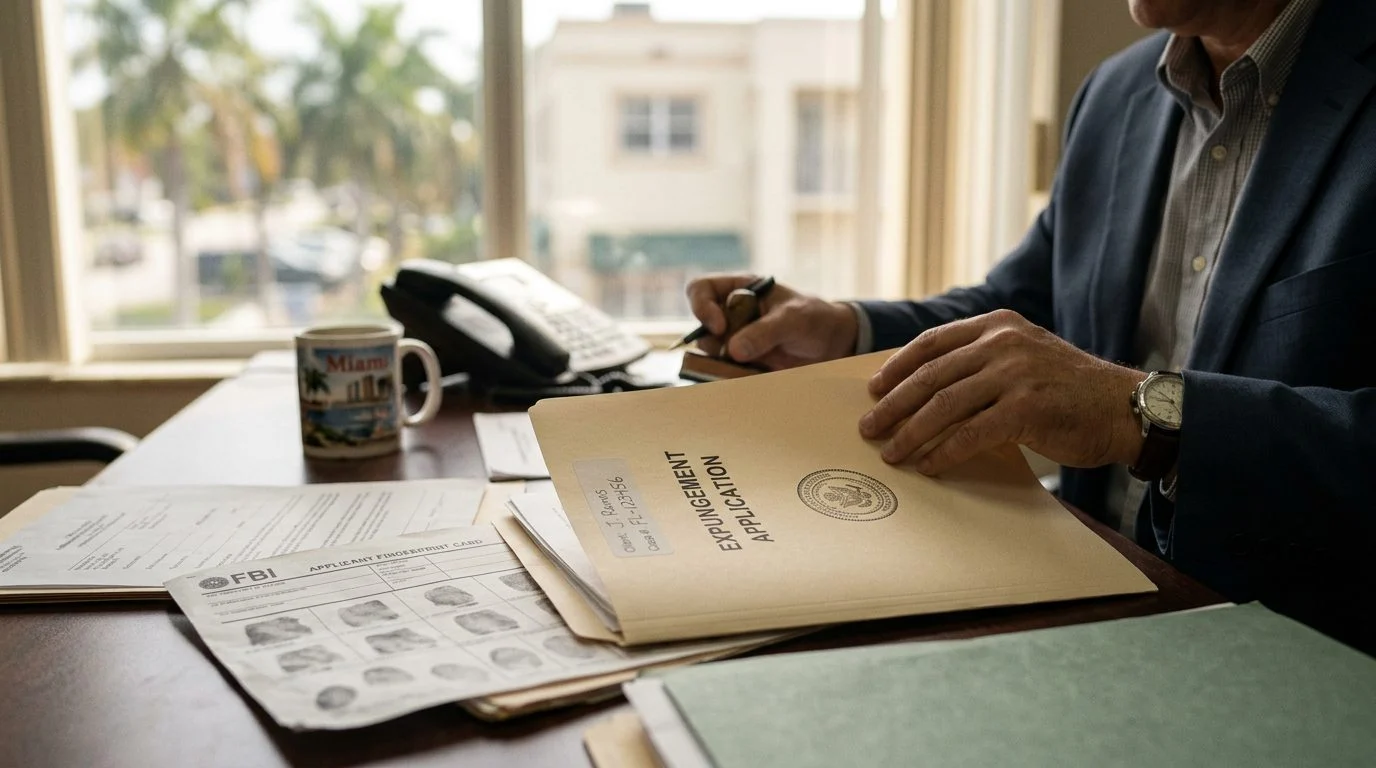
Steps to Ask the Agencies to Update the Federal Record
Get a certified copy of the order, then ask each reporting agency to update its entry. Florida law puts the forwarding duty on the state. Your written follow-up helps confirm each step happened.
- Request a certified copy of the order from the clerk of the court that entered it. Under Fla. R. Crim. P. 3.692, the petitioner pays for certified copies unless indigent.
- List every agency that sent fingerprints or a disposition on your case, including the arresting agency. Under the expunction statute, the arresting agency forwards the order to any agency it gave the record to.
- Send the certified order to each agency with a written request to update its report to the FBI. Keep copies and dates of every letter and email.
- Check your FBI record again after the agencies have had time to act. Keep the new copy with the order.
Sealed and Expunged Records: Who Can Still See Them
Expunction targets the copies agencies hold. Sealing keeps the record but limits who can view it. A sealed record is confidential and is available only to limited persons, such as the subject of the record. A court cannot order sealing until the person has received a certificate of eligibility.
The court keeps control of the result. FDLE’s frequently asked questions say a court, not FDLE, decides whether to grant a petition. Under Fla. R. Crim. P. 3.692, a request may be denied at the court’s sole discretion.
Disclosure is limited. Under the Florida expunction statute, employees of listed licensing and employment entities may not disclose the existence of an expunged criminal history record of someone seeking work or a license, except to the person to whom the criminal history record relates or to persons having direct responsibility for employment, access authorization, or licensure decisions. A violation is a first-degree misdemeanor.
Some convictions block both remedies. A guilty or no contest plea counts as a conviction, even when adjudication is withheld.
Not sure what your next step is?
Talk it through with our team — the first consultation is free, confidential, and carries no obligation.
Talk With Patrick David Wilson About Your Record and the Federal Check
If a Florida arrest or charge may qualify for expunction, and a federal check is coming up, timing matters. The check might be for a job, a license, a firearm purchase, a military role, or an immigration matter. Bring your arrest details, charging papers, and any order to a conversation with Patrick David Wilson at Patrick Wilson Law.
Patrick Wilson Law focuses on criminal defense across South Florida, including Miami-Dade and Broward County. Call 786-761-1719 or leave a message on the contact page. We’ll review your record, your order, and the agencies involved.
The first consultation is free, confidential, and carries no obligation to continue. La consulta inicial es gratuita, confidencial y sin compromiso de continuar.
How Patrick Wilson Law Helps
Review Your Record
We look at the charges, the court orders and the agencies involved so you know which records may still be visible.
Plan Before You Apply
Whether the check is for a job, a professional license or a firearm purchase, we help you decide how to proceed before you disclose anything.
Clear Answers
The first consultation is free, confidential and comes with no obligation to continue.
Based in Miami
Patrick Wilson Law focuses on criminal defense and sealing and expunction matters for clients across South Florida, from Broward County to the Florida Keys.
Do Not Assume a Florida Expunction Is Invisible
Before you answer a background-check question or submit a license or firearm application, confirm what federal records may still show. Answering inaccurately can create problems of its own.
Where Federal Checks May Still Show a Case
Employment Screening
Some employers and background screening services use FBI-based records. A state order may not be enough to close the federal entry.
Professional Licenses
Licensing boards for licensed professionals often review national records, and the outcome can affect a career that took years to build.
Firearm Purchases
Ask before you buy.
Immigration Matters
Non-citizens should understand how an arrest or sealed or expunged record may be viewed in immigration filings before submitting anything.

