

Criminal Defense · Miami, Florida
Facing a Fatal Crash Charge? Ask About Sealing Before You Decide
Patrick Wilson Law explains how a withheld adjudication, a plea and a sealing request can interact, and what to gather before you talk with a lawyer.
By Patrick David Wilson · Published November 17, 2026
If a crash you were involved in killed someone, you may be asking whether the record can ever be sealed. For vehicular homicide and DUI-related charges, Florida law does not let a judge withhold adjudication, so a withhold is not the clean outcome many people expect. Whether a record can be sealed depends on the exact charge and how the case ended.
Short Answer: Can a Withheld Fatal Crash Case Be Sealed in Florida?
For vehicular homicide and DUI-related charges, a withhold is not allowed, and a vehicular homicide conviction cannot be sealed. Florida’s mandatory adjudication statute bars courts from withholding adjudication for these charges. Florida’s sealing ineligibility list names vehicular homicide among the convictions that cannot be sealed.
Sealing runs under § 943.059. That statute requires a certificate of eligibility from the Florida Department of Law Enforcement (FDLE) before any petition is filed. Fatal crash cases carry heavy consequences, so the exact charge and the certified disposition decide what the law allows. Start with those two facts before you assume anything about the record.
Not sure what your next step is?
Talk it through with our team — the first consultation is free, confidential, and carries no obligation.
What a Withhold of Adjudication Means, and How It Differs From a Guilty Adjudication
A withhold of adjudication means the judge does not enter a finding of guilt at that point. For sealing, though, the label alone does not settle the question. § 943.0584 defines a conviction as a determination of guilt from a trial or a guilty or nolo contendere plea, “regardless of whether adjudication is withheld.”
Nolo contendere means a plea of no contest. A withhold that follows a guilty or no-contest plea still counts as a conviction under that definition.
An adjudication of guilt is the formal finding that the person is guilty. A withhold is the alternative to that finding. The distinction matters because the sealing statutes look at the conviction, not only the label on the outcome.
Section 943.0584 does not limit withholds for felonies; it defines a conviction as a determination of guilt, regardless of whether adjudication is withheld. The felony withhold limits are in § 775.08435. § 775.08435 bars a court from withholding adjudication for any capital, life, or first degree felony. It also bars a withhold for any second degree felony, and for third degree felonies that are domestic violence crimes or follow a prior felony withhold, unless the state attorney requests it in writing or the court makes written findings. A prior felony withhold that did not arise from the same transaction bars a withhold outright for a second degree felony, and two or more such prior felony withholds bar a withhold outright for a third degree felony.
A common mistake is treating a withhold as a clean record. Start with the certified disposition, which shows exactly what the court entered.
Sealing Versus Expunction: What Changes for Your Record
Sealing hides a record from public view, while expunction removes it from the official court records. Florida Rule of Criminal Procedure 3.692 draws that line. For expunction, the clerk removes the entries. For sealing, the clerk seals them and keeps them in a nonpublic index.
Under the automatic sealing statute, § 943.0595, the department and other criminal justice agencies keep maintaining the record. Under the automatic sealing statute, § 943.0595, automatic sealing has the same effect as a record sealed under § 943.059, and the department and other criminal justice agencies continue to maintain the record even after it is sealed.
Expunction has its own eligibility rules. § 943.0584 makes a criminal history record ineligible for a certificate of eligibility for expunction or a court-ordered expunction under § 943.0585 if the record is a conviction for certain listed offenses. That exclusion blocks both sealing and expunction for a conviction for manslaughter or homicide under s. 782.07, s. 782.071 (vehicular homicide), or s. 782.072, but whether another crash-related conviction is barred depends on the specific offense of conviction.
Eligibility for Fatal Crash Charges: Offense, Disposition, and Prior Record
Eligibility turns on three things: the charge, how the case ended, and the person’s prior record. Each one has to fit the statute before a petition makes sense.
The charge matters first. Under § 782.071, vehicular homicide is a second degree felony. It becomes a first degree felony when the driver knew or should have known the crash occurred and failed to give information and render aid, or when the driver has a prior conviction under this section, s. 316.193(3)(c)3., s. 327.35(3)(a)3.c., or s. 782.072. Under § 316.193(3), a driver who is in violation of subsection (1), operates a vehicle, and by reason of that operation causes or contributes to causing the death of any human being or unborn child commits DUI manslaughter. DUI manslaughter is a second degree felony. It is a first degree felony when the driver knew or should have known the crash occurred and failed to give information and render aid, or when the driver has a prior conviction under that subparagraph, s. 327.35(3)(a)3.c., s. 782.071, or s. 782.072. A person convicted of DUI manslaughter must be sentenced to a mandatory minimum of 4 years in prison. § 782.071 separately provides for vehicular homicide as a first degree felony in other circumstances, including after a prior conviction under the listed provisions. Under § 316.027, a willful violation of the provision covering a crash that results in death is punishable by a mandatory minimum term of imprisonment of 4 years. The defendant may ask to depart from that minimum. The court may grant that request only if it finds an injustice. Fla. Stat. § 316.027 reads: “The court may grant the motion only if it finds that a factor, consideration, or circumstance clearly demonstrates that imposing a mandatory minimum term of imprisonment would constitute or result in an injustice.” The request is not available when the violation was committed while driving under the influence.
The case outcome matters next. A court cannot withhold adjudication under § 316.656 for a violation of s. 316.193, for manslaughter resulting from the operation of a motor vehicle, or for vehicular homicide. Some non-conviction outcomes differ. Under § 943.0595, certain records qualify for automatic sealing.
Your prior record matters too. § 943.059 also limits sealing to one arrest or one incident; additional arrests may be included only if they directly relate to the original one, and the order must specify that intent.
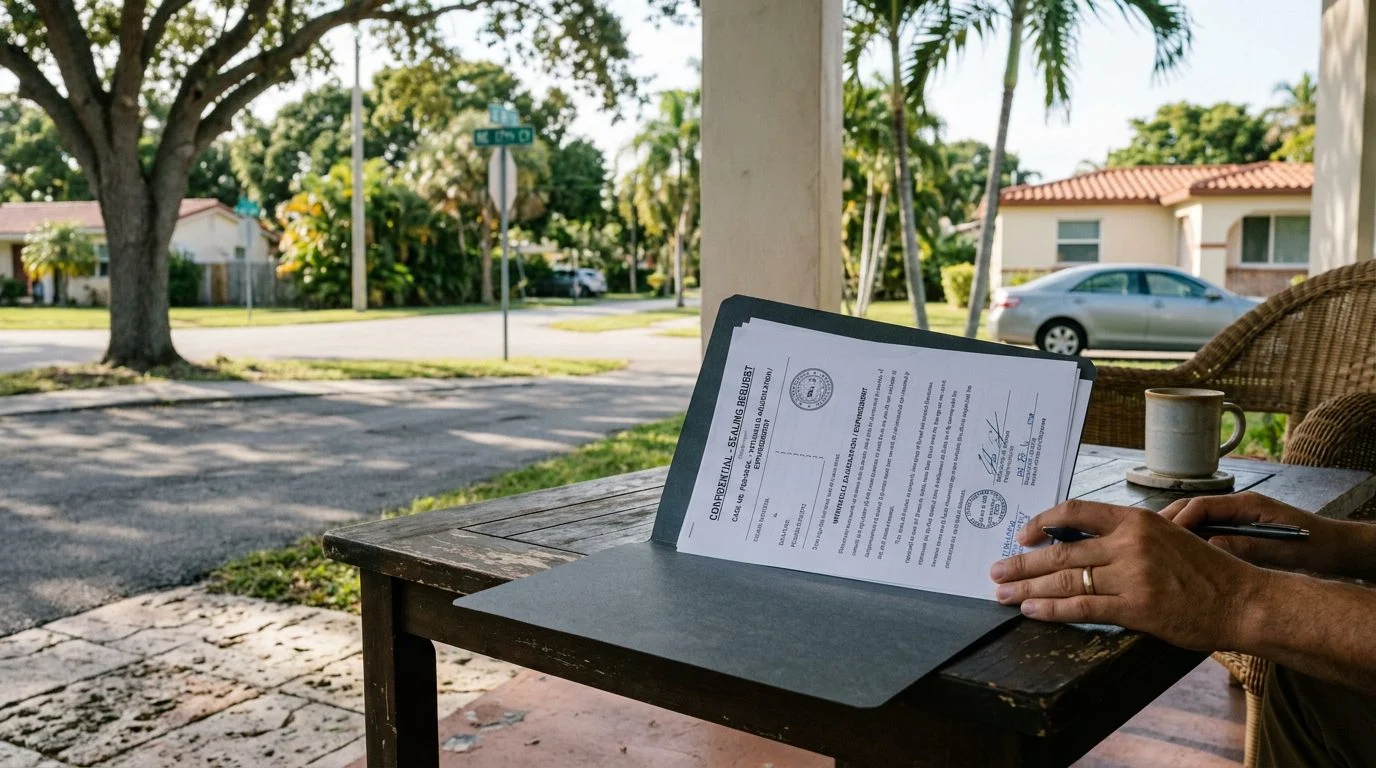
The Sealing Process: Certified Disposition, FDLE Certificate, and Court Petition
The process starts with paperwork, and the FDLE certificate must come before any court petition. Here are the steps.
- Get a certified disposition. § 943.059 requires a certified copy of the disposition of the charge as part of the FDLE application.
- Apply to FDLE for a certificate of eligibility. For sealing, the applicant must first apply to FDLE for a certificate of eligibility for sealing under § 943.059 and submit a certified copy of the disposition of the charge; FDLE’s certificate instructions cover the application process. FDLE’s sealing guide says FDLE issues the certificate, while the court decides whether to grant the petition.
- Prepare the sworn petition. The petition must include the certificate and a sworn statement that you meet the eligibility rules. It must also say no other petition to seal or expunge is pending in any court. Rule 3.692 sets out these requirements.
- File with the clerk. The petition is filed with the clerk. You must serve it on the prosecutor and the arresting agency, which may respond.
- Wait for the judge’s order. The court can deny the request at its sole discretion. The court may not order an agency to seal a record until the petitioner has received the certificate. If the petition is granted, the clerk seals the entries and keeps them in a nonpublic index.
The petitioner pays for certified copies of records unless indigent. Rule 3.692 sets that cost rule.
Frequently Asked Questions About Sealing a Withheld Fatal Crash Record
Is adjudication withheld a conviction in Florida?
Whether a particular record may be sealed depends on the facts of that case. § 943.0584 counts a guilty or no-contest plea as a conviction even when adjudication is withheld.
What is the difference between sealing and expunging in Florida?
Sealing keeps a record out of public view in a nonpublic index. Expunging removes it from the official court records, as Rule 3.692 describes.
Do felonies go away after seven years in Florida?
Eligibility comes from the statutes, not from one set number of years. § 943.059 sets the petition rules, and § 943.0584 lists records that are ineligible.
How much does it cost to seal a record in Florida?
The petitioner pays for certified copies unless indigent, and other FDLE and court costs may apply. Rule 3.692 sets the copy cost rule.
Not sure what your next step is?
Talk it through with our team — the first consultation is free, confidential, and carries no obligation.
Talk With Patrick David Wilson About a Withheld Fatal Crash Case in Miami
Patrick David Wilson is the responsible lawyer for this page at Patrick Wilson Law, PLLC, a criminal defense firm based in Miami. The firm handles seal and expunge matters, along with DUI, vehicular homicide, and leaving-the-scene cases across Miami-Dade and Broward County. A sealing question after a fatal crash usually means reading the charge, the disposition, and the prior record together. Bring whatever paperwork you have, including the charging documents and the disposition.
The initial consultation is free, confidential, and carries no obligation to continue. If a fatal crash case left you with a criminal record and you’re unsure whether it can be sealed, Patrick Wilson Law is ready to talk it through with you. Call 786-761-1719 or leave us a message through our contact page.
How Patrick Wilson Law Approaches These Cases
Focused on criminal defense
Our practice focuses on criminal defense in Miami-Dade, Broward County and the Florida Keys, including vehicular homicide and related traffic charges.
Records reviewed first
We start with the charging documents, plea paperwork and court dispositions so every option is measured against the actual record.
Attention for first-time offenders
Many of the people we help have never been in criminal court before, and we explain each step in plain language.
Confidential, no-obligation start
The initial consultation is free, confidential and carries no obligation to continue.
Do not assume the record is sealed or sealable
A withheld adjudication does not automatically mean a record can be sealed. Gather every court document from your case and bring them to a consultation before you make any filing or statement about the case.
What to Bring to Your Consultation
Charging and court papers
Arrest reports, the information or charging document, and any orders entered in the case.
Plea and disposition records
Any plea forms, sentencing documents and the clerk's final disposition, showing whether adjudication was withheld.
Prior and later records
A list of any other arrests or cases, in Florida or elsewhere, so your history is reviewed completely.
Immigration and license status
If you are not a U.S. citizen or hold a professional license, note that now so it can be considered in the review.

