

Criminal Defense · Miami, Florida
Criminal Lawyer or Criminal Defense Lawyer: Does the Label Change Your Defense?
By Patrick David Wilson · Published November 21, 2026
What’s the Difference Between a Criminal Lawyer and a Criminal Defense Lawyer?
Not sure what your next step is?
Talk it through with our team — the first consultation is free, confidential, and carries no obligation.
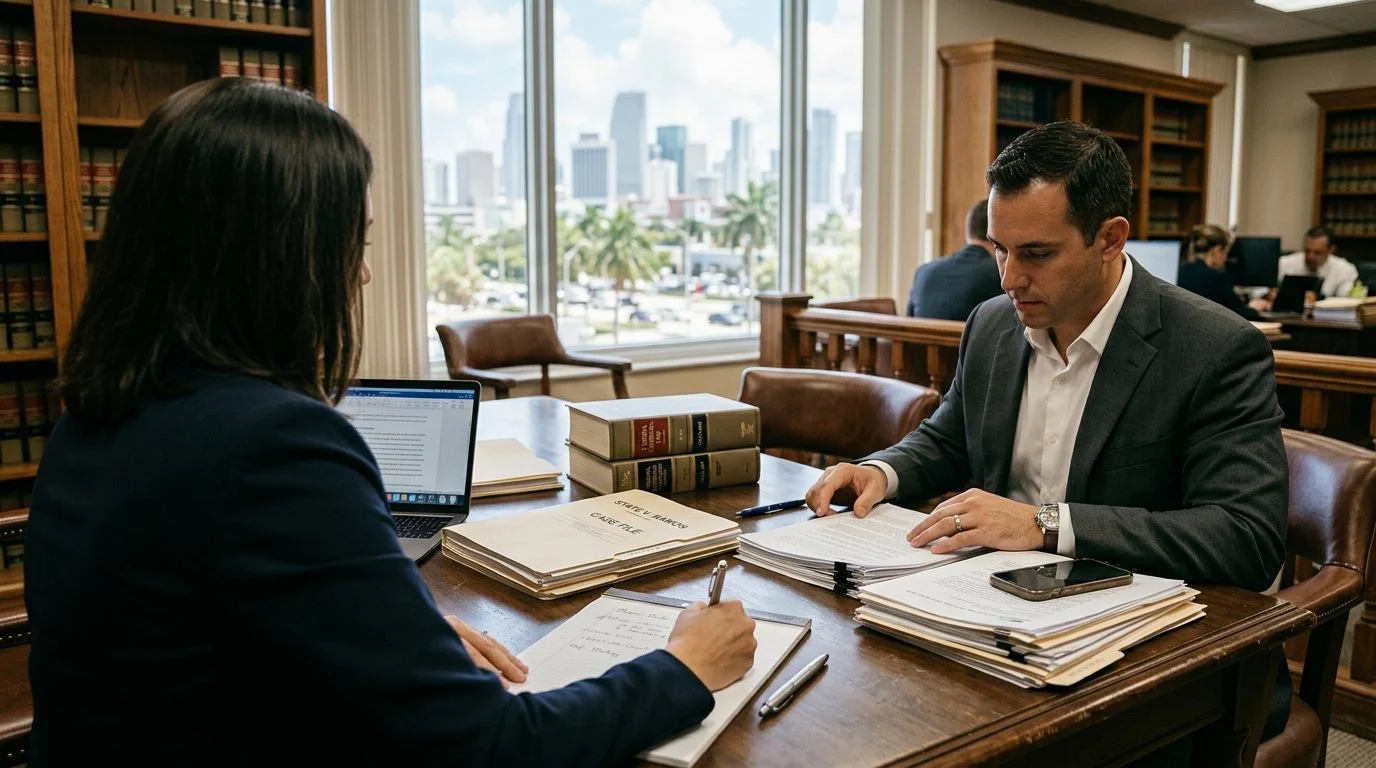
The short answer: what’s the difference between a criminal lawyer and a criminal defense lawyer?
What’s the difference between a criminal lawyer and a criminal defense lawyer? A criminal lawyer is any attorney who handles criminal cases. A criminal defense lawyer is the one who represents the person accused of the crime. In everyday talk, people use the two terms almost the same way.
The real difference is which side the lawyer works for. A defense lawyer works for the accused. A prosecutor works for the state. That split decides whose interests the lawyer protects.
This page explains each role in plain words. It also covers what the difference means when a charge is pending. This is general information, not legal advice about any specific case.
What “criminal lawyer” means as a broad label
“Criminal lawyer” is a general term. It covers any attorney who practices criminal law, the body of law about offenses the state can prosecute.
Criminal law covers many kinds of charges. A driving under the influence (DUI) charge is one example.
Domestic violence and sexual battery charges are also criminal cases. Each one carries its own rules and penalties.
The word “criminal lawyer” does not say which side a lawyer is on. Prosecutors and defense lawyers both practice criminal law. To know the role, you need the second term or the lawyer’s stated role.
What a criminal defense lawyer does for the accused
A criminal defense lawyer represents a person charged with a crime. The lawyer works to protect that person’s rights at every stage of the case.
The work usually includes reviewing the police report and the evidence. It also includes explaining the charge and the possible penalties. The lawyer may file motions, negotiate with the prosecutor, and appear at hearings or trial.
Some motions matter a lot. Under Fla. R. Crim. P. 3.190, a person who claims the state got evidence through an unlawful search or seizure may move to suppress that evidence. A defense lawyer evaluates whether that kind of motion applies.
Plea talks are another key part. Under Fla. R. Crim. P. 3.171, defense counsel cannot finish a plea deal without the client’s full consent. Counsel must also advise the client of all plea offers and the alternatives open to them.
Patrick Wilson Law, PLLC focuses on defense work in Miami and across South Florida. Its listed practice areas include DUI, domestic violence, sexual battery, vehicular homicide, and leaving the scene of an accident. The firm also handles white collar matters, first-time offender cases, criminal defense for licensed professionals, and sealing or expunging records. If your case involves a driving charge, see the DUI defense attorney Miami page.
Prosecutors and public defenders work in the same courtroom
A prosecutor represents the state. A public defender is an attorney appointed for a person who cannot afford a lawyer.
Florida ties appointed counsel to money. Under Fla. R. Crim. P. 3.111, “indigent” means a person unable to pay for an attorney’s services without substantial hardship to the person or the person’s family. Under Fla. Stat. § 27.52, a person who wants a public defender based upon an inability to pay must apply to the clerk of the court. The application asks for net income and other financial details.
Whether a person uses appointed counsel or hires a private lawyer depends on the facts of the case and the person’s finances. A private criminal defense lawyer is hired by the accused and works for that person. That is the role Patrick Wilson Law’s practice describes.
Judges also play a part. Under Fla. R. Crim. P. 3.171, the trial judge has final responsibility for the sentence. The prosecutor and defense lawyer are encouraged to discuss and agree on pleas.
How criminal defense differs from civil law
Criminal cases are brought by the government. They can lead to jail, probation, fines, or a criminal record. Civil cases are brought by private people. They usually seek money or another remedy.
A civil lawyer may handle contracts, injury claims, or family disputes. A criminal defense lawyer handles cases where the state has charged someone with an offense.
The two areas can overlap. A crash can lead to a criminal charge and a civil claim at the same time. So each issue may need its own attention.
Common questions
Is a criminal lawyer the same as a criminal defense lawyer?
Often, yes, in everyday speech. A defense lawyer is the criminal lawyer who represents the accused.
Are public defenders used in felony cases?
Public defenders can be appointed when a person qualifies as indigent. Eligibility depends on the person’s finances and the facts.
Not sure what your next step is?
Talk it through with our team — the first consultation is free, confidential, and carries no obligation.

What the difference means when a charge is pending
If someone you care about was just arrested or cited, you may not yet know what the charge means. That is a hard place to be. Understanding the roles is a good first step.
Some options exist before trial. Under Fla. Stat. § 948.08, a first offender, or a person previously convicted of not more than one nonviolent misdemeanor, charged with a misdemeanor or third-degree felony can be eligible for pretrial intervention, if the program administrator approves and the victim, the state attorney, and the judge who presided at the initial appearance consent. Approval and consents are required. The person must also knowingly waive the right to a speedy trial for the diversion period. Fla. Stat. § 948.08 reads: “However, the defendant may not be released to the pretrial intervention program unless, after consultation with his or her attorney, he or she has voluntarily agreed to such program and has knowingly and intelligently waived his or her right to a speedy trial for the period of his or her diversion.”
Records can also be addressed later. Under Fla. Stat. § 943.0585, a person may petition a court to expunge a record in some situations. Sealing has its own rules under Fla. Stat. § 943.059.
Immigration status adds another layer. Under federal immigration law, a non-citizen convicted of a crime of domestic violence is deportable. Anyone who is not a citizen should raise that fact early.
Patrick David Wilson is the lawyer responsible for this page. Patrick Wilson Law, PLLC offers a free first consultation that is confidential and carries no obligation to continue. You can reach the firm at 786-761-1719 or leave a message at the contact page.
How Our Lawyers Approach Criminal Defense Matters
Defense is the core of the work
Our lawyers focus on representing people who have been accused of a crime, from the first contact with police through court proceedings.
First-time offenders and professionals
The firm concentrates in cases involving first-time offenders and licensed professionals, where a charge can affect a job, a license or a family.
Across South Florida
We represent clients in Miami, Miami-Dade County, Broward County, Fort Lauderdale, Kendall, Hialeah, Miami Beach, Homestead and the Florida Keys.
Matters beyond a single charge
Our lawyers also handle sealing and expunging criminal records for clients seeking to move past an earlier case.
Speak With a Lawyer Before You Make a Statement
Words spoken to police or to others about a charge can be used later in your case. Speaking with a defense lawyer early helps you understand your options before you say more.
Areas of Practice
DUI Defense
The firm focuses on defending DUI charges across South Florida, including first-time offender cases.
Domestic Violence Defense
Our lawyers represent people facing domestic violence allegations and work to address the facts and the court process.
Sexual Battery Defense
The firm defends clients accused of sexual battery, a charge with serious personal and professional consequences.
Vehicular Homicide and Leaving the Scene
Our lawyers defend traffic-related charges, including vehicular homicide and leaving the scene of an accident.

