
Domestic Violence Defense | Miami-Dade County
Arrested for Domestic Violence in Miami? Understand Your Situation Before You Speak
Florida law lets officers make a domestic violence arrest when probable cause exists, even without the victim's consent. Patrick Wilson Law focuses on criminal defense for clients across Miami, Broward County and the Florida Keys.
By Patrick David Wilson · Published October 19, 2026
The Short Answer: Florida Officers May Arrest When Probable Cause Exists
Not in the strict sense. Florida law lets an officer arrest someone for domestic violence when there is probable cause, and the victim’s consent is not required. Many people call this a mandatory arrest rule, but the statutes use the word “may,” not “must.”
§ 901.15 says an officer may arrest without a warrant when there is probable cause to believe a person committed an act of domestic violence. The decision to arrest “shall not require consent of the victim or consideration of the relationship of the parties.”
The same statute says it is Florida’s public policy “to strongly discourage arrest and charges of both parties for domestic violence or dating violence on each other.” That policy matters when both people in a home are hurt or upset.
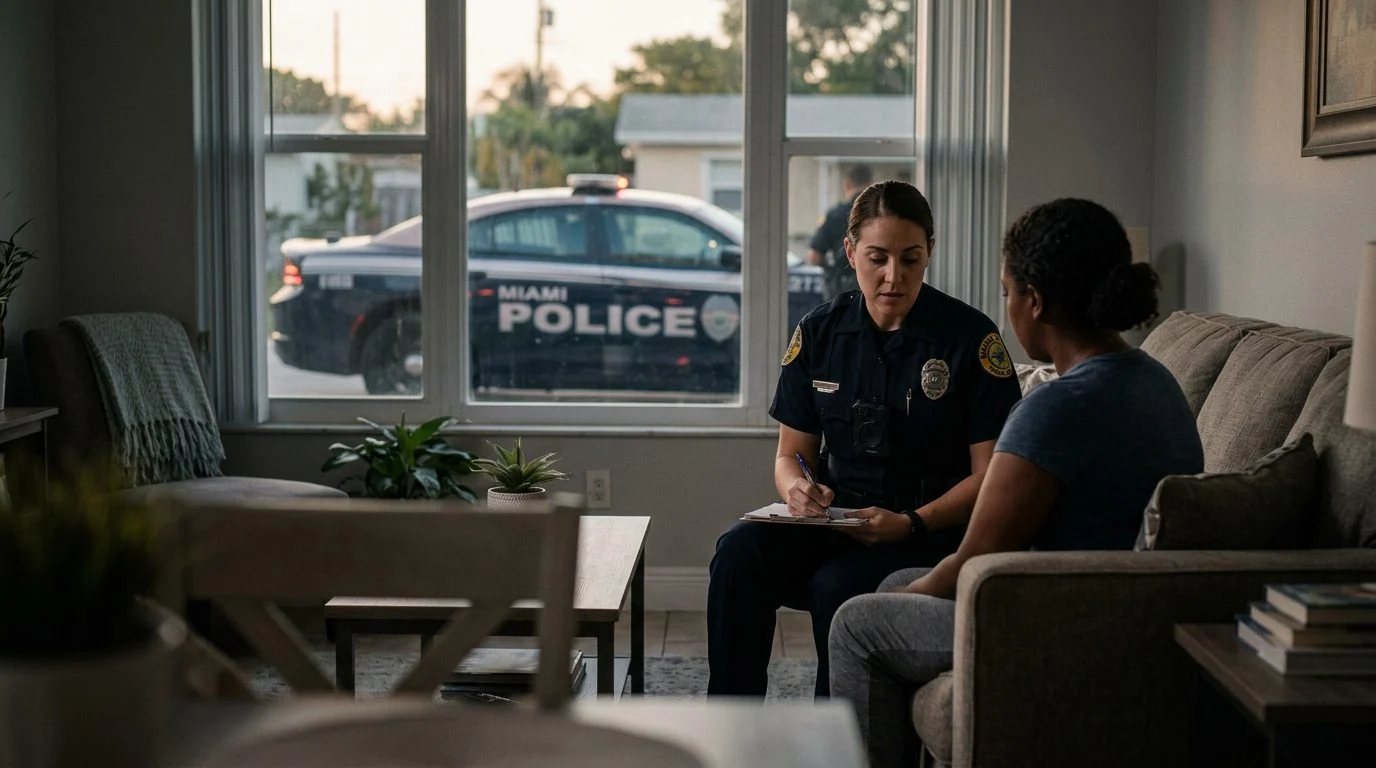
The officer’s decision happens at the scene. It is not a finding of guilt. No judge or jury has weighed the evidence yet. Even so, one call to police can lead to an arrest, even when the family says the argument is over.
If someone you love was just arrested, you don't have to work out the next steps alone; our team can talk it through in a free, confidential first consultation. Talk it through with our team — the first consultation is free, confidential, and carries no obligation.

What Counts as Domestic Violence Under Florida Law?
Domestic violence is a listed crime committed against a family or household member. Florida defines the term in § 741.28.
The list includes assault, battery, aggravated battery, sexual battery, stalking, kidnapping, and false imprisonment. It also covers any criminal offense that results in physical injury or death, when one family or household member harms another.
The “family or household member” label covers more people than most expect. It includes spouses, former spouses, relatives by blood or marriage, and people who are presently residing or have in the past resided together as a family in the same single dwelling unit, as well as parents of a child in common. It also covers parents of a child in common, even if they never married.
The relationship is what places a case under the domestic violence rules instead of a general assault case. Dating violence is a related but separate category under § 784.046.
What Probable Cause Means and Why the Bar Is Lower Than Proof
Probable cause means the officer has a reasonable basis to believe a crime happened and that this person did it.
Officers look at what they can see and hear. That includes injuries, statements from the people present, signs of damage, and other physical evidence. The officer does not need to prove the case before making an arrest.
An officer can have probable cause even when the two sides tell different stories. The conflict does not erase probable cause on its face. The dispute gets tested later, in court, with more evidence.
The statute also protects officers who act in good faith. Under § 741.29, an officer is not liable in a civil action for an arrest based on probable cause. The same section requires officers to help a victim get medical treatment when it is needed.
Why the Alleged Victim Can’t Simply Drop the Charges
Usually, no. Once police arrest someone, the decision to file, not file, or divert a domestic violence charge belongs to prosecutors. The statute says those decisions are made “over the objection of the victim, if necessary,” under § 741.2901.
The Legislature has said domestic violence should be treated “as a criminal act rather than a private matter.” Each circuit’s state attorney must also adopt a pro-prosecution policy for domestic violence acts.
Many families make this mistake. They believe a phone call to police can be undone by a later call to the police or the prosecutor. The complaining person’s wishes do not control the charging decision.
No-contact orders work differently. A judge can set them as a release condition.
How Officers Decide Who Is the Primary Aggressor
When two people both claim the other attacked, the officer must try to find the primary aggressor. The statute applies when two or more people may have committed an offense, or when two or more people make complaints to the officer.
The statute in § 741.29 says arrest is “the preferred response only with respect to the primary aggressor.” It is not the preferred response for a person who acts reasonably to defend themselves or another family or household member.
In practice, officers look at what they see and hear at the scene. That includes injuries, who said what, and what the situation looked like when they arrived.
People often assume the first person to call police is the one who gets arrested.
This judgment is made that night, on limited information. It can be challenged later with more evidence, such as photos, messages, or witness accounts.
What an Arrest Does and Does Not Mean
An arrest means the person is taken into custody. Formal charges are a separate step that comes later. It does not mean the person is guilty.
The accused can challenge the evidence, including the officer’s account.
Release is a separate question. Under § 903.046, the judge weighs the nature of the offense, family ties, the weight of the evidence, and the danger to victims.
Release conditions often include no contact. Under § 903.047, no contact can mean no calls, texts, or messages through others. It also means staying at least 500 feet from the victim’s or other named person’s residence, vehicle, place of employment, or a specified place frequented regularly by such person, even if you share the residence.
Breaking a condition creates a second problem. Under § 903.0471, a court may revoke pretrial release and order detention if it finds probable cause of a new crime or a material violation of a release condition.
Not sure what your next step is?
Talk it through with our team — the first consultation is free, confidential, and carries no obligation.
What Typically Happens After a Domestic Violence Arrest
After an arrest, the person must be brought before a judge within 24 hours, in person or by video. That is set by Fla. R. Crim. P. 3.130.
Under § 741.2901, before a defendant’s first appearance on any charge of domestic violence as defined in s. 741.28, the State Attorney’s Office must perform a thorough investigation of the defendant’s history. The judge must consider the victim’s safety when setting bail.
Formal charges come next. For a person in custody, the State must file formal charges within 30 days, under Fla. R. Crim. P. 3.134. The rule also says no one may stay in custody beyond 40 days without formal charges.
Each case depends on its facts. The details of the arrest shape what follows.
Does an arrest mean the person is guilty?
No. An arrest means the person was taken into custody; charges are a separate step. Except when previously released in a lawful manner, under Rule 3.130 every arrested person must be taken before a judge within 24 hours of arrest.
Can the alleged victim drop domestic violence charges in Florida?
Usually not on their own. Prosecutors decide whether to file or divert the case, even over the victim’s objection.
Can both people be arrested for domestic violence?
Florida policy strongly discourages arresting both parties for domestic violence or dating violence on each other. Officers try to identify the primary aggressor.
Do domestic violence charges require physical injury?

Talk to Patrick Wilson Law About a Domestic Violence Arrest in Miami
If someone you care about was arrested, you may be trying to understand what happens next while the situation feels out of your hands. You don’t have to sort it out alone.
Patrick Wilson Law, PLLC is a Miami criminal defense firm. Patrick David Wilson focuses on domestic violence defense across South Florida, from Broward County to the Keys. Our team supports the practice day to day.
Our first consultation is free, confidential, and carries no obligation to continue. Call 786-761-1719 or leave a message through our contact page to set up that conversation.
An Arrest Is Not a Conviction
Statements made at the scene or at the station can be used later in your case.
How Patrick Wilson Law Approaches a Domestic Violence Case
Criminal defense only
Patrick Wilson Law focuses on criminal defense, including domestic violence charges, DUI and sexual battery cases.
Confidential first consultation
Your free first consultation is confidential and carries no obligation to continue.
Clear explanation of the charge
We walk you through the arrest report, the charge and the steps ahead in plain language.
Serving South Florida
Our team represents clients in Miami, Miami Beach, Hialeah, Kendall, Homestead, Fort Lauderdale and the Florida Keys.
Common Questions About a Florida Domestic Violence Arrest
What is probable cause?
Each case turns on its own facts.
Can police arrest without a warrant?
Florida law allows an officer to arrest without a warrant when there is probable cause to believe domestic violence occurred.
What should I do next?
Patrick Wilson Law offers a free, confidential first consultation with no obligation to continue.

