
Seal & Expunge Criminal Records · Miami, Florida
Can a Cop See My Expunged Record?
Patrick Wilson Law, PLLC focuses on criminal defense across South Florida, including Miami-Dade, Broward County and the Florida Keys. Here is how expunged records work and what you should know.
By Patrick David Wilson · Published November 6, 2026
The Short Answer: Yes, in Some Situations
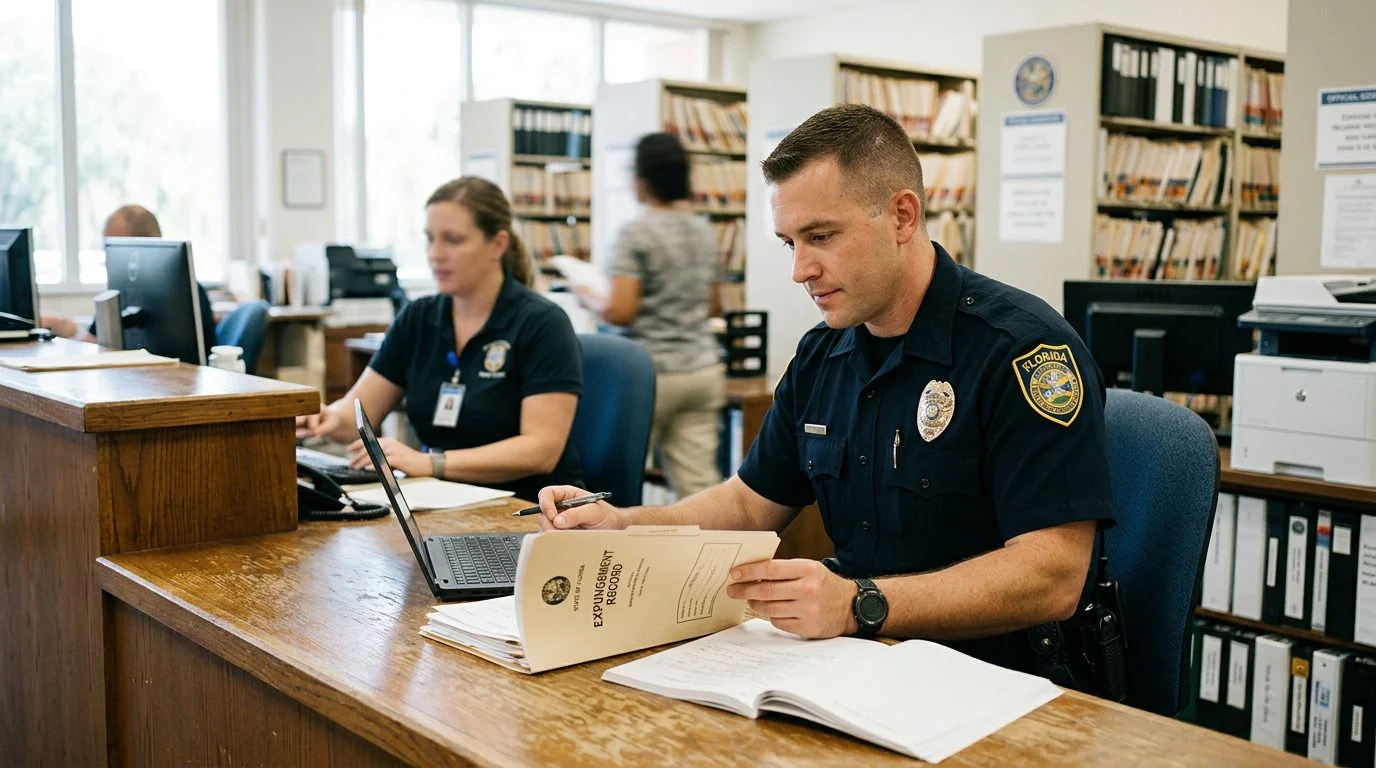
Yes, in some situations. Can a cop see my expunged record? Police can learn that an expunged record exists for their official work, but the public cannot see it. Expunction requires any criminal justice agency with custody of the record to physically destroy or obliterate it, except that the Department of Law Enforcement must retain it; that retained record is confidential and not available to any person or entity except upon court order. Fla. Stat. § 943.0585 sets out how that works.
Sealing is a different tool. The clerk of the court certifies copies of an expunction order to the state attorney or statewide prosecutor and the arresting agency, and the clerk’s removal of expunged entries from the court’s official records is set out in Fla. R. Crim. P. 3.692. Sealed entries stay with the court file in a nonpublic index, subject to further court order. Fla. R. Crim. P. 3.692 describes both steps.
If you’re asking for a family member or a friend, start with one question. Was the record expunged or sealed? The answer changes who can see it. Whether a particular record qualifies, and who can see it afterward, depends on the facts of the case.
If a record you thought was closed still shows up, you don't have to sort it out alone. We can talk through your situation in a free, confidential first consultation. Talk it through with our team — the first consultation is free, confidential, and carries no obligation.

Can a Police Officer See My Expunged Record?
Yes, certain criminal justice agencies can learn about an expunged record for their own official work. The law draws a clear line between government agencies and the public.
The Florida Department of Law Enforcement (FDLE) must keep any record it holds after an expunction order. That retained record is confidential. It is not available to anyone except on order of a court of competent jurisdiction. Fla. Stat. § 943.0585
The department must also disclose that an expunged record exists to criminal justice agencies. Fla. Stat. § 943.0585 reads: “It is unlawful for any employee of an entity set forth in subparagraph (b)1., subparagraph (b)4., subparagraph (b)5., subparagraph (b)6., subparagraph (b)7., subparagraph (b)8., or subparagraph (b)9. to disclose information relating to the existence of an expunged criminal history record of a person seeking employment, access authorization, or licensure with such entity or contractor, except to the person to whom the criminal history record relates or to persons having direct responsibility for employment, access authorization, or licensure decisions.” Under Fla. Stat. § 943.0585(6)(d), the department shall disclose the existence of a criminal history record ordered expunged to the entities listed in subparagraphs (b)1. and 4.-9. for their respective licensing, access authorization, and employment purposes, and to criminal justice agencies for their respective criminal justice purposes. and 4.-9. for their respective licensing, access authorization, and employment purposes and to criminal justice agencies for their respective criminal justice purposes.” It does this for their criminal justice purposes. So a police officer may learn the record exists.
Courts can reach the record too. Under § 943.0585(6)(a), an expunged record held by the department must be retained and remains confidential, and it is not available to any person or entity except upon order of a court of competent jurisdiction. Under Fla. Stat. § 943.0585, any criminal history record of a minor or an adult ordered expunged by a court of competent jurisdiction must be physically destroyed or obliterated by any criminal justice agency having custody of such record, except that any criminal history record in the custody of the department must be retained in all cases.
Expunction is also not automatic. The court can deny a request at its sole discretion.
Why an Expunged Record Can Still Appear Online or on a Background Check
A private website or background report can still show an old entry. Private services collect court and arrest information on their own schedules. Their copies may not change when a new court order is entered.
Timing matters. Under the expunction statute, the clerk certifies copies of the order.
A background check can search public sources. Sealed and expunged files are different. They are restricted under Florida law. Even sealed records remain open to criminal justice agencies. Fla. Stat. § 943.059
Age alone does not decide what a private report shows. Time passing does not remove every old entry from every database. Expect older listings to be the hardest to correct.
Special Situations: Immigration and Licensing
Non-citizens and licensed professionals should raise these concerns early, before a form or application asks.
Non-citizens face federal rules with their own track. Under federal immigration law, a non-citizen who is convicted after admission of a crime of domestic violence, stalking, or child abuse is deportable. The Attorney General may waive the domestic violence and stalking ground for someone who was battered or subjected to extreme cruelty, and who was not the primary perpetrator of violence in the relationship. How a Florida expunction fits into a federal immigration question needs individual review.
Licensed professionals should know that licensing and employment entities can learn of an expunged record. The department must disclose the record’s existence to listed entities for their licensing, access authorization, and employment purposes. It is unlawful for an employee of those entities to disclose information about the existence of an expunged record of a person seeking employment, access authorization, or licensure with that entity, except to that person or to people with direct responsibility for the decision. A person who violates this paragraph commits a misdemeanor of the first degree, punishable as provided in s. 775.082 or s. 775.083. Fla. Stat. § 943.0585
What an Expunged Record Does Not Erase
Expunction does not erase a record from every official eye. Some records can never be expunged or sealed.
Under s. 943.0584, a criminal history record is ineligible for a certificate of eligibility for expunction or sealing, or a court-ordered expunction or sealing, if the record is a conviction for assault or battery, as defined in ss. 784.011 and 784.03, respectively, of one family or household member by another family or household member, as defined in s. 741.28(3). Here a “conviction” includes a guilty finding at trial or a plea of guilty or nolo contendere, even if adjudication was withheld, and, if the defendant was a minor, a finding that the defendant committed or pled guilty or nolo contendere to committing a delinquent act, even if adjudication of delinquency was withheld. The full list of disqualifying offenses appears in the same section.
A form’s exact wording decides what you must disclose. Read each question carefully before you sign.

How to Check Whether a Record Was Expunged and What to Do Next
Start by gathering the case number, the charge, the final result, and the arresting agency. Those details help you find the court file and confirm what it says.
A petition needs a certificate of eligibility from FDLE and a sworn statement. The court may not order an agency to expunge or seal a record until the petitioner has applied for and received that certificate. Fla. R. Crim. P. 3.692 Look in the court file for a written order. The Polk County Clerk notes that FDLE oversees the application process.
You will usually pay for certified copies of court papers. The petitioner bears that cost unless the petitioner is indigent. Fla. R. Crim. P. 3.692
Patrick Wilson Law, PLLC is a Miami criminal defense firm. Patrick David Wilson is responsible for this page. Our team handles seal and expungement matters for people across Miami-Dade County, Broward County, Fort Lauderdale, and the Florida Keys. For more, see our seal and expunge criminal records page.
If a record you thought was closed still shows up, you don’t have to figure it out alone. Call 786-761-1719 or leave us a message. You’ll get a free, confidential first consultation with no obligation to continue.
Frequently Asked Questions
Can a cop see my expunged record?
Yes, criminal justice agencies can learn the record exists for their official purposes. The public cannot see it.
Does an expunged record show up on a background check?
It can. Private services may not update their copies when a court order is entered.
Does a felony show up on a background check after 20 years?
Age alone does not decide what a private report shows. Check the court file and the record’s status.
How can I tell if my record was expunged?
Look for a written court order and confirm the case number, charge, and result match the order.
What an Expunged Record Means in Practice
Criminal justice agencies can still see it
Law enforcement and other criminal justice agencies may learn that an expunged record exists for their official purposes.
The general public cannot
An expunged record is not meant to be available to employers, landlords or neighbors who are not authorized to see it.
Private background checks may differ
Private screening services may keep older copies of records and may not update them when a court order is entered.
Every case turns on its facts
How a record is treated depends on the charge, the court order and the agencies involved. A confidential review of your file is the most reliable starting point.
Important Reminder
Expunction and sealing are different processes with different effects. Do not assume a record is gone from every database or every agency until you have reviewed your court paperwork.
Questions Clients Ask Us
Can a cop see my expunged record?
Yes, for official criminal justice purposes. The general public should not be able to see it through ordinary channels.
Will it show up on a background check?
It can. Some private services keep their own copies and may not update them after a court order.
Does a felony show up the same way?
Felony and misdemeanor records can be treated differently. The charge, the disposition and the court order all matter.
Should I talk to a lawyer first?
Yes. Reviewing your case before you apply helps you understand what your records show and what steps make sense.

