
Miami Criminal Defense | Miami-Dade, Broward and the Keys
Florida Expungement Petitions for Licensed Professionals
An old arrest can still follow a nurse, engineer, or contractor long after the case closed. Patrick Wilson Law reviews your record and explains which relief may be available before anything is filed.
By Patrick David Wilson · Published November 18, 2026
If an old arrest or charge now touches your license, you’re probably asking whether a court can clear it. In Florida, you can ask a court to seal or expunge a record, but only when the record meets the state’s eligibility rules. Relief limits who can see the record. It does not erase every question a licensing board may ask.
This page explains how the petition works, which records qualify, and what to check before you file.
What a Florida Sealing or Expungement Petition Is
A sealing or expungement petition is a written request asking a Florida court to limit access to a criminal history record. The two forms of relief work differently.
Expungement goes further. Under Fla. Stat. § 943.0585, an expunged record must be physically destroyed or obliterated by the agencies that hold it. Fla. Stat. § 943.0585 reads: “(6) EFFECT OF EXPUNCTION ORDER.— (a) Any criminal history record of a minor or an adult which is ordered expunged by a court of competent jurisdiction pursuant to this section must be physically destroyed or obliterated by any criminal justice agency having custody of such record, except that any criminal history record in the custody of the department must be retained in all cases.” The Florida Department of Law Enforcement (FDLE) keeps its copy, and that copy stays confidential.
Sealing hides the record from the public. Once a court seals a criminal history record, the record is confidential and available only to the persons the law lists. FDLE can still share it with certain licensing and employment entities.
Before petitioning a court to expunge a criminal history record, you must apply to FDLE for a certificate of eligibility. Under the expunction statute, Fla. Stat. § 943.0585, a certificate of eligibility for expunction is valid for 12 months after the date stamped on it. Fla. R. Crim. P. 3.692 requires the petition to include a valid certificate and a sworn statement. The court may deny the request at its sole discretion.
If an old arrest or charge is now touching your license or a family member's, we're glad to talk it through with you, and you don't have to sort it out alone. Talk it through with our team — the first consultation is free, confidential, and carries no obligation.
Who This Petition Is For: Licensed Professionals
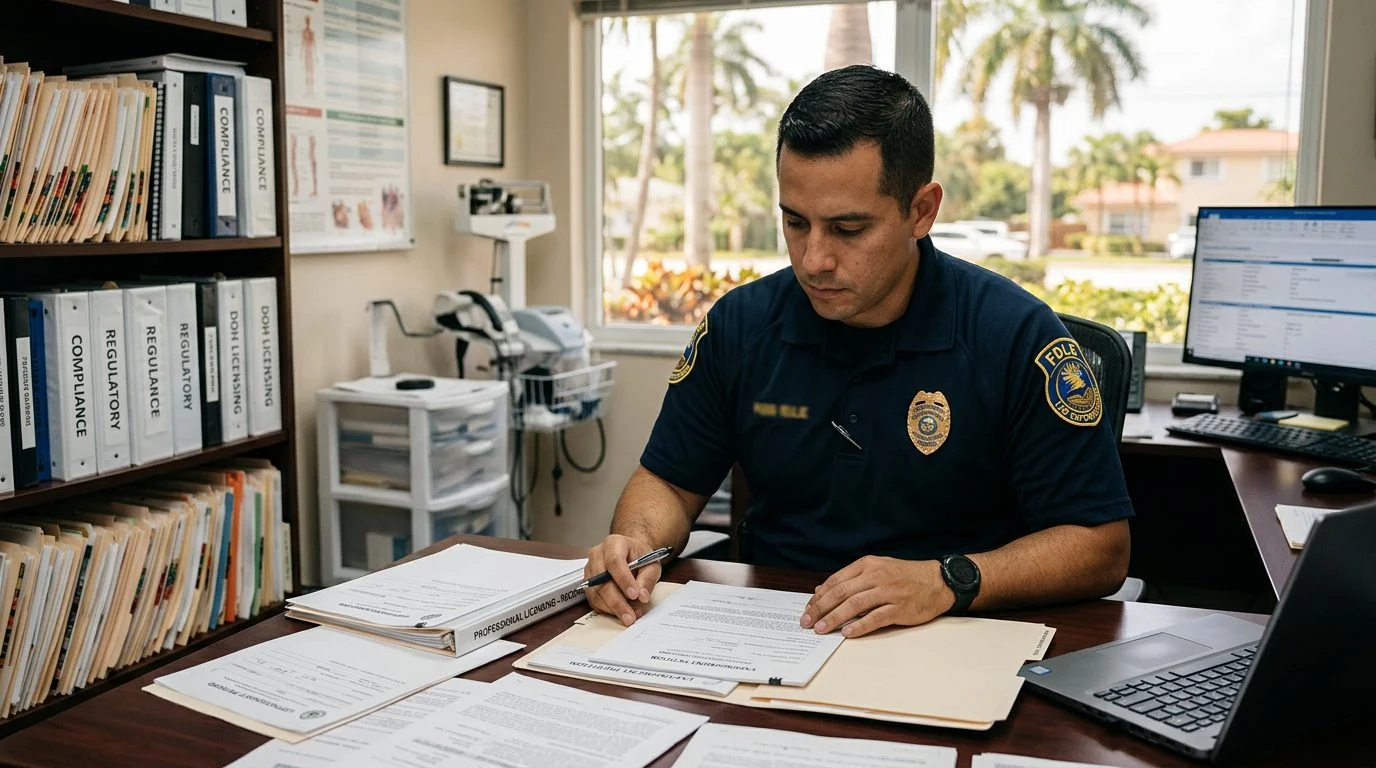
This petition fits licensed professionals whose record could come up on a license application, a renewal, or a board inquiry. That includes nurses, teachers, real estate agents, contractors, and other licensed workers.
The decisions in front of you usually include:
- Whether to petition now or first confirm what the record shows.
- How a past or pending arrest affects license questions.
- How to answer each application truthfully.
Failing to report matters. Under Fla. Stat. § 455.227, a licensee who fails to report in writing to the board, or to the department if there is no board, within 30 days after a conviction, guilty finding, or plea is subject to discipline. The statute applies that duty “regardless of adjudication.”
Withheld adjudication is not a shield. Under Fla. Stat. § 943.0584, a “conviction” includes a guilty plea or trial finding, even when adjudication is withheld.
Some records cannot be sealed or expunged at all. The same statute bars relief for certain convictions. These include chapter 794 sexual battery offenses, homicide offenses such as vehicular homicide under § 782.071, which defines it as the killing of a human being, or the killing of an unborn child by any injury to the mother, caused by the operation of a motor vehicle by another in a reckless manner likely to cause the death of, or great bodily harm to, another, and some family-violence batteries.
First-time status alone does not decide eligibility. The charge, how the case ended, and any earlier sealing all matter.
What the Service Covers
The service covers the eligibility review, the FDLE application, the court petition, and follow-through with the agencies named in the court’s order.
- Review of the charge and outcome. We look at whether the case ended in dismissal, nolle prosequi, a not guilty verdict, an acquittal, or a conviction.
- Automatic sealing check. Under Fla. Stat. § 943.0595, FDLE must seal some records automatically. Some records may not need a petition at all.
- FDLE application support. We help prepare the certificate of eligibility application and supporting papers.
- Petition filing. We prepare the petition and sworn statement, file them with the clerk, and serve the prosecutor and arresting agency.
- Order review. We explain what the court order changes, what it does not change, and how to answer license questions afterward.
- Costs. Under Fla. R. Crim. P. 3.692, you pay for certified copies unless you are indigent. We explain every cost you may owe in writing before work begins.
How the Process Works: Step by Step
The process has five steps, from record review to the court’s written order.
- Review. We review the charge, the case outcome, your prior record, and the licensing question.
- Gather records. You collect certified court dispositions, arrest records, and identity documents.
- Apply to FDLE. FDLE issues the certificate of eligibility. If it expires before you file, you must reapply.
- File the petition. The petition, sworn statement, and certificate go to the clerk. The prosecutor and arresting agency receive copies.
- Response and order. The prosecutor and arresting agency may respond, and the court may take evidence. If the court grants relief, the clerk certifies copies of the order to the state attorney or statewide prosecutor and the arresting agency, and to any other agency the court’s records show received the record.
Timing depends on court and agency schedules. We review the likely timeline at the consultation, without promising a date.
Why Work With Patrick Wilson Law
Patrick Wilson Law, PLLC is a Miami criminal defense firm. It concentrates in DUI, domestic violence, sexual battery, vehicular homicide, white collar, and record relief matters, including criminal defense for licensed professionals.
The firm serves clients across South Florida, from Broward County to the Florida Keys, including Miami-Dade, Kendall, Hialeah, Miami Beach, and Homestead.
Patrick David Wilson is the lawyer responsible for this page. He is one of the firm’s lawyers. The firm’s lawyers include Patrick David Wilson and Sahara Fonseca.
Our team includes assistants and office staff who help gather documents. The firm’s lawyers make the legal decisions on each matter.
We look at the licensing risk before you file. A wrong answer on a form can create its own problem. Under Fla. Stat. § 455.227, a licensee who makes a report the licensee knows to be false, or who makes misleading representations in or related to the practice of the licensee’s profession, is subject to discipline.
Questions People Ask About Florida Record Relief
Most answers come down to the charge, how the case ended, and your prior record.
How can I get a misdemeanor off my record in Florida?
Start with how the case ended and your prior record. If the record qualifies, you can petition after you get the FDLE certificate. Under Fla. Stat. § 775.08, a noncriminal traffic violation is not a misdemeanor.
What is better, sealed or expunged?
Expungement goes further, but which one fits depends on the facts. Sealing keeps the record on file, and certain licensing entities can still see it.
Will a sealed record still show up on a license application?
Applications may still ask about arrests or charges. Answer each question as worded and match your court order.
Are some offenses ineligible?
Yes. Certain convictions bar relief under Florida law, including chapter 794 sexual battery offenses and some homicide and family-violence convictions.
Do I need a lawyer to file?
The petition requires a certificate and a sworn statement. Our firm prepares those steps for clients who retain us.
Not sure what your next step is?
Talk it through with our team — the first consultation is free, confidential, and carries no obligation.
Talk to Our Team About Your Record and Your License
You may be reading this about an old arrest that now affects a license, a renewal, or a board question. It may even be a spouse’s or relative’s record. Either way, you don’t have to work through it alone.
Call 786-761-1719, or leave us a message through our contact page. We will review the record, the case outcome, and the licensing question with you.
The first consultation is free, confidential, and carries no obligation to continue.
La consulta inicial es gratuita, confidencial y sin compromiso de continuar.
This page is handled by Patrick David Wilson, a lawyer with Patrick Wilson Law, PLLC, in Miami, Florida. Esta página la gestiona Patrick David Wilson, abogado de Patrick Wilson Law, PLLC, en Miami, Florida.
How we approach professional clients
Confidential review
Your record and your career are private matters. We treat both with discretion from the first call.
Close reading of the file
We review the charging documents, the case outcome, and your prior record to see which options fit your situation.
Plain-language answers
We explain the difference between sealing and expunging, what the petition involves, and what a licensing board may ask.
Direct communication
You will know who is handling your file and how to reach them. Our team keeps you informed at each step.
Do not assume the record is gone
Many professionals believe an arrest disappears on its own. Whether a record can be sealed or expunged depends on how the case ended and what is on file. Have your record reviewed before you answer a licensing or employment question.
Common questions from licensed professionals
Sealing or expunging: which fits?
Which one applies depends on how the case ended and on your prior record.
Licensing boards and employers
A board or employer may ask about arrests even after a record is sealed or expunged. We help you prepare accurate, consistent answers.
Handling the state paperwork
The petition process runs through Florida state agencies and requires specific documents and fees. Our team organizes the paperwork and tracks each step with you.
Starting with a free consultation
Bring your charging papers and any court documents you have. We will review them with you and explain your options.

