

Criminal Defense | Miami-Dade County
Clearing a Misdemeanor Record in Miami-Dade, Step by Step
A practical look at the paperwork, the agencies involved, and the points where a sealing or expungement request tends to stall.
By Patrick David Wilson · Published November 10, 2026
A misdemeanor arrest can show up on background checks for years, even after the case is closed. In Florida, expunging a misdemeanor means asking a court to order the record removed, and the process starts with a state certificate and a written petition.
Eligibility is the first step, but it doesn’t end the question. Even a qualified person still needs the court to grant the petition, and the court has the final say.
What Does Expunging a Misdemeanor Arrest in Miami-Dade Mean?
Whether a misdemeanor record can be sealed or expunged depends on the facts of each case, so a free, confidential initial consultation is a practical first step to learn your options. Under Fla. Stat. § 943.0585, a criminal justice agency that holds an expunged record must physically destroy or obliterate it, except that the Florida Department of Law Enforcement must retain its copy in all cases.
The Florida Department of Law Enforcement (FDLE) is one exception, since it must retain its copy in all cases, and a criminal justice agency may also keep a notation that it complied with an order to expunge. FDLE keeps its copy, and that copy is confidential and generally available only by court order. However, FDLE must still disclose that an expunged record exists to certain entities for their licensing, access authorization and employment purposes, and to criminal justice agencies for criminal justice purposes.
Sealing is a different remedy. Knowing which one fits your case shapes the whole plan.
An arrest can sit in several places at once. FDLE holds state records, the Miami-Dade clerk holds the court file, and the arresting police agency keeps its own files. If relief is granted, the clerk must certify copies of the order to the State Attorney and the arresting agency. The arresting agency must then forward the order to any other agency it shared the record with. That is why the process has several parts.
If a misdemeanor arrest still shows up on your background check and you're not sure where the case stands, we can review the file with you and talk through your options. Talk it through with our team — the first consultation is free, confidential, and carries no obligation.
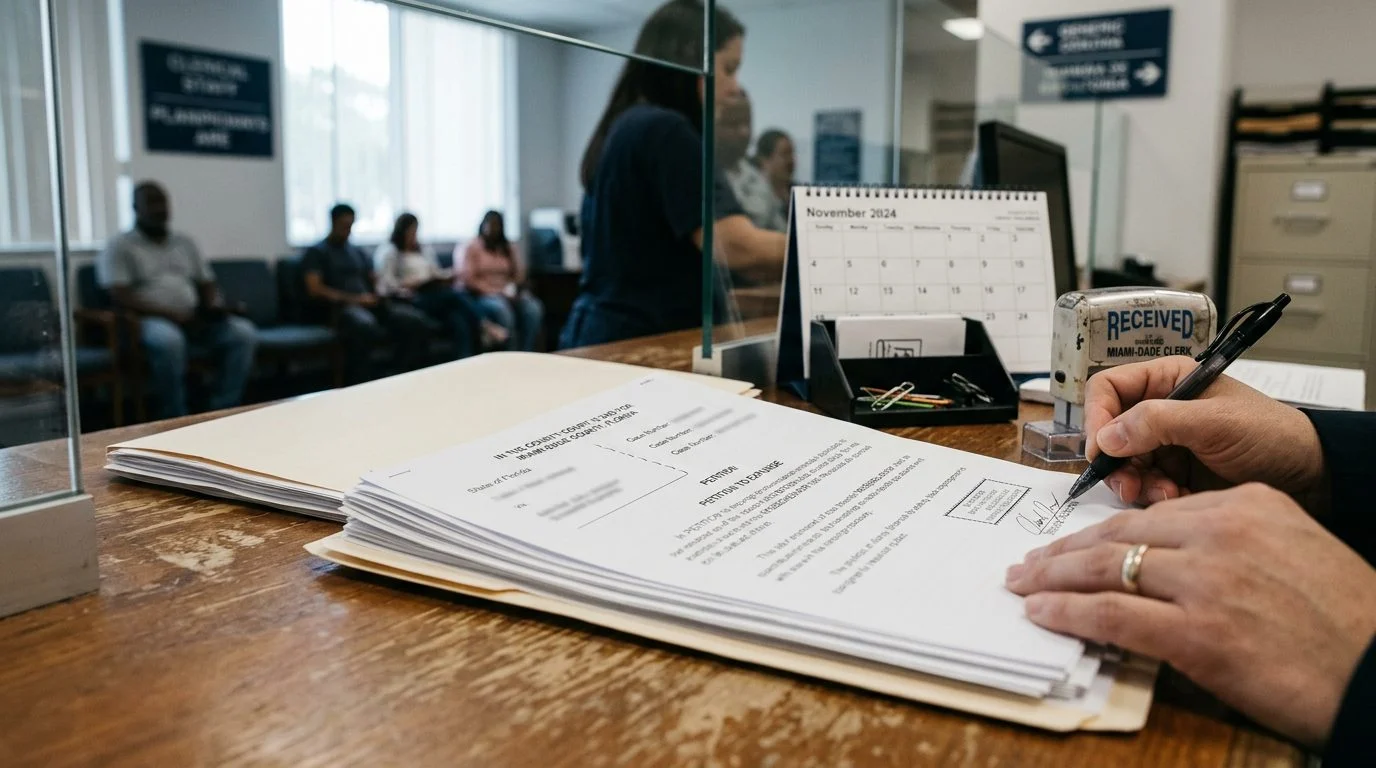
Checking Eligibility Before You File
You can petition to expunge when no charging document was ever filed, but you must also meet the other eligibility conditions set out in the statute. You can also petition when a filed charge was dismissed, dropped by the State Attorney (nolle prosequi), ended in a judgment of acquittal, or ended in a not-guilty verdict, according to Fla. Stat. § 943.0585.
Withheld adjudication can raise separate questions for first-time offenders. For eligibility rules, a prior court-ordered sealing obtained because adjudication was withheld must have lasted a minimum of 10 years, unless no plea was entered or all charges related to the arrest or alleged criminal activity were dismissed before trial, or a judgment of acquittal or a not-guilty verdict was rendered. Fla. Stat. § 943.0584 makes some convictions ineligible, including assault or battery of one family or household member by another. A domestic-related charge deserves a close look before you file.
Before you file, know that a criminal history record of a listed conviction is ineligible for a certificate of eligibility for expunction or a court-ordered expunction. Fla. R. Crim. P. 3.692 requires that certificate with every petition. The court may not order an agency to expunge a record until you have received it.
Review the full file first. Check each charge, each disposition, and each date. Any prior sealing can also change the answer. Gaps at this stage can lead to rejected or denied applications.
Step-by-Step: From Certificate to Court Order
You obtain the FDLE certificate of eligibility first, then file a written petition with the clerk, then the court decides. Each step builds on the one before it.
- Get the FDLE certificate. A certificate of eligibility from FDLE is required before you file anything with the court, as FDLE’s seal and expunge process describes.
- Collect certified copies. Gather certified copies of the court dispositions. You bear the cost of certified copies unless you are indigent, under Fla. R. Crim. P. 3.692.
- File the petition. File a written petition with the clerk. Include the certificate and a sworn statement that you meet the eligibility rules and have no other petition pending.
- Serve the State. Your petition and sworn statement must be served on the prosecuting attorney and the arresting authority. They may respond, and the court may take evidence on any factual question.
- Await the ruling. The court may deny the request in its sole discretion. If it grants relief, it signs a written order.
- Clear the records. The clerk certifies the order to the agencies named in it and removes the entries from the court’s official records, or seals them in a nonpublic index.
Agencies and Courts Involved in Miami-Dade
Each one has a specific job in the process.
FDLE issues the certificate of eligibility and keeps the state’s record. Once an order is entered, FDLE forwards it to the Federal Bureau of Investigation, according to Fla. Stat. § 943.0585.
The Miami-Dade Clerk of the Court receives the petition, certifies orders, and updates the court file. The Eleventh Judicial Circuit’s court handles any hearing.
The State Attorney for the Eleventh Judicial Circuit receives a copy of the petition and may respond to it.
The arresting agency is the police department that made the arrest, such as the Miami-Dade Police Department or a city department. It holds its own arrest records and must forward the order to any other agency it shared the record with.
The exact list of recipients depends on which agencies appear in your case file. The clerk must notify any agency the court records show received the record.
Costs to Expect: Court, Agency, and Attorney Fees
Expect three separate kinds of cost: court and certified-copy charges, FDLE and other agency charges, and attorney fees. Each one is billed differently, so keep them apart when you compare numbers.
Certified copies are the court-side cost you should plan for. Under Fla. R. Crim. P. 3.692, the petitioner pays for certified copies unless the petitioner is indigent.
Ask for each category listed on its own line before you agree to anything. A written breakdown makes it easier to see what you owe to whom.
Patrick Wilson Law offers a free, confidential first consultation with no obligation to continue.
Common Causes of Delay in a Miami-Dade Expunction
Delays can stem from paperwork or from court scheduling. Missing records, mismatched details, and filing errors can cause restarts.
Missing dispositions slow the process.
Mismatched details cause returned paperwork. A name or date that doesn’t match across the FDLE, court, and agency records can stall a filing.
The certificate comes first. The court cannot act until you have the FDLE certificate, so that wait sets the pace for everything after it.
Court timing can add time to the process. The judge may take evidence on factual issues, and a hearing may be set. Under Fla. R. Crim. P. 3.050, a court may extend a deadline for good cause if the request comes before the deadline expires, or, upon motion and notice after it expires, permit the act to be done when the failure to act was the result of excusable neglect; it may not extend time for a new trial motion, an appeal, or a judgment of acquittal motion except as provided by statute or elsewhere in the rules.
Agency updates take time. The order moves from the clerk to the arresting agency and then to FDLE and the FBI.
Errors in the petition restart the clock. A missing sworn statement or a pending petition can lead to rejection. A court may order a criminal justice agency to seal a record only after the petitioner has applied for and received a certificate of eligibility under Fla. Stat. § 943.059.
Not sure what your next step is?
Talk it through with our team — the first consultation is free, confidential, and carries no obligation.

Does a Misdemeanor Arrest on Your Record Qualify? Talk With Patrick David Wilson
Whether your arrest qualifies depends on how your case ended and what else is in your record. Patrick David Wilson is the responsible lawyer for this page, and Patrick Wilson Law, PLLC is a Miami criminal defense firm that serves clients across South Florida.
Do I need an FDLE certificate before I file?
Yes. Fla. R. Crim. P. 3.692 requires a valid certificate of eligibility with every petition.
Does a withheld adjudication disqualify me?
It can. Florida counts a withheld adjudication as a conviction for eligibility rules, so the offense matters. Review the file before you assume you qualify.
Does the FBI remove the record?
The FBI does not act on its own. FDLE forwards the expunction order to the FBI under Fla. Stat. § 943.0585.
Is a no-charge arrest sealed automatically?
Some are. Under Fla. Stat. § 943.0595, the department must automatically seal certain records, such as those with no charging document filed.
If you are unsure where your arrest stands, call 786-761-1719 or send a message through our contact page. We will review your case file and the next steps with you during a free, confidential first consultation, with no obligation to continue.
How Patrick Wilson Law Approaches Record Relief
Early file review
Our team starts by reviewing the court docket and charging documents to identify anything that could affect eligibility before a petition is prepared.
Focus on first-time offenders
Patrick Wilson Law focuses on criminal defense for first-time offenders, including people seeking to seal or expunge a past record.
Clear communication
We explain each stage of the process in plain language so you know what is needed from you and what to expect next.
Planning around your career
For licensed professionals and workers whose jobs depend on a clean background, we consider how a record may affect their work.
Do not file on assumptions
A record that looks minor can still raise eligibility questions. Have the full file reviewed before you submit a petition or pay any filing fees.
Where Misdemeanor Expungements Usually Slow Down
Incomplete court records
Missing dispositions, sealed portions of a file, or case numbers that do not match across agencies often require follow-up before a judge can act.
Agency and court scheduling
Clerks, state agencies, and court calendars each run on their own timing, so a petition can wait in line even when it is complete.
Responses and hearings
The state may respond to a petition, and a hearing may be set. Preparing for those steps early keeps the matter moving.

