
Seal & Expunge | Miami, Broward & South Florida
Moving Past a Battery Arrest Starts With the Right Record Plan
Patrick Wilson Law helps clients across South Florida pursue sealing or expungement of a battery arrest, with clear answers about what comes next.
By Patrick David Wilson · Published November 18, 2026
A battery arrest can stay on your record long after the case is over. In Florida, a battery record can sometimes be sealed or expunged, but only when the case ended in a way the law allows, and only through a court petition.
This page explains how to seal a battery record in Florida, the steps involved, and the limits that apply.
What Sealing and Expunging a Battery Arrest Means in Florida
Sealing and expunging both limit who can see a criminal record.
Expunction is covered by Fla. Stat. § 943.0585. The rule is Fla. R. Crim. P. 3.692.
Sealing is covered by Fla. Stat. § 943.059. A sealed record is confidential and generally hidden from the public, but some agencies can still see it.
Sealing and expunction are not automatic for every arrest. Florida does have an automatic sealing rule for certain non-conviction records under Fla. Stat. § 943.0595.
Which remedy fits depends on how the case ended. Find the final result on the court paperwork first. That result shapes every later step.
A battery arrest can follow you long after the case ends, and you don't have to sort out the sealing process alone. Our team is ready to talk it through with you. Talk it through with our team — the first consultation is free, confidential, and carries no obligation.
Battery vs. Assault: How Serious Is a Battery Charge?
A basic battery charge is generally a first-degree misdemeanor in Florida. That is more serious than simple assault, which is a second-degree misdemeanor.
Battery happens when a person actually and intentionally touches or strikes another person against that person’s will, or intentionally causes bodily harm. See Fla. Stat. § 784.03. A first-degree misdemeanor can bring up to 1 year in jail under Fla. Stat. § 775.082. The base fine for a first-degree misdemeanor can reach $1,000 under Fla. Stat. § 775.083, but a higher amount is possible, such as double the pecuniary gain or loss, or any higher amount specifically authorized by statute.
Simple assault is an intentional threat, with an apparent ability to carry it out, that creates a well-founded fear of violence. It is a second-degree misdemeanor under Fla. Stat. § 784.011. That carries up to 60 days in jail.
Aggravated battery is a different and more serious charge. It applies when a person causes great bodily harm, permanent disability, or permanent disfigurement, or uses a deadly weapon. It is a second-degree felony under Fla. Stat. § 784.045.
A repeat battery can raise the level. Under Section 784.03(2), a person who has one prior conviction for battery, aggravated battery, felony battery or resisting an officer with violence under s. 843.01 and who commits any second or subsequent battery commits a felony of the third degree, and for this purpose a ‘conviction’ means a determination of guilt by plea or trial, even if adjudication is withheld or a plea of nolo contendere is entered.
Who Qualifies to Seal or Expunge a Battery Arrest
A battery arrest may qualify when the case ended without a conviction. Common examples include a dismissal, a nolle prosequi (a prosecutor’s formal decision to drop the charge), or a not guilty verdict.
- No charge filed. Expunction may be available when no charging document was ever filed in the case (Fla. Stat. § 943.0585).
- Withheld adjudication still counts as a conviction here. Florida’s ineligibility statute says a conviction includes a guilt finding even when adjudication is withheld (Fla. Stat. § 943.0584).
- Some battery cases are ruled out. The list in Fla. Stat. § 943.0584 applies only to convictions, and a conviction includes a plea of guilty or nolo contendere even when adjudication is withheld. A record of a conviction for battery of one family or household member by another, or for felony battery, is ineligible for sealing or expunction under that section. A dropped or dismissed charge is not a conviction under this list.
- An expunction petition requires that you have never been adjudicated guilty in Florida of any criminal offense, or been adjudicated delinquent in Florida for a felony or certain listed misdemeanors, including assault, unless that delinquency record has been expunged under s. 943.0515 (Fla. Stat. § 943.0585).
- One arrest at a time. A court may order relief for one arrest or one incident. Additional arrests count only if they directly relate and the order says so.
Whether a particular case qualifies depends on the facts in the case file, not only the charge name.
Before you start, gather the case number, the arrest date, and the final order or dismissal paperwork.
How to Seal or Expunge a Battery Record in Florida: Step by Step
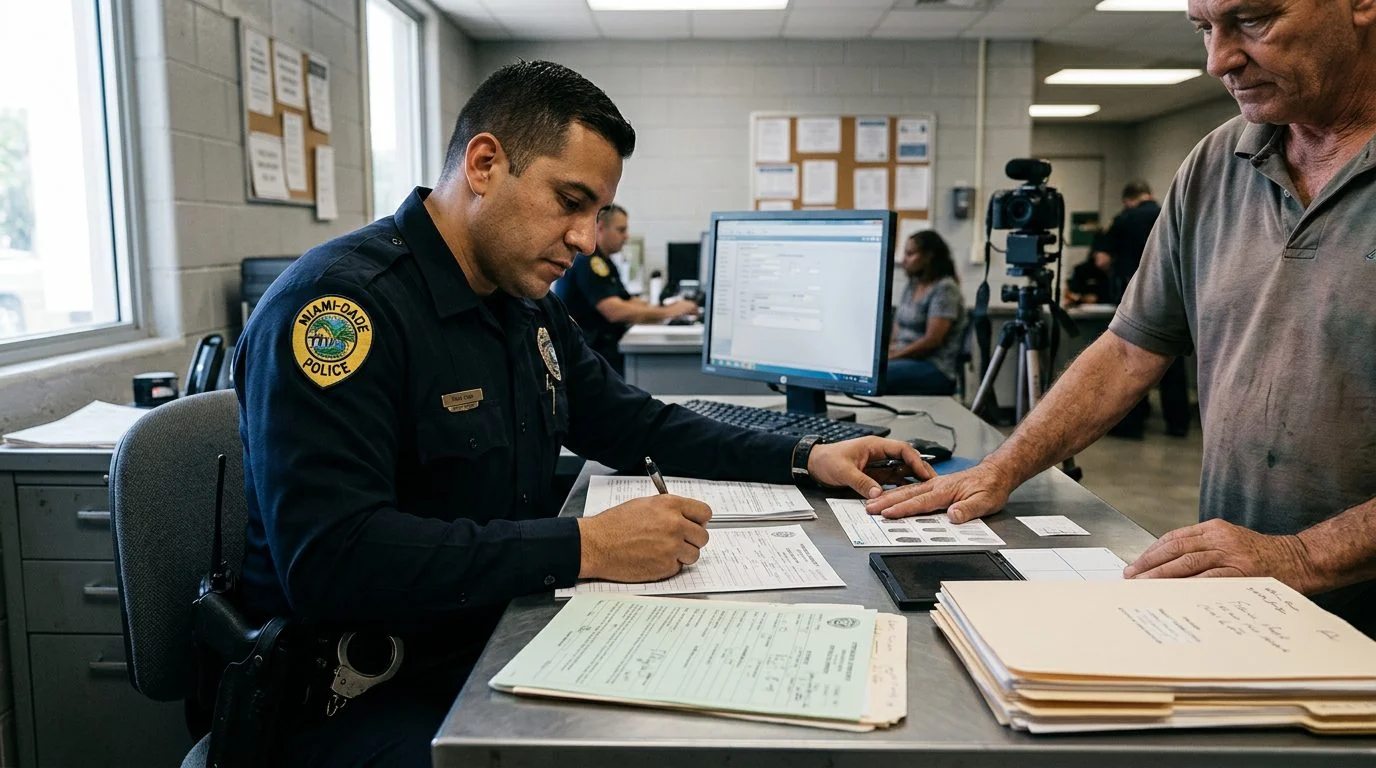
The process runs in order. You get a state eligibility certificate first, then you file a sworn court petition.
- Confirm the case has ended. Eligibility turns on the final result, so the case must be resolved.
- Apply to the Florida Department of Law Enforcement (FDLE) for a Certificate of Eligibility. A sealing petition requires this certificate first (Fla. Stat. § 943.059). The court cannot order an agency to act until you have it (Fla. R. Crim. P. 3.692).
- File a written petition with the clerk of court. Attach the FDLE certificate and a sworn statement. The statement says you meet the eligibility rules and have no other petition pending.
- Serve the petition. Give copies to the prosecuting attorney and the arresting agency. They may respond, and the court may take evidence on any factual issue.
- Wait for the court’s ruling. The court decides, and it can deny a request at its sole discretion. If granted, the court signs a written order listing the records and agencies it covers.
- Pay for certified copies. You bear the cost unless you qualify as indigent.
The rules do not set one fixed timeline. Each step moves at the pace of the court calendar and agency processing.
What the Petition Covers and Who Can Still See a Sealed Record
A sealed record stays hidden from the public, but some government and licensing bodies can still see it. The order also goes to other agencies that hold the record.
Under Fla. Stat. § 943.059, the state can still share a sealed record with listed licensing, access authorization, and employment entities. Employees of those entities who disclose information about the existence of a sealed record of a person seeking employment, access authorization, or licensure with that entity, except to the person it relates to or to those with direct responsibility for employment, access authorization, or licensure decisions, commit a first-degree misdemeanor.
After a court grants relief, the clerk sends certified copies of the order to the state attorney and the arresting agency.
For licensing and employment purposes, the department shall disclose the sealed criminal history record to the entities set forth in the statute, which is a different disclosure rule from expunction. Fla. Stat. § 943.059 reads: “An employee of an entity set forth in subparagraph (b)1., subparagraph (b)4., subparagraph (b)5., subparagraph (b)6., subparagraph (b)8., subparagraph (b)9., subparagraph (b)10., or subparagraph (b)11. may not disclose information relating to the existence of a sealed criminal history record of a person seeking employment, access authorization, or licensure with such entity or contractor, except to the person to whom the criminal history record relates or to persons having direct responsibility for employment, access authorization, or licensure decisions.” The state can still disclose that an expunged record exists to listed entities for those purposes (Fla. Stat. § 943.0585). Fla. Stat. § 943.0585 reads: “It is unlawful for any employee of an entity set forth in subparagraph (b)1., subparagraph (b)4., subparagraph (b)5., subparagraph (b)6., subparagraph (b)7., subparagraph (b)8., or subparagraph (b)9. to disclose information relating to the existence of an expunged criminal history record of a person seeking employment, access authorization, or licensure with such entity or contractor, except to the person to whom the criminal history record relates or to persons having direct responsibility for employment, access authorization, or licensure decisions.”
Why Work with Patrick Wilson Law on a Battery Record
Patrick Wilson Law is a Miami criminal defense firm. It lists sealing and expunging criminal records among its services and serves clients from Broward County to the Florida Keys.
The firm focuses its criminal defense work on DUI, domestic violence, sexual battery, vehicular homicide, and related charges. It works with first-time offenders and with licensed professionals whose careers are on the line.
Patrick David Wilson is the responsible lawyer for this page. The firm’s lawyers include Patrick David Wilson and Sahara Fonseca, and the firm’s assistants and office staff support their work.
The firm reviews the case result and the eligibility questions before a petition is filed. That way you know what a petition can and cannot accomplish for your record.
The firm cannot promise how a court will rule on any petition, because the court decides each one on its own record. The initial consultation is free, confidential, and carries no obligation to continue.
Not sure what your next step is?
Talk it through with our team — the first consultation is free, confidential, and carries no obligation.
Frequently Asked Questions About Sealing a Battery Arrest
How do I seal my record in Florida?
Get a Certificate of Eligibility from FDLE first. Then file a sworn petition with the clerk of court, and the court decides whether to grant it.
Is battery a misdemeanor in Florida?
Yes, basic battery is generally a first-degree misdemeanor under Section 784.03.
Is battery more serious than assault?
Generally, yes. Battery is a first-degree misdemeanor, while simple assault is a second-degree misdemeanor.
How serious is a charge of battery?
A first-degree misdemeanor can bring up to 1 year in jail and a fine up to $1,000. Aggravated battery is a second-degree felony.
Can a battery arrest be sealed if the charges were dropped?
A dismissed case or a nolle prosequi is one of the endings the statutes cover. The court still decides whether to grant the petition.
Can employers see a sealed battery record?
A sealed record is generally unavailable to the public. Listed licensing and employment entities can still see it.
If a battery arrest still follows you and you’re unsure whether it can be sealed, you don’t have to work through the steps alone. Call 786-761-1719 or schedule a free consultation with Patrick Wilson Law.
What to expect when you contact our office
Confidential first call
Your first consultation is free, confidential and carries no obligation to continue.
Review of your record
We look at the charge, how the case ended and what paperwork your situation requires before recommending a path forward.
Plain-language guidance
Our team explains each step of the petition process in terms you can use when making decisions about work, housing and school.
Serving South Florida
Patrick Wilson Law represents clients in Miami-Dade, Broward County, Fort Lauderdale, Kendall, Hialeah, Miami Beach, Homestead and the Florida Keys.
Don't assume the arrest is off your record
An arrest or charge can still appear on background checks for employers, landlords and licensing boards after the case has ended. Speak with a lawyer before you assume the record is gone.
How the sealing or expungement process generally works
1. Gather your case information
Collect the arrest report, court papers and final disposition so the petition reflects your case accurately.
2. Request your Certificate of Eligibility
The Florida Department of Law Enforcement (FDLE) issues the certificate that is required before a petition can be filed.
3. File a sworn petition
The petition is filed with the clerk of court in the county where the case was handled, with the required supporting documents.
4. Court review
The judge reviews the petition and decides whether to grant it. We prepare you for each step and explain what to expect.

