
Seal and Expunge Criminal Records | Miami-Dade and Broward
A Signed Sealing Order Starts the Next Phase, Not the Finish
Here is how the order moves through the court, prosecutors and agencies, and what to check once it reaches them.
By Patrick David Wilson · Published November 19, 2026
You have a judge’s sealing order, or you’re waiting on one, and you want to know what comes next. The steps after the signature are easy to overlook.
This guide walks through each step in plain English. It relies on Florida’s sealing statute, the court rule for petitions, and guidance from the state agency that tracks these records.
What a Signed Sealing Order Means in Florida
A signed sealing order makes a criminal history record confidential, but the record still exists. Under Florida Statute § 943.059, a sealed record is available only to the subject of the record and to certain listed persons.
Sealing is not the same as expunging. Sealing falls under § 943.059. Expunction falls under Florida Statute § 943.0585. An expunged record must be physically destroyed or obliterated by the criminal justice agencies that hold it, except that the state keeps its own copy. Fla. Stat. § 943.0585 reads: “(6) EFFECT OF EXPUNCTION ORDER.— (a) Any criminal history record of a minor or an adult which is ordered expunged by a court of competent jurisdiction pursuant to this section must be physically destroyed or obliterated by any criminal justice agency having custody of such record, except that any criminal history record in the custody of the department must be retained in all cases.”
The order doesn’t finish the job on its own. The steps after the judge signs are what make the order work.
If your sealing order is still waiting on agency notice, or a licensing question is still open, you don't have to sort it out alone, so reach out to Patrick Wilson Law. Talk it through with our team — the first consultation is free, confidential, and carries no obligation.
What the Clerk and the Court Do Next
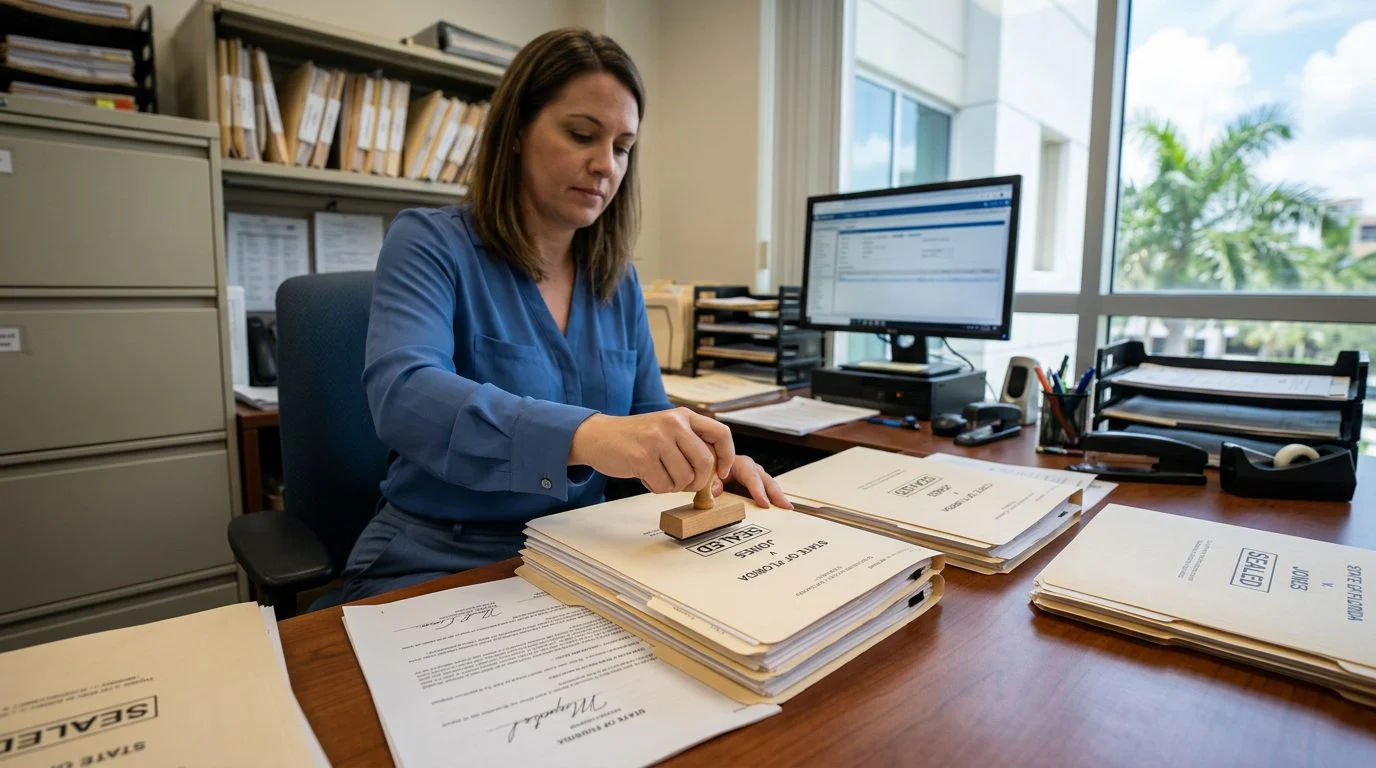
The clerk seals the court’s own records in the case. Under Florida Rule 3.692, the clerk seals the entries and records, or certified copies, with the court file. These are kept in a nonpublic index, subject to further court order.
The clerk also certifies copies of the order to the state attorney or statewide prosecutor. The clerk sends a copy to the arresting agency too. Under § 943.059, the clerk certifies copies to any other agency the court’s records show received the record from the court.
Scope matters. A court may seal one arrest or one incident. It can include more arrests only when they directly relate to the original arrest, and the order must say so. The court decides the petition, not FDLE, as FDLE’s FAQ explains.
How Agencies Are Notified and What Sealed Means for Background Checks
Notice moves down a chain of agencies. The arresting agency forwards the order to the other agencies it gave the record to. The department then forwards the order to the Federal Bureau of Investigation.
Public access ends, but some authorized users still see the record. The department shall disclose a sealed record to the listed entities for licensing, access authorization, and employment purposes.
So a sealed record is hidden from the public, not from every authorized user. Plan on that difference when you answer a question about your history.
Certified Copies, Agency Requests, and Your Own Steps
You pay for certified copies of your order. The petitioner bears all costs of certified copies, unless the petitioner is indigent, under Florida Rule 3.692.
Keep several certified copies in a safe place. Licensing boards and agencies may ask for proof that a record is sealed.
Keep a written log. Note each agency you sent a copy to, the date, and how you sent it. Save every confirmation or reply letter.
Watch the timing of your petition too. A certificate of eligibility is valid for 12 months after the date stamped on it. After that, you must reapply, and the law in effect at renewal decides eligibility, under § 943.059.
Limits That Still Apply After a Sealing Order
Not every conviction can be sealed. Florida lists offenses that make a record ineligible for sealing, under § 943.0584.
The list includes any offense defined in chapter 794, which covers sexual offenses. It also includes felony battery and domestic battery. Homicide and manslaughter offenses under sections 782.07, 782.071, and 782.072 are on the list too.
Automatic sealing is a separate route. Under § 943.0595, the department must seal certain records automatically. These include cases with no charging document, and cases dismissed or nolle prossed on all counts, but not records for a forcible felony as defined in s. 776.08 or dismissals under s. 916.145 or s. 985.19.
The court still has discretion. A request to seal may be denied at the sole discretion of the court, under Florida Rule 3.692.
Licensed Professionals and Questions About a Sealed Record
A sealed record can still reach a licensing board. Florida law lets the department share sealed records with listed licensing and employment entities for their decisions.
If you hold a license, take three steps. First, get a certified copy of the order and keep it with your records. Second, read each application question as it is written.
Many of these questions turn on the facts of your case. The answer depends on the facts.
Not sure what your next step is?
Talk it through with our team — the first consultation is free, confidential, and carries no obligation.

Your Next Step After a Sealing Order Is Signed
After the order is signed, your job is to track agency notice, keep certified copies, and check that your records match the order. Each step is small, but each one matters.
Frequently Asked Questions
What happens after a judge signs a sealing order?
The clerk certifies copies to the prosecutor and the arresting agency. Those agencies pass the order along, and the record becomes confidential.
Who gets a copy of a Florida sealing order?
The state attorney, the arresting agency, and any agency that received the record from the court. The department also forwards the order to the FBI.
Does a sealed record show up on a background check?
Sealing removes the record from public access. Certain authorized entities can still see it for licensing and employment purposes.
How long is a certificate of eligibility valid?
A certificate of eligibility for sealing is valid for 12 months after the date stamped on it.
Patrick Wilson Law, PLLC serves clients across South Florida, from Broward County to the Florida Keys. This page is the responsibility of Patrick David Wilson, the firm’s responsible lawyer, in Miami, Florida. The firm handles seal and expunge matters as part of its criminal defense practice.
If your sealing order is still waiting on agency notice, or a licensing question is still open, you don’t have to sort it out alone, so reach out to Patrick Wilson Law.
The first consultation is free, confidential, and carries no obligation to continue.
Call 786-761-1719 or contact us online.
Why Clients Bring Their Sealing Questions to Patrick Wilson Law
Criminal defense focus
Patrick Wilson Law focuses on criminal defense across Miami-Dade, Broward and the Florida Keys, including sealing and expunging criminal records.
Following the paperwork
Our team helps clients track where a sealing order has been sent and whether the agencies involved have received it.
Free first consultation
The initial consultation is free, confidential and comes with no obligation to continue.
Easy to reach
Call 786-761-1719 or leave us a message to start the conversation.
Do Not Assume the Order Has Reached Everyone
A judge's signature does not automatically confirm that every agency has received and acted on the order. Ask a lawyer to review how the order was distributed before you rely on it.
Common Questions After a Sealing Order Is Signed
Who receives copies
Prosecutors, arresting agencies and other agencies that received the record are typically among those who get copies of the order.
What confidential means for you
Confidential treatment limits who can see the record, but it does not erase every place the arrest appears. We explain what changes and what does not.
Checking agency follow-through
We can help you identify which agencies should have the order and what to ask them to confirm.
What to bring to a consultation
Bring the signed order, the case number and any notices you have received so we can review your situation.

