
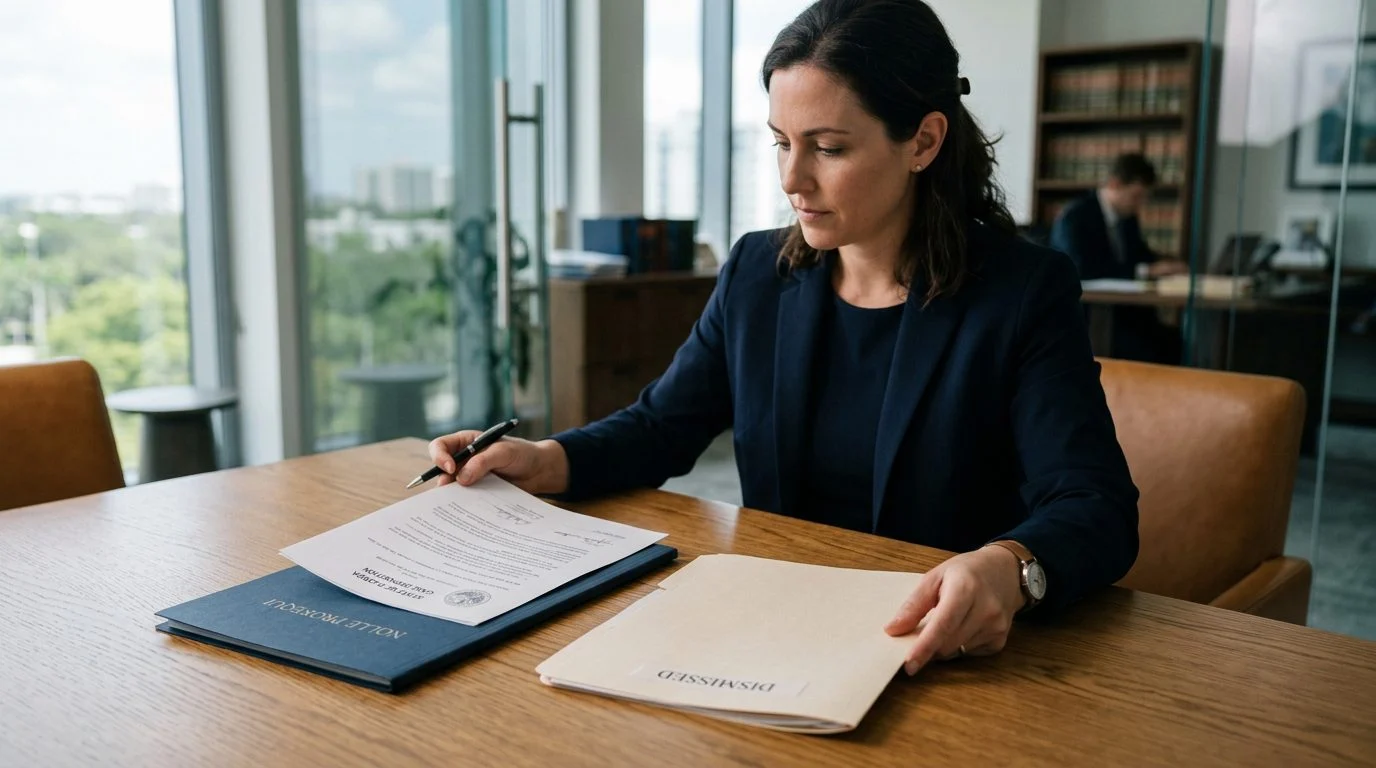
Criminal Defense | Miami, Florida
Nolle Prosequi or Dismissed: What Your Case Ending Really Means
Patrick Wilson Law, PLLC helps clients across South Florida read confusing court paperwork and understand what comes next, including sealing and expunging a record.
By Patrick David Wilson · Published November 5, 2026
Is nolle prosequi better than dismissed? The short answer
Neither one is automatically better. Sealing and expunging a criminal record are often discussed together, but they are different processes with different requirements. What matters is who ended the case, at what stage, and what you need the record to do for you.
Many people ask this question because the case ended, but the paperwork says something they don’t recognize. Knowing the terms helps you read the file and talk with a lawyer. This page explains each term, the differences between them, and the questions to ask about your own paperwork. Think of it as a guide to the terms, not a forecast of how any case will end.
If a case in your family has just ended, or is still open, you don't have to sort through the paperwork alone. We're glad to talk it through with you. Talk it through with our team — the first consultation is free, confidential, and carries no obligation.

What does nolle prosequi mean?
A nolle prosequi is a formal notice that the prosecutor will not go forward with the charges. The phrase is Latin and roughly means “unwilling to pursue.” It ends the prosecution. It does not decide guilt or innocence.
In Florida, the state attorney or the statewide prosecutor enters it. The expunction statute names this exact ending. A person may petition for expunction when a charging document was filed and then “dismissed or nolle prosequi by the state attorney or statewide prosecutor” (Fla. Stat. § 943.0585).
You may see “nolle prosequi,” “nol pros,” or “nolle” on a court docket or disposition sheet. Recognizing those words helps you read the file. The exact filed wording is what counts later, when forms ask how the case ended.
How is a dismissal different from a nolle prosequi?
A dismissal also ends the case, but the person who ends it can differ. A prosecutor can enter a nolle prosequi, and a court can dismiss a case. The expunction statute lists both as separate endings.
Here’s the key point. The same subsection covers a prosecutor’s nolle prosequi and a court dismissal. For expunction eligibility, the statute treats them as qualifying endings in the same way (Fla. Stat. § 943.0585).
In everyday talk, people use “dismissed” for almost any ended case. Court papers may use either word. So the exact filed document matters more than the word a friend, a neighbor, or an officer uses. Check who signed the entry and what date it carries.
Is a case dismissed the same as charges dropped?
In everyday speech, people often use the two phrases the same way. Legally, the case ends through a specific filed action, such as a nolle prosequi, a dismissal, or a verdict. “Charges dropped” is a casual way to describe that result.
The precise action matters because forms ask for it. A job application, a licensing form, or a sealing petition may ask how the case ended. A vague answer can create confusion later, and a wrong answer can cause bigger problems.
Ask the clerk of court for the certified disposition paperwork. That document shows the exact wording the court entered. Certified copies cost money. Under Florida’s petition rule, the petitioner pays for certified copies unless the petitioner is indigent (Fla. R. Crim. P. 3.692).
Is not guilty the same as a dismissal?
No. A not guilty verdict comes from a judge or jury at the end of a trial. A nolle prosequi or dismissal usually ends a case before any trial verdict.
Under Florida’s rule on not guilty judgments, a defendant in custody is discharged right away, unless held on another charge. If the defendant is out on bail, the sureties are exonerated. Any bail money or bonds are refunded (Fla. R. Crim. P. 3.690).
They are still different documents, so each needs its own paperwork check.
Does nolle prosequi show on background checks?
It can. A nolle prosequi ends the prosecution, but the arrest and case history may still exist unless a court orders sealing or expunction. A court may not order a criminal justice agency to expunge a criminal history record until the person seeking to expunge it has applied for and received a certificate of eligibility under subsection (2).
Getting relief takes a court petition. The petition must include a certificate of eligibility from the Florida Department of Law Enforcement and a sworn statement (Fla. R. Crim. P. 3.692). The court may deny the request at its sole discretion.
Sealing is a separate path that requires a petition, a certificate of eligibility, and a court order. Other agencies may still keep the record, but a sealed criminal history record is confidential and available only to the persons and entities listed in Fla. Stat. § 943.059(6)(a).
Employers and licensing boards ask different questions. Read each form closely before you answer.
Sexual battery cases need extra care. Sexual battery charges depend heavily on the specific facts alleged in each case. Under Florida law, a conviction record for any chapter 794 offense is ineligible for sealing or expunction. Under s. 943.059, a person must satisfy the eligibility criteria and must not be ineligible for court-ordered sealing under s. 943.0584, so the exact ending on the paperwork matters.
Not sure what your next step is?
Talk it through with our team — the first consultation is free, confidential, and carries no obligation.
Which result matters more for your situation?
The better ending depends on your goals. Compare four things: why the case ended, what record remains, whether sealing or expunction is open to you, and what each form asks.
If you hold a professional license, the question is how the ending fits your board’s rules. Florida law lists misleading or deceptive representations about a licensee’s practice as a ground for discipline (Fla. Stat. § 456.072). An accurate answer on every licensing form matters.
Because the ending affects that analysis, non-citizens need a separate review before deciding anything.
The defendant or the defendant’s immediate family may not personally contact the victim or the victim’s immediate family to acquire the victim’s consent (Fla. Stat. § 948.08). If the person completes the program, the court dismisses the charges.
Questions to ask about your paperwork before you decide anything
Gather these answers before you make any decision:
- What is the exact disposition wording on the court’s entry?
- What is the filing date, and who entered the ending: the state attorney, a judge, or a jury?
- Was any diversion program or condition part of the outcome?
- Was adjudication withheld? Under § 943.0584, a withheld adjudication counts as a conviction for eligibility rules.
- Is another matter pending, such as a traffic or civil case, tied to the same incident?

Talk through your situation with Patrick Wilson Law
If you’re reading this about a case that just ended, or one that’s still open, you may be handling a family member’s paperwork. You may be trying to make sense of documents you never expected to receive. That’s a hard place to be, and you don’t have to sort it out alone.
Patrick David Wilson is the responsible lawyer for this page. Patrick Wilson Law, PLLC has its office in Miami and serves clients across South Florida, from Broward County to the Keys. Our team can look at the exact filed paperwork with you. Call 786-761-1719, leave us a message, or use our contact page. The first consultation is free, confidential, and without obligation.
Four questions that shape your next step
Who ended the case
A prosecutor's decision to drop charges is recorded differently from a judge's order dismissing a case. The source of the ending matters.
At what stage it ended
A case closed before filing, early in the process, or after a hearing can produce very different paperwork and different options.
What the record shows
The wording on the disposition is what courts and agencies read. Small differences in language can change how a record is treated.
What you need the record to do
Employment, professional licensing, immigration, and housing questions each call for a different plan, which is why the goal shapes the strategy.
Do not assume a closed case is a sealed case
A case that ended in your favor can still appear on public records. Before you apply for a job, license, or visa, review the actual court disposition and ask a lawyer how it affects your record.
How to prepare for your consultation
Gather the paperwork
Bring any court notices, the arrest report, release papers, and the final disposition or docket sheet if you have them.
Write down the dates
Note when the arrest happened, when the case ended, and any hearings you attended. Clear dates help us review the file faster.
List your goals
Tell us what you need the record to do, such as supporting a job application, a professional license, or a move abroad.
Ask your questions
Bring a list of concerns. Your first consultation is confidential, and it gives you time to understand your options.

