
Sexual Battery Defense | Miami and South Florida
Served With a Sexual Violence Injunction? Don't Wait to Get Advice.
Patrick Wilson Law, PLLC focuses on criminal defense in Miami-Dade, Broward and the Florida Keys. Learn what the papers mean, what to do next, and how a free, confidential first consultation can help.
By Patrick David Wilson · Published November 3, 2026
Sexual violence injunction Florida: what to do if you were served. If you were served with an injunction for protection against sexual violence, start by reading every page and writing down the hearing date. This is a civil court order, separate from any criminal charge, and it can limit your contact before the final hearing. This guide explains the papers, the first steps, the hearing, and how a parallel criminal case can change the picture.
Patrick Wilson Law, PLLC is a Miami criminal defense firm that focuses on sexual battery defense, domestic violence, and related matters across South Florida. Patrick David Wilson is the responsible lawyer for this page.
What a Sexual Violence Injunction Is in Florida
A sexual violence injunction Florida judges issue is a civil order. It protects a person from sexual violence, and it is not a criminal case, though the same events can lead to both.
Florida’s injunction statute defines “violence” broadly. Under Fla. Stat. § 784.046, the term includes sexual assault and sexual battery. It also covers assault, aggravated assault, battery, aggravated battery, stalking, aggravated stalking, kidnapping, false imprisonment, and any criminal offense resulting in physical injury or death, when one person commits it against another.
The court forms use two key words. The petitioner is the person asking for the injunction. The respondent is the person named in the order. If you were served, you are the respondent.
Sexual battery is a separate crime. It is covered in Fla. Stat. § 794.011, which defines consent. For the wider criminal picture, see our sexual battery defense overview. Patrick Wilson Law focuses on sexual battery defense in Miami, Miami-Dade County, and Broward County.
If you were just served and the hearing date is already on your calendar, you don't have to read those papers alone. We can talk through them with you. Talk it through with our team — the first consultation is free, confidential, and carries no obligation.

If You Were Just Served: Your First Steps
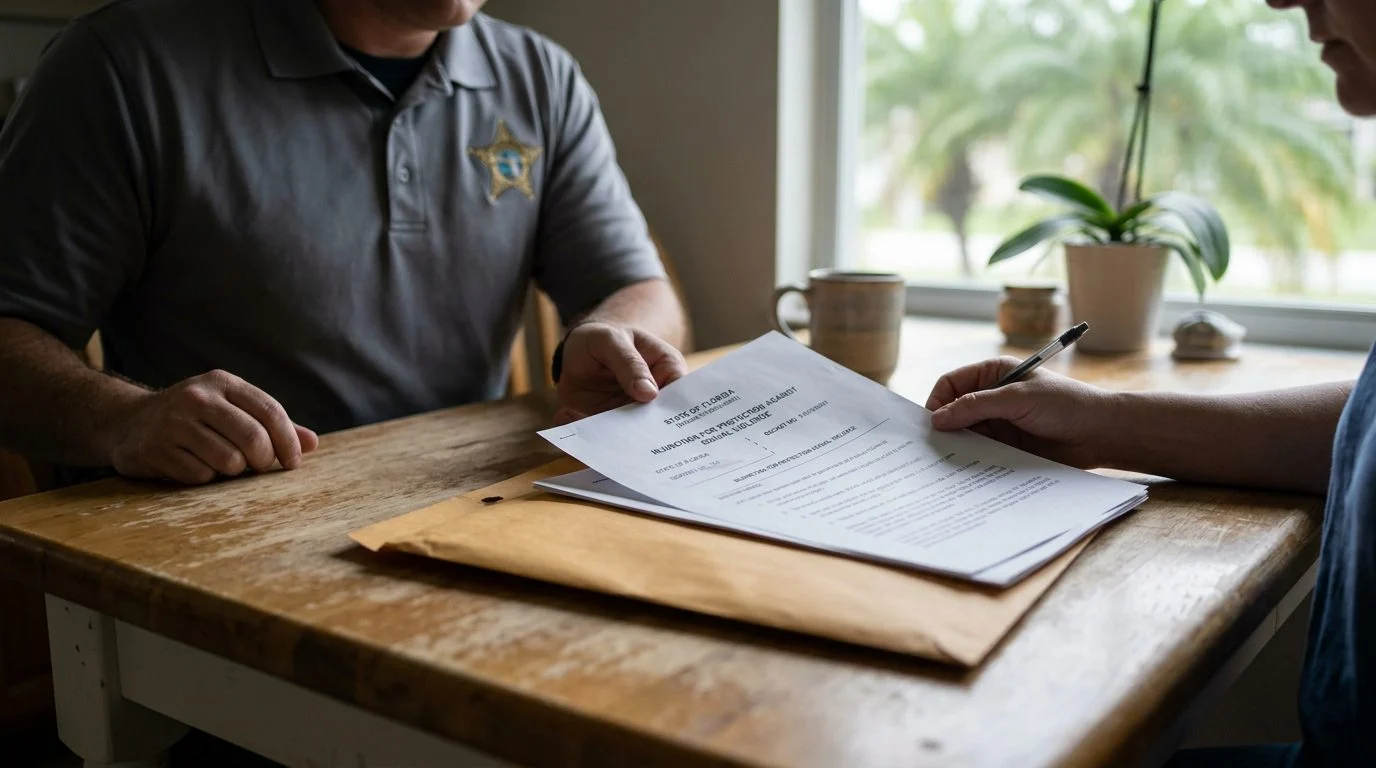
The first step is to read every page of the papers. Look for the petition, the notice of hearing, any temporary injunction, and the proof of service. Write down the case number, the hearing date, and the hearing time.
Treat the hearing date as a deadline. Missing it can have serious consequences for your case, so put it on your calendar that day.
Service follows a set path. For injunctions against repeat violence, sexual violence, or dating violence, the clerk of the court must electronically transmit a copy of the petition, notice of hearing, and temporary injunction, if any, to the sheriff or a law enforcement agency within 24 hours after the court issues the injunction. That happens within 24 hours after the court issues the injunction. Only a law enforcement officer may serve it. The Miami-Dade Clerk’s domestic violence page describes how these filings work in the county.
Avoid three common mistakes. Don’t contact the petitioner, directly or through friends or family. Don’t post about the case online. Any contact the order forbids can create new exposure. Keep a private written record of dates, messages, and who was present.
The Temporary Injunction and What It Restricts
A temporary injunction is an order that can apply before the final hearing. You must follow it as written.
Read every restriction line by line. Common terms bar contact with the petitioner. Some also keep you away from the petitioner’s home, workplace, or school, and some set a stay-away distance.
A text, a social media message, or a message passed through a friend may break the order. A violation can also create separate legal trouble, even when you believe the contact was harmless.
For non-citizens, the stakes go further. A non-citizen enjoined under a protection order can become deportable if the court determines that the person has engaged in conduct violating the part of the order that protects against credible threats of violence, repeated harassment, or bodily injury. That happens if a court finds a violation of the order’s protection against credible threats, repeated harassment, or bodily injury. The statute says “protection order” includes temporary or final injunctions from civil or criminal courts.
What to Expect at the Injunction Hearing
Think before you answer. Anything you say in the hearing can matter later, including in a criminal case.
Expect questions about your relationship with the petitioner, the conduct described in the petition, and the terms the petitioner wants. Answer only what is asked, and keep your answers short and accurate. A lawyer can prepare you for these questions and object when a question goes too far.
Arrive early and dress as you would for any court appearance. Bring the papers, the case number, and any documents that relate to the case.
How an Injunction Can Be Dismissed or End
An injunction can end or change when a judge modifies or dissolves it.
That request is a formal step. You make it by asking the court to act, not by speaking with the petitioner. A request to change a stay-away distance or another term goes to the judge the same way.
No outcome can be promised in any case. Some cases end when the petitioner no longer pursues the request, and others end after a hearing.
Don’t ignore the order while you wait for a change. It stays in place until a judge changes it.
Injunctions and a Parallel Criminal Case
A civil injunction and a criminal sexual battery charge are separate cases.
During that time, don’t discuss the underlying facts with the petitioner, family, or anyone other than your lawyer.
Judges can also act in the criminal case. The Florida Courts domestic violence legal outline explains that a court can impose a no-contact order as a pretrial release condition.
Consent often matters in these cases. Florida law defines consent as intelligent, knowing, and voluntary, and it does not include coerced submission. The statute also says a failure to physically resist is not treated as consent.
For readers asking how a prosecutor can drop a charge, see our nolle prosequi page. For professionals in professions regulated by the department under this chapter, Fla. Stat. § 456.072 lists having a license or the authority to practice revoked, suspended, or otherwise acted against, by the licensing authority of any jurisdiction, for a violation that would constitute a violation under Florida law, as grounds for discipline. Raise license concerns with counsel early.
Not sure what your next step is?
Talk it through with our team — the first consultation is free, confidential, and carries no obligation.
Frequently Asked Questions
Can a sexual violence injunction be changed or ended?
Yes.
Is a sexual violence injunction the same as a criminal charge?
No. It is a civil order, separate from any criminal case, although the same events can lead to both.
Can I be arrested for violating a temporary injunction?
A violation can create separate legal trouble. Follow every term until a judge changes it.
Does a sexual violence injunction affect immigration status?
It can. A non-citizen can be deportable when a court determines that he or she violated the protective terms of an order against credible threats of violence, repeated harassment, or bodily injury.
Do I have to attend the hearing?
Treat the hearing date as a deadline. Missing it can have serious consequences for your case.
Talk Through Your Papers With Patrick Wilson Law
If you were served recently, you may be reading this page under pressure. You may be reading it for a family member, in a situation you did not choose.
The petition and the hearing date are in front of you now. Patrick Wilson Law, PLLC is a Miami criminal defense firm, and Patrick David Wilson is the responsible lawyer for this page. A conversation can help you understand what those specific papers ask of you.
Call 786-761-1719 or leave a message through our contact page. The first consultation is free, confidential, and carries no obligation to continue.
This page is general information, not advice about your case. Your situation depends on its facts. You are not obligated to hire the firm.
How Patrick Wilson Law Can Help
Review of Your Papers
We look closely at the petition, the injunction and any hearing notice so you understand what is being alleged and what happens next.
Protecting Your Record
Our criminal defense work is built around the possible consequences of a related criminal charge, including the effect on your job, your license and your future.
Attorneys Who Know Criminal Defense
Patrick David Wilson and Sahara Fonseca handle sexual battery and domestic violence matters, and our team supports every client through the process.
Serving South Florida
We represent people in Miami, Miami Beach, Hialeah, Kendall, Homestead, Fort Lauderdale, Broward County and the Florida Keys.
Important: Do Not Ignore Court Papers
Read every page you were served and note any hearing date on it. Do not contact the person who filed the petition in a way the order may prohibit, even if you believe the order is unfair. Talk to a lawyer before you respond to anything.
What to Do If You Have Been Served
1. Keep the Papers Safe
Store the injunction, any temporary order and the hearing notice in one place. Bring them to your first meeting with an attorney.
2. Write Down What Happened
Note dates, places and who was present, while the details are fresh. Share these notes only with your lawyer.
4. Get Legal Advice Early
A free, confidential first consultation with no obligation to continue gives you a chance to ask questions and understand your options.

