
Criminal Defense | Miami-Dade, Broward and the Florida Keys
A Dropped Charge Can Still Follow You. Here's How to Protect Your Record.
Many people assume a case closed without a trial is the end of the matter. Learn what a nolle prosequi can mean for background checks, employment and licensing, and what steps may help.
By Patrick David Wilson · Published November 22, 2026
If you’re asking, “Will I have a criminal record if my case was nolle prosequi in Florida?”, the short answer is often yes, in some form. A nolle prosequi means the prosecutor dropped the charge without a conviction. But the arrest and the closed case can still appear in court and state records until a judge orders sealing or expunction.
This page explains what the term means, what stays visible, how Florida sealing and expunction work, and when timing matters. If you’re reading this for someone else, the same facts apply.
What a Nolle Prosequi Means in a Florida Criminal Case
A nolle prosequi is the prosecutor’s formal decision to end a charge without a trial verdict. People also say “nolle pros” or “nolle prossed.” These terms describe the same outcome.
The state attorney or statewide prosecutor enters it. It is not an acquittal, and it is not a finding of guilt. No conviction or sentence follows from it.
Florida’s expunction statute uses this exact language. It allows a petition when a charge was “dismissed or nolle prosequi by the state attorney or statewide prosecutor” (Fla. Stat. § 943.0585). The closing entry in the file usually does not explain why the state dropped the case.
The key point is simple. The case ended, but it did not end in a conviction. That difference drives every option that follows.
If your case was dropped but the record still worries you, our team can review your file and talk through your options. Talk it through with our team — the first consultation is free, confidential, and carries no obligation.
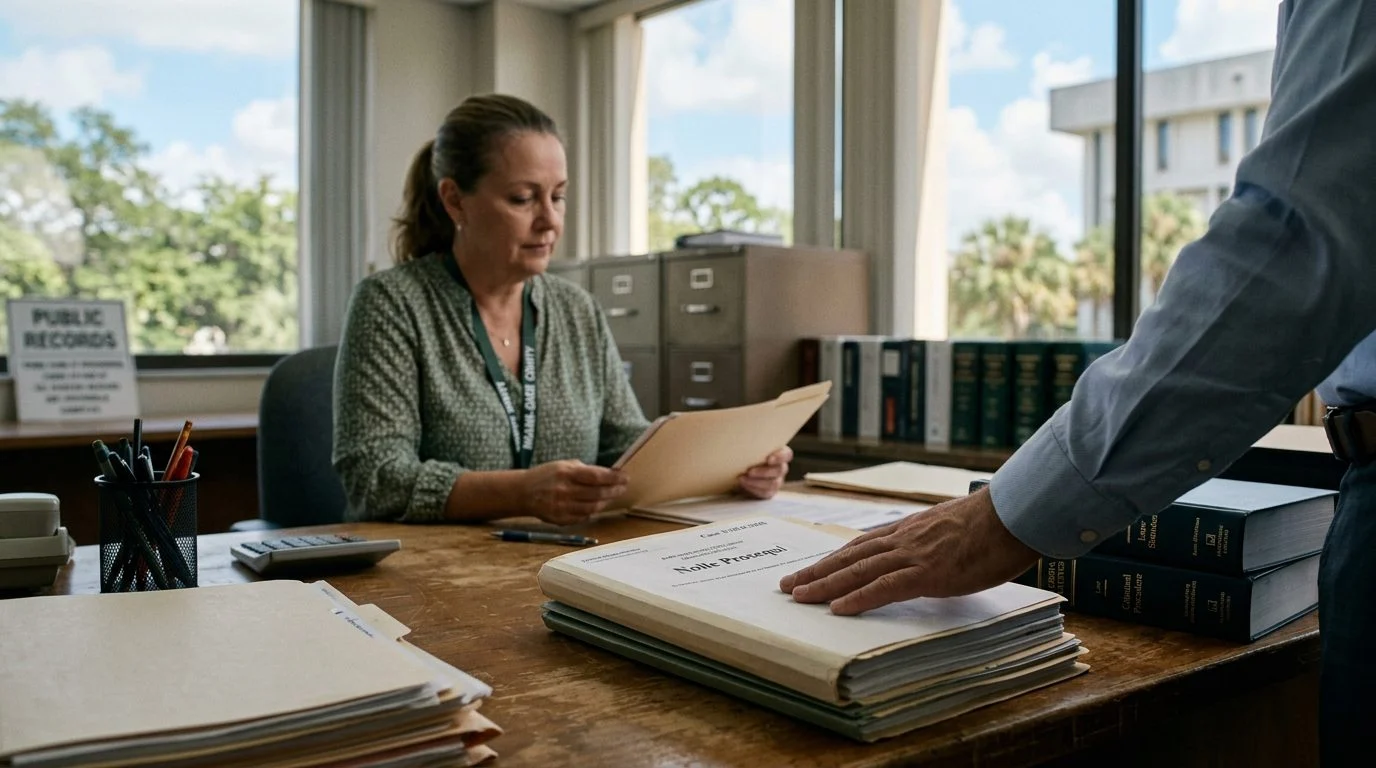
Does a Nolle Prosequi Still Leave a Record?
Yes, a closed case can still leave a trace. Without a conviction, the arrest and the charge may remain in several places until a court acts.
Three places matter most:
- The court file. The clerk keeps the charge and the closing entry.
- The state criminal history record. The Florida Department of Law Enforcement (FDLE) keeps these records. Even after a record is sealed or expunged, FDLE and other criminal justice agencies may still maintain it.
- Private background checks. Employers and landlords may order their own searches. Florida’s sealing and expunction statutes address state and court records, so a separate search can still show the case.
Sealing and expunction are the legal tools that limit who can see a record. They are the route to narrowing access, not a shortcut around the rules.
Sealing and Expunging a Case Closed by Nolle Prosequi
Yes, a case closed by nolle prosequi can qualify for sealing or expunction. Whether yours qualifies depends on your charges and your history.
Satisfying these requirements allows you to ask a court for relief, but expunction is not automatic: under section 943.0585, Florida Statutes, the court may deny the request at its sole discretion, and sealing is governed by a separate statute, section 943.059, with its own requirements.
Both routes follow the same early steps. You need a valid certificate of eligibility from FDLE and a sworn statement. Then you file a written petition with the clerk (Fla. R. Crim. P. 3.692). The prosecutor and arresting agency receive a copy and may respond.
The court can deny a request at its sole discretion (Fla. R. Crim. P. 3.692). FDLE says the court, not FDLE, decides (FDLE FAQ). The Polk County Clerk of Court notes that FDLE oversees the application process.
Sexual battery cases need extra care. The statute’s exclusion list makes a record ineligible only when it is a conviction for listed offenses, including any offense in chapter 794 (Fla. Stat. § 943.0584). Sexual battery falls in that chapter.
Florida also has automatic sealing for some cases. Whether your case fits depends on the facts of the file.
Can the State Refile After a Nolle Prosequi?
Refiling depends on the time limits in Fla. Stat. § 775.15, which set limits by offense. Some of these limits start on different dates.
- Some crimes have no time limit. A capital felony, life felony, or felony that resulted in a death may be prosecuted at any time.
- For sexual battery involving a victim under 18, the clock does not start until the victim turns 18 or the crime is reported, whichever comes first, and a first or second degree sexual battery reported within 72 hours after it is committed may be prosecuted at any time.
- The clock does not run while the defendant is continuously out of Florida or has no fixed home or work in the state. That pause cannot extend the period by more than three years.
Formal charges after arrest follow a separate schedule. The state must file within 30 days for someone in custody, and within 60 days for someone on pretrial release (Fla. R. Crim. P. 3.134). Those deadlines are about charging after arrest.
Why the Record Question Matters for Jobs, Licenses, and Immigration
A closed case can still matter when an employer, licensing body, or immigration officer looks at your history. What they see depends on which record they check.
For jobs and licenses, a sealed record is not fully hidden. Fla. Stat. § 943.059 allows FDLE to disclose a sealed record to listed licensing and employment entities. Fla. Stat. § 943.059 reads: “An employee of an entity set forth in subparagraph (b)1., subparagraph (b)4., subparagraph (b)5., subparagraph (b)6., subparagraph (b)8., subparagraph (b)9., subparagraph (b)10., or subparagraph (b)11. may not disclose information relating to the existence of a sealed criminal history record of a person seeking employment, access authorization, or licensure with such entity or contractor, except to the person to whom the criminal history record relates or to persons having direct responsibility for employment, access authorization, or licensure decisions.” Licensed professionals should plan with that in mind.
For non-citizens, the rules work differently. 8 U.S.C. § 1227 makes certain convictions grounds for deportation, including crimes of domestic violence. That law turns on convictions. A case ended by nolle prosequi is analyzed differently, but it still needs its own review.
Before deciding next steps, gather three documents: the arrest report, the state attorney’s nolle prosequi order, and your FDLE criminal history.
Frequently Asked Questions
Will I have a criminal record if my case was nolle prosequi in Florida?
Often a record of the arrest remains, even without a conviction. Sealing or expunction can limit who sees it.
Does a nolle prosequi show up on a background check in Florida?
It can. Sealing or expunction is the legal route to limit that access.
Is a nolle prosequi the same as a dismissal?
Both end a case without a conviction. Florida’s expunction statute lists them together as outcomes that can qualify.
Can the state charge me again after a nolle prosequi?
Possibly. The time limits in Florida law depend on the offense.

Talk Through Your Own Case With Patrick Wilson Law
You may be the one who was charged. Or you may be watching someone you love carry the uncertainty after the state dropped the case. Either way, the open question is what the record will show later.
Patrick Wilson Law, PLLC is a Miami criminal defense firm. It focuses on criminal defense matters in South Florida, including sexual battery, and serves Miami-Dade, Broward County, and the Florida Keys. Our team can review your file and talk through the decisions in front of you. Those include whether to seek sealing or expunction, when timing matters, and how the record may look to an employer, a licensing board, or immigration review.
For background on the charge involved, see our sexual battery defense overview.
Our first consultation is free, confidential, and without obligation to continue. Call 786-761-1719 or leave a message through our contact page to talk about your case.
How Patrick Wilson Law Approaches Your Case
Criminal defense focus
Patrick Wilson Law focuses on criminal defense across South Florida, including cases involving first-time offenders and licensed professionals.
A free, confidential first consultation
The first consultation is free, confidential, and carries no obligation to continue.
Responsible lawyer and support team
Patrick David Wilson is responsible for this page. Our team of assistants and office staff helps keep your case organized from the first call.
Serving South Florida
We represent clients in Miami, Miami-Dade County, Broward County, Fort Lauderdale, Kendall, Hialeah, Miami Beach, Homestead and the Florida Keys.
Do not assume a closed case means a clean record
A case ended by a nolle prosequi may still leave an arrest record visible to employers, landlords and licensing boards. Ask about sealing or expunction options before you rely on the case being closed.
Questions to Bring to Your Consultation
What the prosecutor actually did
Knowing whether the State declined to proceed, dropped the charge or filed a nolle prosequi shapes what records may exist.
Who can still see the arrest
Background checks, professional licensing and immigration reviews can each draw on different records. We help you identify which ones matter for you.
Sealing or expunction
These are separate court processes with their own requirements. We explain how each may apply to your record and what paperwork is involved.
Your career and status
Licensed professionals and non-citizens often face consequences beyond the courtroom. We review those concerns alongside the criminal record.

