
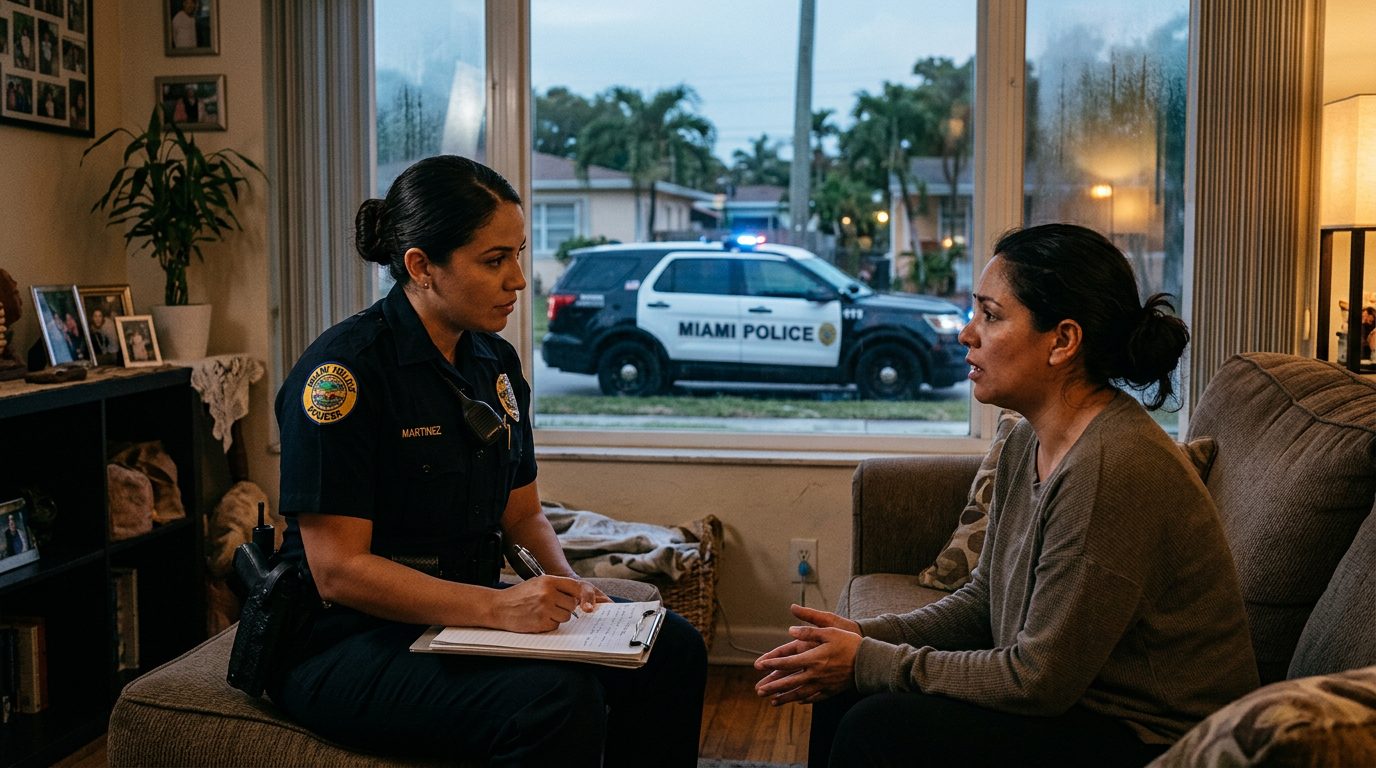
Domestic Violence Defense | Miami, FL
Aggravated Domestic Violence Defense: How the Evidence in Your Case Is Reviewed
Patrick Wilson Law, PLLC focuses on criminal defense in Miami and across South Florida. Learn how police reports, recordings, texts and witness statements are examined, challenged and used in an aggravated domestic violence case.
By Patrick David Wilson · Published October 27, 2026
A domestic violence charge can change a family’s life quickly. If you’re researching aggravated domestic violence defense evidence, this guide explains the main types of proof a defense lawyer reviews. It covers what each type can show and where it can fall short. Patrick Wilson Law, PLLC is a Miami firm that focuses on criminal defense across South Florida, including domestic violence cases.
What evidence can be used to defend against aggravated domestic violence allegations?
Evidence in these cases usually falls into a few groups: recordings and digital records, medical and physical proof, police and witness records, proof of self-defense, and facts suggesting the accusation is wrong or driven by another motive. How much any item helps depends on the facts and on how it fits with the rest of the case. Florida’s definition of domestic violence is broad. It covers assault, aggravated assault, battery, aggravated battery, sexual assault, sexual battery, stalking, aggravated stalking, kidnapping and false imprisonment, plus any criminal offense resulting in physical injury or death, when one family or household member harms another; family or household members include spouses, former spouses, relatives by blood or marriage, persons who live or have lived together as a family, and parents of a child in common, and, except for parents of a child in common, they must currently reside or have in the past resided together in the same single dwelling unit (Fla. Stat. § 741.28). Our Miami domestic violence defense page covers the wider process, from arrest to court.
If someone you love is facing this charge, you don't have to sort through the evidence alone, and we're glad to talk it through with you. Talk it through with our team — the first consultation is free, confidential, and carries no obligation.

What is aggravated domestic battery vs domestic battery?
Battery is the base offense, and aggravated battery is a more serious charge with added factors. The state’s allegations set the charge level, so the proof needed to challenge each level can differ. Battery happens when a person actually and intentionally touches or strikes another person against that person’s will, or intentionally causes bodily harm (Fla. Stat. § 784.03). Aggravated battery involves intentionally or knowingly causing great bodily harm, permanent disability or permanent disfigurement, or using a deadly weapon. Aggravated battery also includes a battery on a victim who was pregnant when the offender knew or should have known it, and it is a second-degree felony (Fla. Stat. § 784.045). Assault is a related offense. It requires an intentional, unlawful threat by word or act, an apparent ability to carry it out, and an act that creates a well-founded fear of imminent violence (Fla. Stat. § 784.011). Early in a review, the question is which of these elements the evidence actually supports.
How do 911 calls, body camera footage and surveillance video help a defense?
These recordings capture what was said and done close to the event, often before anyone wrote a report. They can support or contradict the accounts people give later. A 911 recording preserves the caller’s words, tone and timing. It can show what was said before officers arrived. Body camera footage and home or neighborhood surveillance video can show positions, injuries and the order of events. A reviewer compares that footage with each written account.
Timing matters. Recordings can be overwritten or deleted, so requests should be made early. Discovery rules help here. After a charging document is filed, the defense can elect discovery, and a court may stop the state from using material it did not disclose (Fla. R. Crim. P. 3.220).
What digital messages and phone records can show in a domestic violence case?
Texts, call logs, social media posts and app messages can show the history between two people. They can also show what each person said before and after an incident. Contact that conflicts with the allegation can be important. Location data and timestamps can place each person at a certain time and place. A message sent after an alleged event can bear on the claimed fear.
Context matters, though. A single screenshot can leave out the message that came before it. Messages are most useful when they are saved in full, with dates, and read as a whole thread. The U.S. Department of Justice describes domestic violence to include physical, sexual, emotional, economic, psychological and technological abuse, so digital evidence often matters in these cases.
Can medical records and physical evidence support a defense?
Yes. Medical records and physical evidence can show whether an injury matches the account given to police. Medical records document the type, location and timing of an injury. They may also record how the injury was described at the time. Photographs, damaged property, clothing and the scene itself can show whether an event could have happened as described.
A missing injury does not end a case. Its significance turns on the charges and on the other proof. Keep photos and damaged items as they are when you can. A lawyer can then decide what needs to be preserved, tested or explained.
How can police reports and witness statements be challenged?
Police reports and witness statements can be tested against recordings, physical evidence and each other. A police report is a written summary. It is not a complete record of the scene. Differences between the report, a recording and later testimony can matter. Witness statements can be compared for gaps, contradictions and changes over time.
A reviewer also asks how each statement was taken, who was present and whether every relevant record was turned over. The discovery rule requires certain witnesses to be identified, including those present when a statement was taken (Fla. R. Crim. P. 3.220).
Not sure what your next step is?
Talk it through with our team — the first consultation is free, confidential, and carries no obligation.
What evidence supports a self-defense claim in a domestic violence case?
Florida law lets a person use non-deadly force against imminent unlawful force when it is reasonably believed necessary. That person has no duty to retreat before using or threatening such force (Fla. Stat. § 776.012). Deadly force has a higher standard. It requires a reasonable belief that it is necessary to prevent imminent death, great bodily harm or a forcible felony.
Under Fla. Stat. § 776.041, the justification is not available to a person who initially provokes the use or threatened use of force against himself or herself, unless an exception applies. The justification described in the preceding sections of this chapter is not available to a person who: (1) Is attempting to commit, committing, or escaping after the commission of, a forcible felony; or (2) Initially provokes the use or threatened use of force against himself or herself, unless: (a) Such force or threat of force is so great that the person reasonably believes that he or she is in imminent danger of death or great bodily harm and that he or she has exhausted every reasonable means to escape such danger other than the use or threatened use of force which is likely to cause death or great bodily harm to the assailant; or (b) In good faith, the person withdraws from physical contact with the assailant and indicates clearly to the assailant that he or she desires to withdraw and terminate the use or threatened use of force, but the assailant continues or resumes the use or threatened use of force (Fla. Stat. § 776.041). Useful proof often includes injuries to the accused, recordings, witness accounts, earlier reports of threats and messages showing who started the argument. Self-defense is fact-specific, so each item must be read against the actual sequence of events. If charges are dismissed on a lawful self-defense finding, that finding is documented.
Can evidence show that a domestic violence allegation is false or motivated by something else?
Evidence of an ongoing dispute can bear on whether an accusation is reliable. Examples include a divorce, custody fight, property disagreement or breakup. Reviewers also look for inconsistent statements over time, accounts later withdrawn, and messages showing a motive to make or change a claim. These points can be raised in court. Whether the judge allows them in is a separate question, so careful handling matters.
Some cases also involve battered-spouse syndrome. A defendant who plans to rely on that defense must give written notice no later than 30 days before trial. Under Fla. R. Crim. P. 3.201, the notice must include a statement of particulars showing the nature of the defense and the names and addresses of the witnesses. Without that notice, the evidence offered for the defense may not be admitted (Fla. R. Crim. P. 3.201).
How should someone get a Miami domestic violence case reviewed?
Start by saving records, dates and names, and by following any court order about contact. Write down what happened while you remember it. Keep texts, call logs and photos in full. Note the names of anyone who saw or heard the events.
Protective injunctions carry their own rules. When there has been no arrest for an alleged violation of a protective injunction, the petitioner may contact the circuit court clerk in the county where the violation is alleged to have occurred for help with an affidavit. If the affidavit alleges a crime has been committed, the local law enforcement agency must complete its investigation and forward the report to the state attorney no later than 20 days after receiving the initial report (Fla. Stat. § 741.31).
Does an injunction violation always require an arrest?
No. When there has been no arrest, the petitioner can contact the circuit court clerk for help preparing an affidavit (Fla. Stat. § 741.31).
Can self-defense apply if I started the argument?
Only in limited cases. Initially provoking the use or threatened use of force removes the justification unless a statutory exception applies (Fla. Stat. § 776.041).
When must a battered-spouse notice be filed?
It must be filed no later than 30 days before trial (Fla. R. Crim. P. 3.201).
If you’re reading this because someone you love is facing this charge, you’re likely carrying a lot of worry right now. Patrick David Wilson is available to talk through the evidence and your options. Call 786-761-1719 or leave a message. The first consultation is free, confidential and comes with no obligation to continue. You can also request a free consultation online.
What Our Team Examines in Evidence Review
Police and arrest reports
We compare the official account against the timeline, the statements recorded and the details that appear in the paperwork.
How evidence was collected
We look at whether searches, statements and seizures followed the procedures required by law.
Timing and sequence
We build a clear timeline of calls, messages, photographs and medical visits to test how the events unfolded.
Witness accounts
We review what each person saw and heard, and where their accounts agree or conflict with the physical record.
Be Careful What You Say and Post
Text messages, social media posts and conversations with family, friends or coworkers can become evidence. Do not discuss the allegations or contact the other person about the case until you have spoken with a lawyer.
Common Types of Evidence in These Cases
911 calls and body camera footage
Recordings often capture the first account of events. We review what was said, how it was said and whether it matches later statements.
Texts, call logs and social media
Digital records can show context, tone and timing. We examine the full conversation rather than isolated messages.
Medical and photographic records
Injury reports and photos are reviewed for what they show, how they were taken and what they may not establish.
Neighbor and third-party statements
We assess who was present, what each person could actually observe and whether their account changed over time.

