
Domestic Violence Defense | Miami
Charged with Aggravated Domestic Violence? Self-Defense Deserves a Careful Look
Patrick Wilson Law focuses on criminal defense across South Florida, including self-defense claims in aggravated domestic violence cases. Your first consultation is free, confidential and comes with no obligation to continue.
By Patrick David Wilson · Published October 27, 2026
Aggravated domestic violence self defense is a real option in Florida, but it has strict rules. If you’re facing an aggravated domestic violence charge, you may be asking whether you acted lawfully. Or you may be worried about someone you love who was arrested. This page explains the justification rules, the proof that matters, and how the claim gets raised. Patrick Wilson Law, PLLC is a Miami criminal defense firm that serves Miami-Dade, Broward County, and the Florida Keys.
What self-defense or justification defenses apply to aggravated domestic violence charges?
Self-defense and defense of others are the main justification defenses in Florida.
Under § 776.012, a person may use force, other than deadly force, when that person reasonably believes it is necessary to defend himself, herself, or another against the other’s imminent use of unlawful force. That person has no duty to retreat first. Deadly force is allowed only to prevent imminent death or great bodily harm, or an imminent forcible felony.
A justification defense is different from a denial. A denial says the act never happened. A justification admits the contact but argues the law excused it. Which one fits is a question of what the evidence shows.
Home cases have their own rule. Under § 776.013, a person inside a home where they have a right to be has no duty to retreat. The statute also presumes reasonable fear in some forced-entry situations. That presumption does not apply when the other person has the right to be in or lawfully resides in the home, and no injunction for protection from domestic violence or written pretrial no-contact order is against that person; it also does not apply in other listed cases, such as when the person sought to be removed is a child or grandchild or is in the lawful custody or guardianship of the person using force, or when the person against whom force is used is a law enforcement officer acting in the performance of official duties who identified himself or herself in accordance with any applicable law, or whom the person using force knew or reasonably should have known was a law enforcement officer.
Saying the other person started it is not enough by itself.
If you're facing this charge after a confrontation you believe was defensive, our team can review the facts with you in a free, confidential consultation. Talk it through with our team — the first consultation is free, confidential, and carries no obligation.

What Is Considered Domestic Violence Under Florida Law?
Florida treats an offense as domestic violence when one family or household member commits one of the listed offenses (such as assault, battery, aggravated assault, or aggravated battery) or any criminal offense resulting in physical injury or death against another, as defined in § 741.28. The offense can be assault, battery, aggravated assault, or aggravated battery, among others listed in § 741.28.
That definition covers spouses and former spouses. It also covers relatives by blood or marriage and parents of a child in common. Other people who live, or have lived, together as a family can also fall within it.
The label attaches only when a listed criminal offense, such as assault or battery, is committed by one family or household member against another. Family or household members include spouses, former spouses, persons related by blood or marriage, and parents of a child in common; except for persons who have a child in common, they must currently reside or have in the past resided together in the same single dwelling unit, so the relationship alone is not enough. The charge level depends on the conduct alleged. The charge level depends on the conduct alleged.
Aggravated battery is the more serious charge. Under § 784.045, a person commits aggravated battery, in committing a battery, by intentionally or knowingly causing great bodily harm, permanent disability, or permanent disfigurement, or by using a deadly weapon; it is also aggravated battery if the victim was pregnant at the time of the offense and the offender knew or should have known it. It is a second-degree felony. Aggravated assault, under § 784.021, involves an assault with a deadly weapon without intent to kill, or an assault with intent to commit a felony.
Each element is a point the defense can test. If the injury or the weapon is disputed, that dispute can matter as much as the self-defense question.
What Does Self-Defense Mean Under Florida Law?
Self-defense means you reasonably believed force was necessary to stop an imminent threat of unlawful force. The force must match what the situation required. For deadly force, the standard is higher. You must have reasonably believed it was needed to prevent imminent death, great bodily harm, or an imminent forcible felony.
Three points decide most of these claims. The first is belief. The statute asks whether the person reasonably believed force was needed. The second is timing. The threat must be imminent, meaning about to happen, not something that already ended. The third is who started it.
On that third point, § 776.041 bars the justification for a person who initially provokes the force. There are two exceptions. The first applies when the force is so great that the person reasonably believes they face imminent death or great bodily harm, and has exhausted every reasonable means of escape other than the use or threatened use of force which is likely to cause death or great bodily harm to the assailant. The second applies when the person in good faith withdraws from physical contact, clearly indicates to the other person that they want to withdraw and end the force, and the other person continues or resumes the attack.
A claim gets weaker when force continues after the threat has ended.
Can you be charged with assault if it was self-defense?
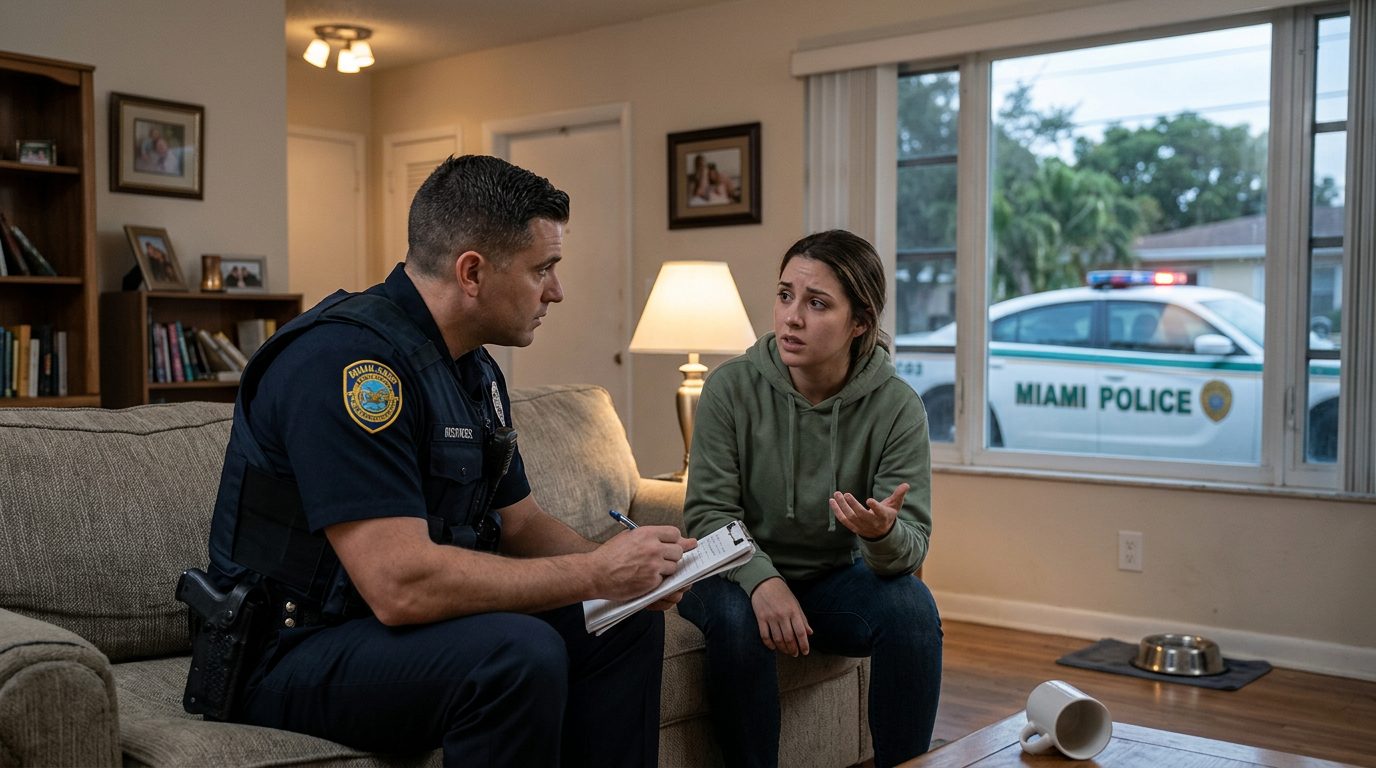
Yes. A person can be arrested or charged even when they say they acted in self-defense. Many people first learn about their case when they are charged, and the early stage is often when questions are worth discussing with a lawyer.
Florida law does limit arrests in this setting. Under § 776.032, a law enforcement agency may not arrest a person for using force unless it finds probable cause that the force was unlawful. Officers still must sort out what happened at the scene, so the first report often shapes early decisions.
Both people can end up arrested. This happens when each person tells police the other was the aggressor. Each account affects how officers document the scene and how prosecutors charge the case.
Self-defense is raised as a defense to the charge. It can come up early in the case or later at trial.
What Evidence Can Help Support a Self-Defense Claim in a Domestic Violence Case?
The strongest evidence shows what happened before, during, and after the force was used. Start with the 911 recording, any body camera footage, and the police report. Photos of injuries on every party and medical records can also matter.
Text messages, voicemails, and social media posts can show threats or earlier violence. That matters because the defense asks whether the fear was reasonable. The U.S. Department of Justice describes domestic violence as including emotional, psychological, and technological abuse. Messages and online threats can carry weight in these cases.
Witnesses help too. Neighbors or others who saw the events leading up to the incident can give a clearer picture. Write down the timeline while it is fresh, and keep the original messages and records you have.
Talk about the incident with your lawyer, not with the other person.
Can a Self-Defense Claim Lead to Pretrial Immunity Under Florida’s Stand Your Ground Law?
Yes, in some cases. Under § 776.032, a person who uses force as the self-defense statutes permit is justified and immune from criminal prosecution and civil action, unless the person against whom force was used or threatened is a law enforcement officer acting in the performance of official duties and the officer identified himself or herself or the person knew or reasonably should have known the officer was one. Whether that immunity applies depends on the facts of your case.
The statute’s definition of prosecution is broad. It includes arresting, detaining in custody, and charging or prosecuting the defendant.
Immunity is raised early, not only at trial. Under Fla. R. Crim. P. 3.190, immunity under section 776.032 must be raised by a motion to dismiss the charging document.
Under § 776.032(4), once the defendant raises a prima facie claim of immunity at a pretrial immunity hearing, the party trying to overcome immunity must prove its case by clear and convincing evidence. Immunity is raised by motion under Fla. R. Crim. P. 3.190. The process can involve sworn filings and evidence.
Domestic cases can also involve no-contact orders. The Florida courts domestic violence outline notes that a judge may impose a no-contact order as a pretrial release condition.
Not sure what your next step is?
Talk it through with our team — the first consultation is free, confidential, and carries no obligation.

Talk With Patrick Wilson Law About Your Aggravated Domestic Violence Charge
Being charged after a confrontation you believe was defensive is frightening. Watching someone you love get arrested is hard too. Early choices, like what you say and who you talk to, can shape the case.
Patrick Wilson Law, PLLC is a Miami criminal defense firm. Patrick David Wilson is the responsible lawyer for this page. Our Miami office serves Miami-Dade County, Broward County, and the Florida Keys. The firm defends domestic violence, DUI, sexual battery, and traffic homicide charges.
No outcome can be promised. Every case turns on its own facts.
Quick answers
Is aggravated domestic violence self defense valid in Florida?
It can be, when the force was reasonably believed necessary to stop an imminent threat of unlawful force.
Does Florida’s stand your ground law apply to domestic violence cases?
It can, under the immunity statute, if the force was justified. The claim is raised through a pretrial motion.
Can self-defense work if I started the argument?
Florida law bars the justification for someone who initially provokes force, unless a statutory exception applies.
If you’re facing this charge after a confrontation you believe was defensive, our team can review the facts with you in a free, confidential initial consultation with no obligation to continue. Call 786-761-1719 or leave us a message.
How Our Firm Approaches Self-Defense Cases
Review the Full Record
We examine the police report, witness statements, photographs, medical records and any recorded evidence to understand what happened before, during and after the incident.
Evaluate the Self-Defense Claim
We assess whether the facts support a claim that the force used was reasonably believed necessary to stop an imminent threat of unlawful force.
Plan the Defense Early
Early decisions about motions, evidence and communications can shape how a case develops, so we address them from the first consultation.
Protect Your Defense From Day One
Avoid discussing the incident with the other person involved, posting about it on social media or giving statements to anyone other than your attorney. Anything you say or write can become evidence.
Questions to Bring to Your Consultation
What Happened Before the Force?
Context, such as threats, prior incidents or who first made physical contact, often matters in a self-defense analysis.
What Did Police Document?
Arrest reports, body camera footage and 911 recordings can support or challenge the account you give.
Is a Pretrial Motion Possible?
In some cases, a self-defense claim can be raised through a pretrial motion, and we will discuss whether that path fits your situation.
What Are Your Options?
Every case is different. We explain the possible paths forward in plain language so you can make informed decisions.

