

Criminal Defense | Miami, Florida
Sealed Record, Still Unsure What to Disclose? Get Clear Answers First
Job applications, licensing forms and immigration questions each word the same issue differently, so the right answer depends on the exact question in front of you.
By Patrick David Wilson · Published November 13, 2026
If you’re filling out a job or license form, a sealed arrest can feel like a trap. You want to answer honestly without giving up a record the law may let you keep private.
In most cases, Florida law lets you deny or leave out a sealed arrest on an application. Whether an exception applies can depend on the facts of each case, so a free, confidential first consultation with Patrick Wilson Law is a good place to review your specific situation.
The Short Answer: Florida’s General Rule for Sealed Records
Under Florida law, you generally may deny or fail to acknowledge a sealed arrest. The sealing statute, Fla. Stat. § 943.059, says the subject of a sealed record may lawfully deny the covered arrests. The exceptions are listed in the same statute.
The statute also protects you from perjury and false-statement claims. A person granted a sealing may not be held to commit perjury for failing to recite the sealed record. That protection carries the same exceptions, so the general rule does not cover every form.
Not sure what your next step is?
Talk it through with our team — the first consultation is free, confidential, and carries no obligation.
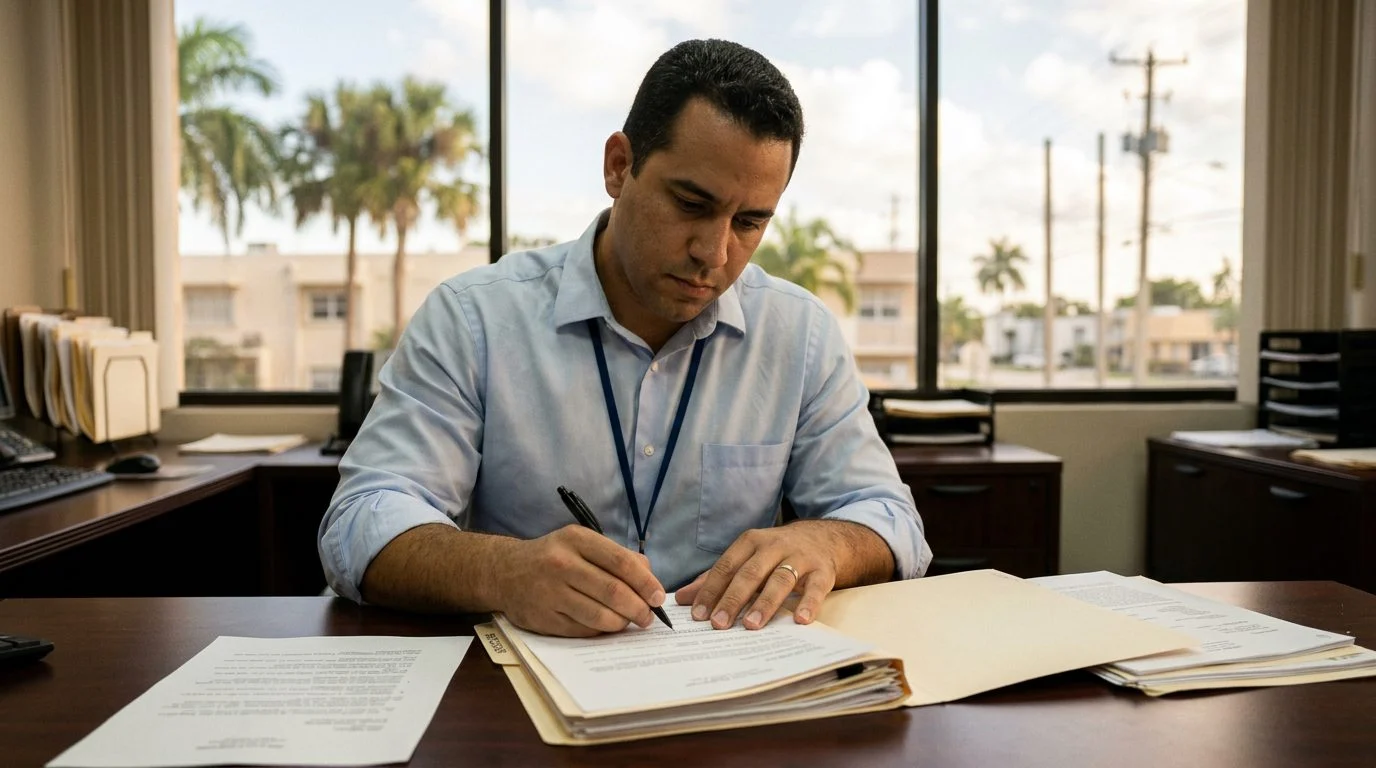
Sealed vs. Expunged: Why the Difference Matters on an Application
Sealing lets you deny or fail to acknowledge covered arrests, except when the subject of the record is a candidate for employment with a criminal justice agency or falls within the other listed exceptions. But they are separate court processes with separate rules. Sealing runs under § 943.059. Expunction runs under § 943.0585, which has its own eligibility conditions, such as whether a charging document was ever filed in the case.
A sealed record is confidential. Under the sealing statute, it is available only to the subject and to specified persons and entities. Some of those entities can see it for licensing, access authorization, and employment purposes.
An expunged record gets similar protection. The subject may lawfully deny or fail to acknowledge the covered arrests, except when the subject of the record is a candidate for employment with a criminal justice agency or meets another exception listed in § 943.0585.
Neither label makes a record invisible. Certain agencies and entities can still see it. So before you answer, find out which process cleared the record, and check the form against that.
When a Sealed Record Still Has to Be Disclosed
Yes, some applications still require disclosure. The exceptions are the most important part of the answer.
Under § 943.059, the right to deny does not apply when the subject is a candidate for employment with a criminal justice agency. It also does not apply when the person is screened through the Care Provider Background Screening Clearinghouse. The statute also gives certain licensing and employment entities access to sealed records that the general public cannot see.
Some records cannot be sealed or expunged at all. Under § 943.0584, a conviction makes a record ineligible for sealing or expunction if it falls within the listed offenses. The list includes homicide under s. 782.071, which covers vehicular homicide, and any offense defined in chapter 794, which covers sexual battery. It also lists certain domestic offenses and felony battery. If your case involves one of these convictions, the sealing route may not be open at all.
How the Wording of the Question Changes the Answer
The wording of the question often decides the answer. “Have you ever been arrested?” and “Have you ever been convicted?” call for different responses.
Under § 943.0584, a conviction means a determination of guilt after trial, or a guilty or nolo contendere plea. That counts even when adjudication is withheld. So a withheld adjudication can still count as a conviction on a form that asks about convictions.
Before you answer, do three things. Read the exact question and any instructions. Note whether it asks about arrests, charges, or convictions. Check whether any case is still open, because a pending case is not a sealed record and needs its own answer.
Licensed Professionals and Licensing-Board Applications
Under Fla. Stat. § 455.227, a licensee must report in writing, within 30 days, a conviction, a finding of guilt, or a guilty or nolo contendere plea. The duty applies regardless of adjudication. Failing to report is a ground for discipline.
A resolved case can still create that duty under § 455.227(1)(t), and failing to perform any statutory or legal obligation placed upon a licensee is also a ground for discipline. If the case ended in a plea or a finding of guilt, the reporting rule can apply even if adjudication was withheld. So check the reporting duty against the case’s outcome, not only against whether the record is sealed.
Criminal defense for licensed professionals is a large part of what this firm handles, so a licensing question often needs a close review of the case file.
Automatic Sealing and Petition-Based Sealing
Some records seal without a petition. Under § 943.0595, the Florida Department of Law Enforcement must automatically seal certain records. These include records where no charging document was filed, where charges were dismissed or nolle prossed, and where the case ended in a not guilty verdict or judgment of acquittal on all counts. The record must not result from a forcible felony as defined in s. 776.08 or from an offense enumerated in s. 943.0435(1)(h)1.a.(I).
Automatic sealing has the same effect as a sealing under § 943.059, except as the statute provides.
Petition-based sealing works differently. Under Florida Rule of Criminal Procedure 3.692, a petition must be in writing and filed with the clerk. It must include a valid certificate of eligibility from FDLE and a sworn statement. The court may deny any request at its sole discretion. The FDLE frequently asked questions page confirms that a court, not FDLE, has discretion over these petitions.
Not sure what your next step is?
Talk it through with our team — the first consultation is free, confidential, and carries no obligation.
What Happens if an Application Answer Is Inaccurate
An inaccurate answer can cost you a job or a license. The perjury protection covers failing to recite a sealed record, but only within the statute’s exceptions. An answer outside those exceptions has no such protection.
For licensees, the risk is higher. Under Fla. Stat. § 455.227, making or filing a report the licensee knows to be false is a ground for discipline, for reports signed in the capacity of a licensee. Under Fla. Stat. § 456.072, misleading representations about the profession are also grounds for discipline.
Can I deny a sealed arrest on a job application in Florida?
Exceptions apply, so check the exact question and who is asking.
Is a sealed record the same as an expunged record?
No. They are separate processes with different eligibility rules.
Does a withheld adjudication count as a conviction?
Under Fla. Stat. § 943.0584, a guilty or nolo contendere plea counts as a conviction even when adjudication is withheld.

Talking Through an Application With Patrick Wilson Law
If a job offer or a licensing deadline has you stuck on one question, you don’t have to work it out alone. Patrick Wilson Law, PLLC is a criminal defense firm based in Miami. It serves Miami-Dade County, Broward County, Fort Lauderdale, and the Florida Keys. Patrick David Wilson is the responsible lawyer for this page.
Our team handles criminal defense for licensed professionals and seal and expunge matters. Schedule your free, confidential first consultation at our contact page or call 786-761-1719. The consultation carries no obligation to continue.
How Patrick Wilson Law Can Help
Review the exact wording
We look at the precise question on your form or application so you understand what it asks and what it does not.
Criminal defense focus
Patrick Wilson Law focuses on criminal defense across South Florida, including sealing and expunging criminal records.
Built for first-time offenders and professionals
Our team regularly works with first-time offenders and licensed professionals whose careers depend on getting this right.
Confidential first conversation
Your free initial consultation is confidential and carries no obligation to continue.
Answer Carefully
A wrong answer on an application or licensing form can create problems of its own. Before you respond to any question about a sealed record, have the exact wording reviewed.
Common Situations We Hear About
Employment applications
Employers often phrase questions about arrests and records in different ways, and each version calls for a careful reading.
Professional licensing
Licensing boards and professional agencies may ask for detailed history, so the answer needs to match the form exactly.
Immigration and non-citizen matters
Forms tied to status or residency can ask about records in ways that carry their own consequences.
School and housing applications
Applications for education or housing may ask about past charges, and the wording determines what you need to disclose.

