

Seal & Expunge Criminal Records | Miami, FL
Wondering How to Clear a Misdemeanor From Your Record in Florida?
Learn how sealing and expungement differ, what a cleared record can and cannot do for you, and how a Miami criminal defense lawyer can review your options.
By Patrick David Wilson · Published November 18, 2026
A misdemeanor charge can follow you long after the case is over. If you want it off your record in Florida, the two main options are sealing and expunction, and the one you can seek depends on how the case ended.
Sealing hides the record from the public but keeps it for certain agencies. Expunction removes the entries from the court’s official records. Both usually run through the Florida Department of Law Enforcement (FDLE) and a court order. This guide walks through each step in plain terms.
Sealing and expunction: what each one does for a misdemeanor
Sealing hides a misdemeanor record from the public, while expunction takes it out of the court’s official files.
When a record is sealed, the clerk keeps the entries in a nonpublic index, subject to further court order. Fla. R. Crim. P. 3.692 describes this process.
Expunction goes further. The clerk removes the entries and records from the court’s official records. If removal isn’t practical, the clerk makes certified copies and then expunges the originals.
The two aren’t interchangeable. Expunction eligibility is governed by the conditions listed in Fla. Stat. § 943.0585, under which a person is eligible to petition a court to expunge a criminal history record if the listed conditions are met. Expunction and sealing are separate procedures under Florida law, each with its own eligibility requirements.
Your options depend on how the case ended, not only on the name of the charge. Two cases with the same charge can end in very different ways.
Neither remedy wipes the arrest from every database. The Florida Department of Law Enforcement must retain any criminal history record in its custody in all cases, even after a court orders expunction.
For a full overview of this practice area, see the firm’s seal and expunge criminal records page.
If an old misdemeanor is still holding you back, we can talk through how your case ended and whether sealing or expunction may fit. Talk it through with our team — the first consultation is free, confidential, and carries no obligation.
Eligibility: how the case ended matters most
You can usually petition for expunction when no charge was filed, or when the charge was dismissed, dropped through a nolle prosequi (the state attorney’s decision to drop the case), ended in acquittal, or ended in a not guilty verdict. Florida law sets out the eligibility requirements for petitioning a court to expunge a criminal history record.
Eligibility depends on the requirements set out in the statute, and whether a petition is available in your case depends on the facts of your record.
Adjudication withheld still matters. It means the judge did not enter a formal finding of guilt. For the ineligibility list, though, a conviction includes a guilty or no contest plea “regardless of whether adjudication is withheld.” Fla. Stat. § 943.0584 states that rule.
Earlier sealings also count. The expunction statute ties a prior sealing of at least 10 years to some cases where adjudication was withheld, so your full history matters.
Whether you qualify depends on the facts of your case. A charge name alone doesn’t answer the question.
Step one: obtaining a Certificate of Eligibility from FDLE
You must apply to FDLE for a certificate of eligibility before you petition a court. A court may not order a criminal justice agency to expunge a record until the person has applied for and received a certificate of eligibility from the Florida Department of Law Enforcement.
FDLE issues the certificate only when the record meets the statute’s criteria. Gather your case paperwork first. Collect the arrest date, the arresting agency, and the case number too.
Many people treat the certificate as the finish line. It isn’t. It only lets you file the petition, and the court still decides the request.
Certified copies cost money. Fla. R. Crim. P. 3.692 places that cost on the petitioner.
Step two: filing the petition with the court clerk
You file a written petition with the clerk of court. Attach your FDLE certificate and a sworn statement.
The sworn statement says you meet the eligibility rule and that no other petition to seal or expunge is pending. Fla. R. Crim. P. 3.692 lists these requirements.
You must also serve the completed petition, sworn statement, and certificate on the prosecuting attorney and the arresting authority. The state doesn’t need to name any other agency as a party.
The prosecutor and arresting agency may respond. The court may receive evidence on any fact it needs to decide the petition.
Incomplete or inconsistent paperwork can hold up a petition. Check dates and case numbers against your certified records before you file.
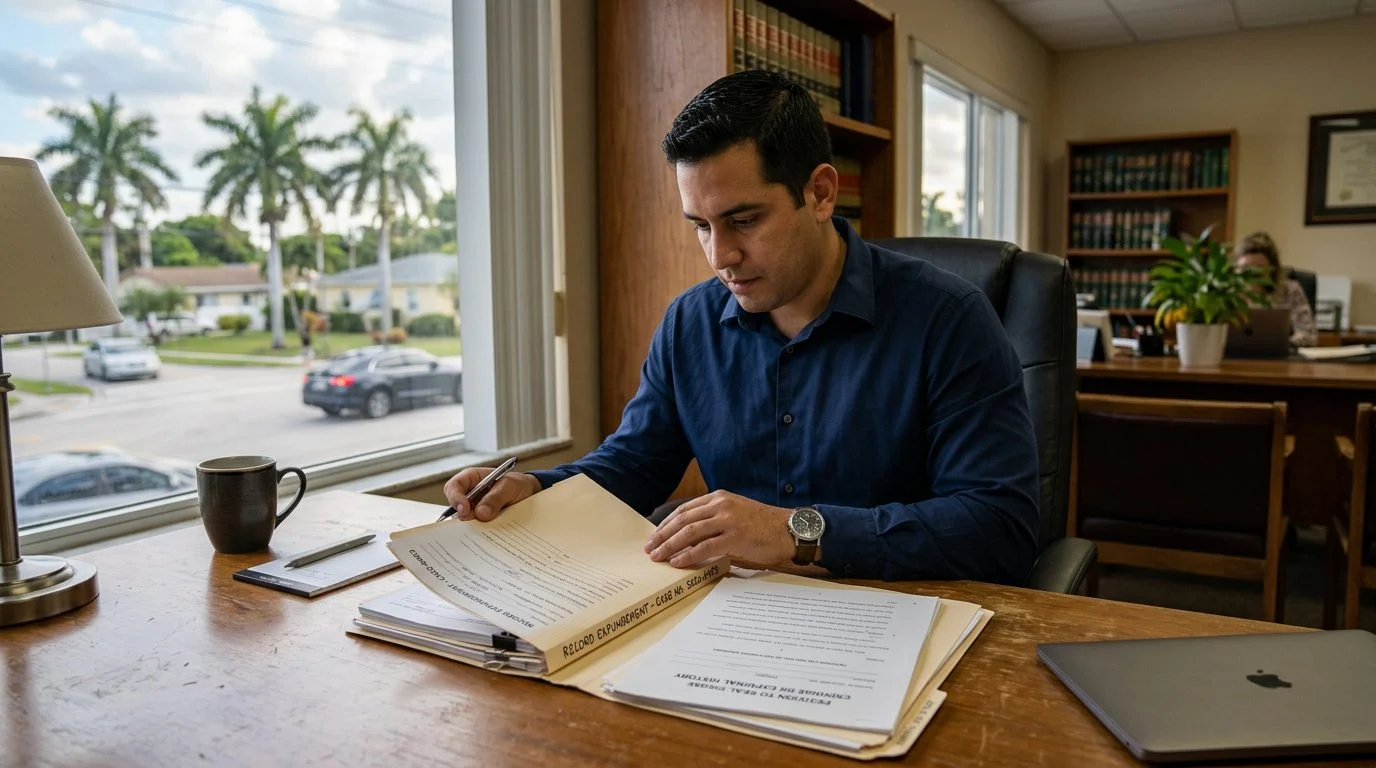
Step three: court review, the order, and what changes afterward
The judge decides the petition, and the written order is what changes the record.
The court can deny a request at its sole discretion. It can’t order an agency to seal or expunge a record until you have applied for and received the certificate. If the petition is granted, the order names the records and agencies it covers. Fla. R. Crim. P. 3.692 sets out these rules.
Sealed or expunged records don’t disappear for everyone. A court may deny any request to expunge or seal a record at its sole discretion.
Florida also seals some records automatically, without a petition, for outcomes such as a dismissal or a not guilty verdict. Under that law, other criminal justice agencies keep their own copies. Fla. Stat. § 943.0595 covers automatic sealing.
How you answer an employer or landlord depends on the exact question asked and the order you receive.
Misdemeanors that need closer review: DUI, domestic violence, and records with adjudication
DUI and domestic violence charges need closer review because they can raise separate eligibility questions.
A DUI charge arises when a person drives or is in actual physical control of a vehicle within this state while under the influence of alcoholic beverages, any chemical substance set forth in s. 877.111, or any substance controlled under chapter 893, to the extent that normal faculties are impaired. Fla. Stat. § 316.193 defines the offense.
Domestic violence is defined in Fla. Stat. § 741.28 to include battery and other assaults against a family or household member. A conviction for assault or battery of one family or household member by another is on the ineligibility list in Fla. Stat. § 943.0584.
First-time offenders may have another path. A person charged with a misdemeanor who has a substance abuse problem and no prior felony conviction can be admitted to a pretrial program. Florida’s misdemeanor pretrial substance abuse education and treatment intervention program is available to a person charged with a misdemeanor who is identified as having a substance abuse problem and has not previously been convicted of a felony. If charges are dismissed after successful completion, the arrest record may be expunged, if the person is otherwise eligible.
Licensed professionals whose license is at stake can read the firm’s page on criminal defense for licensed professionals.
Not sure what your next step is?
Talk it through with our team — the first consultation is free, confidential, and carries no obligation.
Talk with a Miami criminal defense team about your record
A consultation can help you see whether sealing or expunction may fit how your case ended.
You may be reading this after your own arrest, while a family member’s case is pending, or because an old misdemeanor keeps appearing on background checks.
Patrick Wilson Law, PLLC is a criminal defense firm in Miami. It serves Miami-Dade and Broward counties and the Florida Keys, and sealing and expunction are among its practice areas. Patrick David Wilson is the lawyer responsible for this page.
Can I get a misdemeanor sealed or expunged in Florida?
Often, if the case ended without a conviction, such as a dismissal or an acquittal. Whether you qualify depends on the facts of your case.
Will a sealed record still show up on a background check?
It may. Other criminal justice agencies can keep their own copies, and some licensing and employment entities can still learn of it.
If an old misdemeanor is still holding you back, call 786-761-1719 or leave us a message. The first consultation is free, confidential, and carries no obligation to continue.
Why Clients Work With Patrick Wilson Law
Criminal defense focus
Patrick Wilson Law focuses on criminal defense across South Florida, including the record-clearing matters that follow a criminal case.
Clear, practical review
We explain the difference between sealing and expunging, review the court file, and walk you through the steps that apply to your situation.
Attention for first-time offenders
Many of our clients are facing a first charge for the first time. We take the time to explain each option in plain language.
Planning beyond the case
Our team considers how a record may affect jobs, licenses, housing and immigration status, and what steps may help.
Important: A Cleared Record Is Not Always Invisible
Sealing or expunging a record does not erase it everywhere. Some agencies keep their own copies, and certain employers or licensing bodies may still see the matter. Talk with a lawyer before you assume the case is fully hidden.
Common Questions About Clearing a Misdemeanor
Sealing versus expunging
Both options can limit public access to a case, but they work differently. Which one may fit depends on how the case ended and what the court record shows.
What happens after the case closes
A closed case does not automatically disappear from every database. Reviewing the court file and the background checks that may matter to you is an important early step.
Your next step
Bring copies of the charging documents, any dismissal or disposition papers, and a list of where you need the record cleared. This helps us give you a clearer picture at your consultation.

