
Miami Criminal Defense | Super Speeder Charges
Facing a Super Speeder Charge in Florida?
Patrick Wilson Law, PLLC defends drivers across South Florida, from Miami-Dade and Broward to the Florida Keys. Learn how these charges work and what defense options may apply to your case.
By Patrick David Wilson · Published November 4, 2026
A super speeder charge in Florida is a charge for dangerous excessive speeding. You commit this offense when you drive 50 miles per hour or more over the speed limit, or when you drive at 100 mph or more in a way that threatens others. It is far more serious than an ordinary speeding ticket. It can bring jail time, fines and license trouble.
This guide explains the charge in plain terms. It covers how Florida classifies it, what the penalties are at each level, how points and license rules apply, and how drivers in Miami-Dade, Broward and the Florida Keys can think about their options.
What Is a Super Speeder Charge in Florida?
A super speeder charge is a charge for dangerous excessive speeding under Florida’s dangerous excessive speeding statute. The law sets two paths. The first is driving 50 mph or more above the speed limit. The second is driving 100 mph or more in a way that threatens the safety of people or property, or interferes with the operation of any vehicle.
The speed limit is the posted limit on the road you were driving. The math starts from that posted number. If the limit is 55 mph and you drive 105 mph, you are 50 over. If the limit is 30 mph on a city street and you drive 80 mph, the same rule applies.
Ordinary speeding is handled differently. Florida’s unlawful speed statute covers everyday speeding. Dangerous excessive speeding is a separate offense with its own penalties. Keeping these two apart is the first step in understanding your exposure.
If you have a ticket for driving far over the posted limit and can't decide whether to fight it, accept it or ask about your license, we can help you sort it out. Talk it through with our team — the first consultation is free, confidential, and carries no obligation.
How Florida Classifies the 50-Over Offense
Ordinary unlawful speed is a noncriminal traffic infraction. Dangerous excessive speeding is different because it carries possible jail time. Under Florida’s penalties statute, a noncriminal violation cannot bring imprisonment or any punishment more severe than a fine, forfeiture, or other civil penalty, except as provided in chapter 316 or by ordinance of any city or county. Chapter 316 is the traffic chapter that contains the super speeder offense.
The default limits are 30 mph in business and residence districts and 55 mph at all other locations. Cities and counties can set lower limits on some local streets after an investigation. That is set out in § 316.183.
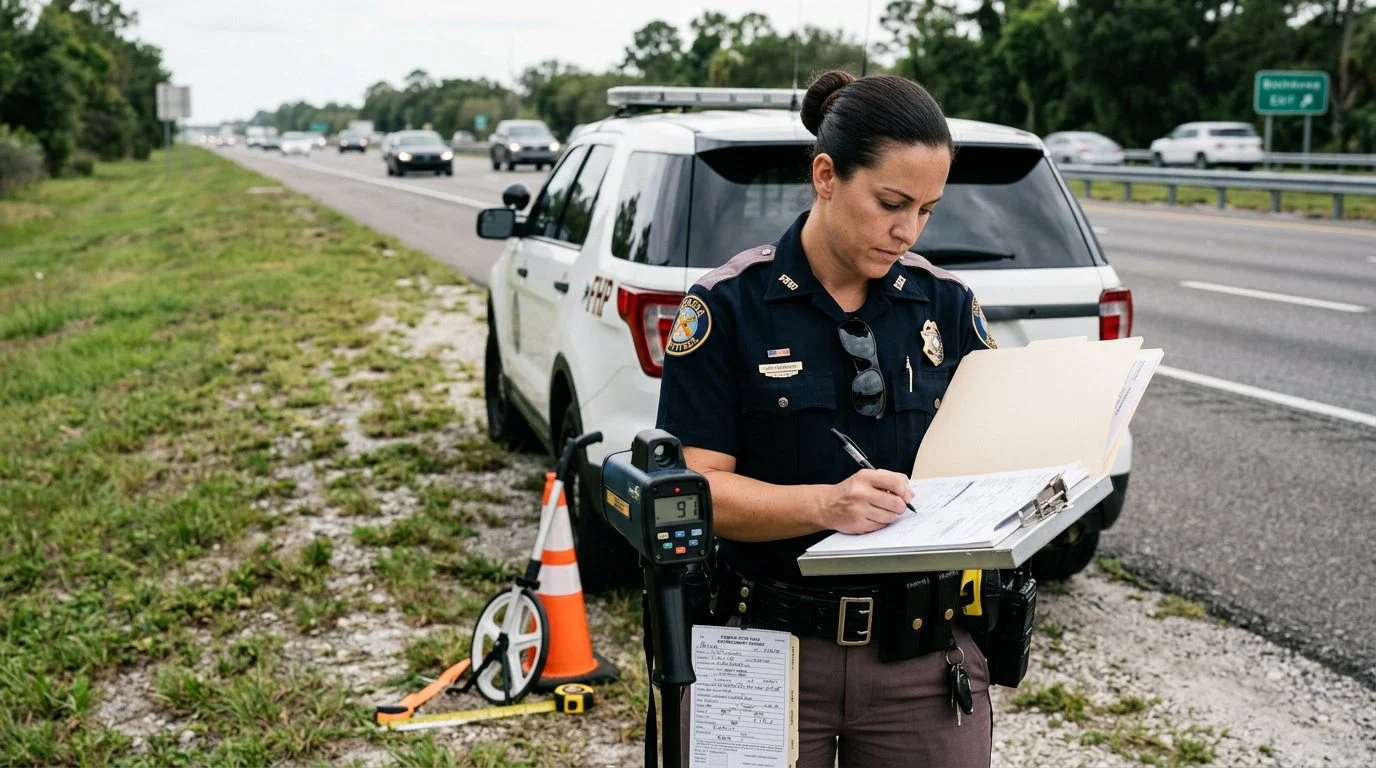
The officer’s paperwork matters. The speed reading, the posted limit and the citation all shape how the charge is built. Section 7 explains how the speed measurement can be reviewed.
Penalties Under the Super Speeder Law: First Offense
A first conviction carries up to 30 days in jail, a $500 fine, or both. This comes from § 316.1922. The statute allows jail, a fine, or both.
The fine is only part of the bill. Court costs are added on top of the fine for a criminal traffic offense under state law. Under § 775.083, those costs are $20 for any offense other than a felony. The costs are assessed in addition to the fine.
License action can also follow. See § 322.27.
First-time drivers often ask how a charge will affect work and daily driving. The answer turns on the sentence and any license action. Those are the first things to review on your own case.
Second and Third Offenses and License Suspension
A second or later conviction carries up to 90 days in jail, a $1,000 fine, or both. Fla. Stat. § 316.1922 sets penalties for a first conviction and for a second or subsequent conviction. A third conviction falls under the second-or-subsequent rule.
A person convicted of a second or later violation of this section that occurs within 5 years after the date of a prior conviction for dangerous excessive speeding under this section has their license revoked for at least 180 days but no more than 1 year. § 316.1922 states this rule.
Prior convictions are counted carefully. A prior conviction counts only if it was a conviction for dangerous excessive speeding under this section, and the license revocation applies when the new violation occurs within 5 years after the date of that prior conviction. That rule matters when a driver has more than one ticket in a short period.
A prior conviction can change both the jail range and the license outcome, so the full record needs review.
Points, Insurance and the Wider License Consequences
Florida tracks driving convictions with a point system. A licensee who accumulates 12 points within a 12-month period faces a suspension of not more than 30 days.
Points depend on the violation. The Florida Department of Highway Safety and Motor Vehicles administers the point system.
Insurance is a separate question. Insurers set their own rating rules, so premiums can change in different ways from one company to another. Keep your records of any citation or conviction so you can answer your insurer’s questions accurately.
Consequences for Licensed Professionals and Non-Citizens
A super speeder conviction can carry consequences beyond the court sentence. For licensed professionals, the impact turns on the profession and the licensing board’s rules. Florida’s discipline statute for licensed health professionals lists grounds for discipline. It also lists penalties such as suspension, restriction of practice and remedial education.
For non-citizens, the stakes can be higher. Federal law lists classes of deportable non-citizens, and one class covers criminal offenses. See 8 U.S.C. § 1227. Whether a particular speeding conviction falls within those classes turns on the exact charge and the record. That review is separate from the state penalties.
If alcohol was involved in the stop, the case can include separate DUI charges. Those charges have their own penalties and license rules, so they need their own review.
Patrick Wilson Law handles criminal defense for licensed professionals and for non-citizens. These collateral issues are often as important to the client as the speeding charge itself.
Not sure what your next step is?
Talk it through with our team — the first consultation is free, confidential, and carries no obligation.
How a Super Speeder Charge Is Defended
A super speeder charge can be challenged by testing the stop, the speed reading and the equipment used. Florida sets specific rules for radar evidence. Under § 316.1906, radar speed evidence is inadmissible unless the officer completed the state radar training course. Fla. Stat. § 316.1906 reads: “(2) Evidence of the speed of a vehicle measured by any radar speed-measuring device shall be inadmissible in any proceeding with respect to an alleged violation of provisions of law regulating the lawful speed of vehicles, unless such evidence of speed is obtained by an officer who: (a) Has satisfactorily completed the radar training course established by the Criminal Justice Standards and Training Commission pursuant to s. 943.17(1)(b).” The officer must also have made an independent visual determination that the vehicle was speeding.
The same statute has other requirements. The citation must be written from radar when conditions allow a clear reading on a single vehicle. The radar unit must have no automatic speed lock and no audio alarm, unless they are disconnected or deactivated. Speed evidence from radar is inadmissible unless the officer has completed the radar training course, made an independent visual determination that the vehicle is operating in excess of the applicable speed limit, written the citation from radar when conditions permit a clear assignment of speed to a single vehicle, has audio Doppler engaged, and is using a radar unit that meets the minimum design criteria set by the Department of Highway Safety and Motor Vehicles.
Automated speed detection systems follow their own rules. The system must run a self-test at least once every 30 days, and the agency must keep a log of those tests. An independent calibration test must be done at least once every 12 months. Those logs and calibration results can be used in court for certain speed citations.
Dash-camera and body-camera video, witness information and the timeline of the stop can also matter. Defense options can include contesting the charge, seeking a reduced charge, or negotiating a resolution. The right path turns on the record in your case.
Is Fighting a Super Speeder Charge Worth It?
Fighting a super speeder charge is worth weighing against the cost of accepting it without review. The exposure includes up to 30 days in jail for a first offense, a $500 fine, and $20 in court costs. A second or subsequent conviction adds up to 90 days in jail, a $1,000 fine, or both; if the violation occurs within 5 years after a prior conviction, the driving privilege is also revoked for at least 180 days but no more than 1 year.
Other factors matter too. Consider your prior record, the license at stake, and any job or licensing requirement that depends on a clean driving record. Consider how a conviction could affect a professional license or immigration status.
Whether a defense is worth pursuing turns on the facts of the stop and your record. Patrick Wilson Law reviews those facts in a free, confidential first consultation. That review gives you a clear comparison for your specific case.
Can a super speeder ticket be dismissed in Florida?
A dismissal depends on the facts of each case, and no result can be promised. The evidence and procedure in your case decide what options exist.
How many days in jail for speeding 50 over in Florida?
A first conviction carries up to 30 days in jail. A second or later conviction carries up to 90 days.
Can a super speeder conviction suspend my license?
A court can direct a license suspension. A second violation within 5 years after a prior conviction requires revocation of 180 days to 1 year.
Where Patrick Wilson Law Handles Super Speeder Cases
Patrick Wilson Law, PLLC is a criminal defense firm based in Miami, Florida. The firm focuses on criminal defense across South Florida, from Broward County to the Florida Keys. The firm serves Miami, Miami-Dade County, Broward County, Fort Lauderdale, Kendall, Hialeah, Miami Beach, Homestead and the Florida Keys.
The firm handles DUI, domestic violence, sexual battery, vehicular homicide, white collar matters, leaving the scene of an accident, and super speeder charges. It also handles criminal defense for licensed professionals, criminal defense for non-citizens, first-time offender cases, and record sealing and expungement.
The firm’s lawyers include Patrick David Wilson and Sahara Fonseca. Our team, including the firm’s assistants and office staff, supports each matter from the first call through the case.
Talk With Patrick Wilson Law About Your Ticket
If you have a citation in hand for driving far over the posted limit, you may be weighing whether to fight it, accept it, or ask about your license. Those choices carry real consequences for your record, your job and your driving. You don’t have to make them alone.
You can call 786-761-1719, leave us a message, or schedule a free consultation. The first consultation is free, confidential and comes with no obligation to continue (consulta inicial gratuita, confidencial y sin compromiso).
This page is the responsibility of Patrick David Wilson, Patrick Wilson Law, PLLC, located in Miami, Florida.
Common Questions About Super Speeder Charges
Can a super speeder ticket be dismissed?
Outcomes depend on the facts of each case. Our team reviews the evidence and procedure in yours and explains which options may exist. No result can be promised.
What are the penalties for speeding 50 over?
Florida law sets jail, fine and license consequences that can increase with prior convictions. We walk you through the penalties that may apply to your charge.
Can a first-time offender have different options?
First-time offenders may face different options than drivers with a prior record. We discuss how your history affects your defense during your free consultation.
Does a prior record change my case?
Prior convictions can change what is at stake. Bring your paperwork to your consultation so we can review it with you.
How Our Team Approaches Super Speeder Cases
Careful Review of the Charge
We look at the citation, the speed reading, the equipment used and the paperwork to understand what the state must prove in your case.
Defense Options Explained
Every case is different. We explain the defense options that may apply to your situation and what each could mean for you.
Clear, Direct Communication
You will know what to expect at each stage, and our team answers your questions without pressure.
Support for First-Time Offenders
Many people facing a super speeder charge have never been in trouble before. We focus on protecting your record and your driving privileges.
Serving South Florida
We represent drivers in Miami, Miami-Dade, Broward, Fort Lauderdale, Kendall, Hialeah, Homestead, Miami Beach and the Florida Keys.
Do Not Ignore the Citation
A super speeder charge can carry serious consequences, including possible jail time and license consequences. Speak with a lawyer before you respond to the court or sign any paperwork.

