
Vehicular Homicide Defense | Miami-Dade County
Miami Vehicular Homicide Crash Reconstruction Guide: How Crash Evidence Is Analyzed
Patrick Wilson Law, PLLC explains how crash reconstruction evidence is gathered, measured and challenged in vehicular homicide cases across South Florida.
By Patrick David Wilson · Published October 22, 2026
For crash reconstruction vehicular homicide Florida cases, the central questions are speed and causation. Crash reconstruction and event data recorder (EDR) data are often the main evidence on both. Florida law requires the state to prove that a driver operated a vehicle in a reckless manner likely to cause death or great bodily harm. This guide explains how that physical evidence is gathered, tested and challenged. Patrick Wilson Law, PLLC is a Miami criminal defense firm. Patrick David Wilson is the responsible lawyer for this page.
Why speed and causation decide so much in a Florida vehicular homicide case
Speed and causation often decide whether a vehicular homicide charge can be proven. In Florida, vehicular homicide is the killing of a human being, or the killing of an unborn child by any injury to the mother, caused by the operation of a motor vehicle by another in a reckless manner likely to cause the death of, or great bodily harm to, another. Speed is the fact most often argued.
Florida uses more than one speed standard. Under Fla. Stat. § 316.183, a driver cannot go faster than is reasonable and prudent for the conditions. That rule applies even when the driver stays under the posted limit. Reckless driving under Fla. Stat. § 316.192 includes driving in willful or wanton disregard for safety, and fleeing a law enforcement officer in a motor vehicle is reckless driving per se. Each test asks a different question, so the same physical evidence can be read in different ways.
Braking, lane position and timing also matter. Prosecutors and defense teams often dispute these physical facts. Patrick David Wilson focuses on vehicular homicide defense for drivers in Miami-Dade, Broward and the Florida Keys.
If your vehicle has been towed or its crash data is already part of the investigation, we can review what was collected with you in a free, confidential first consultation. Talk it through with our team — the first consultation is free, confidential, and carries no obligation.
What crash reconstruction is and who usually performs it
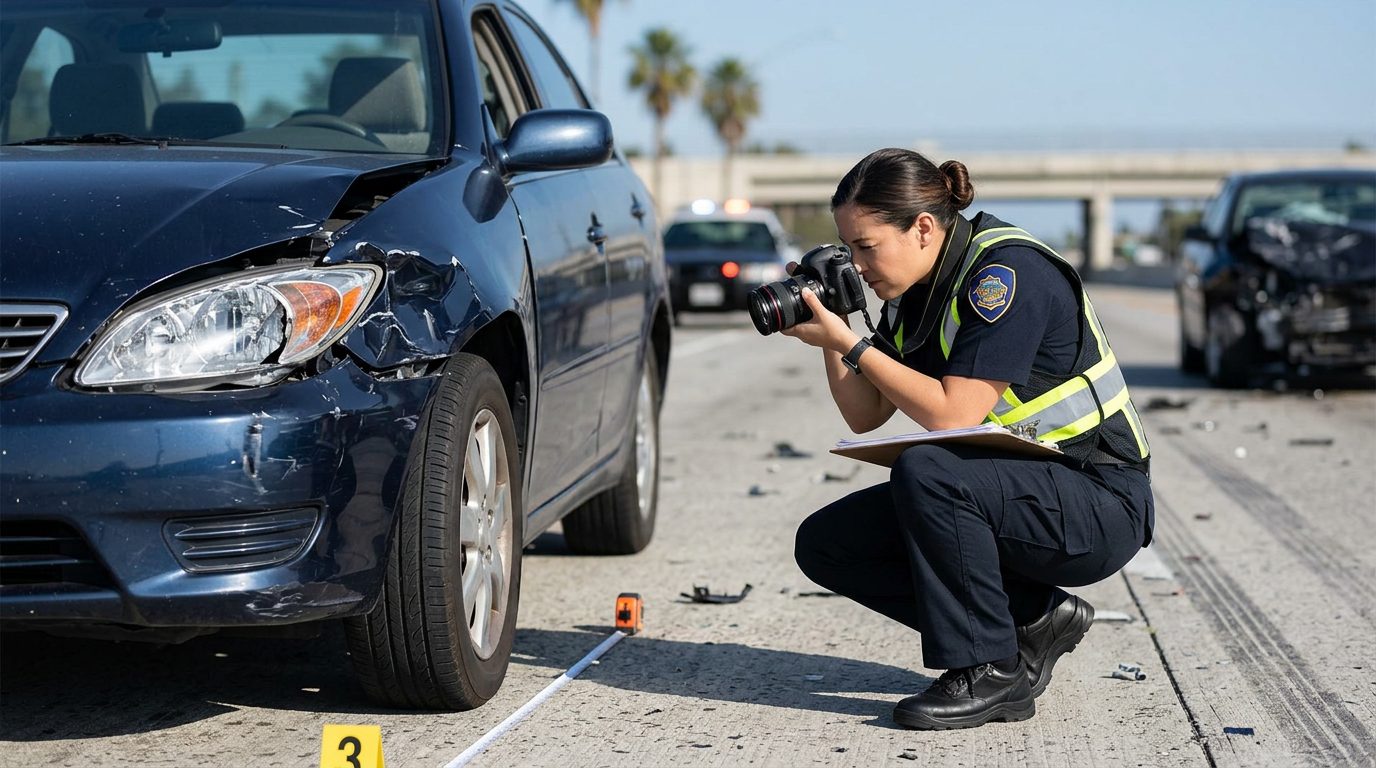
Crash reconstruction is the study of physical evidence to estimate how a crash happened. Investigators look at roadway marks, debris fields, where vehicles came to rest, vehicle damage and measured distances at the scene. A crash report is usually the starting record.
A detailed reconstruction may come from agency investigators. It may also come from outside reconstructionists hired by either side. Most rely on physics-based math, including momentum, friction and energy calculations. Each step rests on assumptions. How carefully those assumptions are written down and checked decides how much weight a speed estimate deserves.
How event data recorder data captures the seconds before a crash
An event data recorder (EDR) is a vehicle module that stores data around a crash. Many modern vehicles have one, often housed in the airbag control module. Depending on the make and model, it may record speed, brake switch status, accelerator position, steering input and seatbelt status.
Reading an EDR takes dedicated tools and software. Analysts then compare the data with scene evidence, such as tire marks and damage. They check whether the numbers fit the physical crash. A mismatch can matter as much as a match.
EDR data is also fragile. It can be overwritten or lost if the vehicle is repaired, sent to salvage or if its module is replaced. That makes early preservation of the vehicle important.
How speed and causation findings are tested
Speed findings are tested by checking whether all the evidence tells the same story. A reliable reconstruction reconciles EDR data, scene measurements, witness statements, any phone or dash camera timestamps, and the damage pattern.
When police used radar or another speed device, Florida law sets its own foundation rules. Under Fla. Stat. § 316.1906, in a proceeding over an alleged violation of the laws regulating the lawful speed of vehicles, radar speed evidence is inadmissible unless the officer met conditions such as completing required training and making an independent visual determination of speed.
For speed-calculating devices, Fla. Stat. § 316.1905 requires testing not less than once each 6 months. Under Fla. Stat. § 316.1905, a signed and witnessed certificate showing that the device was tested within the required time period and was working properly creates a presumption that the device was working. Fla. Stat. § 316.1905 reads: “(b) Upon the production of a certificate, signed and witnessed, showing that such device was tested within the time period specified and that such device was working properly, a presumption is established to that effect unless the contrary shall be established by competent evidence.” That presumption can be challenged with competent evidence. An accused driver is entitled to have the officer who operated the device testify on oral or written motion.
Defense review also looks at calibration, whether data reflects wheel speed or ground speed, and chain of custody. It asks whether a sudden hazard or mechanical problem could explain the damage.
Questions that often come up about obtaining vehicle data
Vehicle data is gathered through police and investigative steps. The lawful route depends on the facts of the case.
Can investigators download vehicle data?
Whether investigators could lawfully download vehicle data depends on the facts. Those circumstances can affect what evidence may be used. Florida also has a blood-test rule for fatal crashes. When an officer has probable cause that an impaired driver caused death or serious bodily injury, the officer must require a blood test. The officer may use reasonable force if needed, under Fla. Stat. § 316.1933. Under Fla. Stat. § 316.193, a person is guilty of driving under the influence if the person is driving or in actual physical control of a vehicle within this state and is under the influence to the extent that the person’s normal faculties are impaired.
What should a defense team request?
A defense team typically asks for the raw download file, the software version and settings, the technician’s notes, and the reconstruction calculations. A summary alone is not enough. Florida’s discovery rule helps here. Under Fla. R. Crim. P. 3.220, a “statement” includes police and investigative reports prepared for or in connection with the case, but not the notes from which those reports are compiled. Prosecutors must also disclose certain reports made in connection with the case. If material is not disclosed, the court may prohibit the state from introducing it.
Does the crash report decide the case?
No single report decides the case.
Where reconstruction fits within the rest of a vehicular homicide case
Reconstruction is one piece of a larger case. The case may also include impairment, leaving the scene and the driver’s record.
Leaving the scene carries its own risk. Under Fla. Stat. § 316.027, a driver in a crash that causes death must stop and remain at the scene. Under Fla. Stat. § 316.027(2)(c), a driver who willfully fails to stop and remain at the scene of a crash that results in a person’s death commits a first-degree felony and faces a mandatory minimum term of imprisonment of 4 years. The defendant may move to depart from the mandatory minimum term of imprisonment prescribed in paragraph (c) of Fla. Stat. § 316.027, unless the violation was committed while the defendant was driving under the influence. The court may grant the motion only if it finds that a factor, consideration, or circumstance clearly demonstrates that imposing the minimum would result in an injustice, and the motion is unavailable if the violation was committed while the defendant was driving under the influence.
The vehicular homicide statute also has its own tiers. Under Fla. Stat. § 782.071, the offense is a first-degree felony if the driver knew or should have known the accident occurred and failed to give information and render aid. It is also a first-degree felony if the driver has a qualifying prior conviction.
Crashes in different parts of South Florida may involve different investigating agencies. That can shape where vehicle evidence is collected. For a broader overview, read the vehicular homicide defense guide.
Not sure what your next step is?
Talk it through with our team — the first consultation is free, confidential, and carries no obligation.
Why early review of crash and vehicle evidence matters
Early review shows which vehicle data has been collected and which has not. It also shows what may still be preserved. Vehicles get repaired, towed and sold. Witnesses forget details, and scene conditions change.
A timeline built early makes it easier to compare the physical evidence with each side’s account. Early photos of the scene, the vehicles and the damage are often valuable. They record conditions that later change.
Raising preservation early lets the defense ask for records before they change or disappear.
Talk with Patrick Wilson Law about your crash and vehicle data
If your vehicle has been towed, its module has been pulled, or a crash report lists a speed you think is wrong, a conversation can clarify what has been collected. It can also show what is still available.
Patrick Wilson Law, PLLC is based in Miami. The firm represents people in Miami, Miami-Dade, Broward, Fort Lauderdale, Kendall, Hialeah, Miami Beach, Homestead and the Florida Keys. The firm’s lawyers, including Patrick David Wilson and Sahara Fonseca, handle vehicular homicide matters.
The first consultation is free, confidential and carries no obligation to continue. To talk about your crash evidence, request a free consultation or call 786-761-1719.
How our lawyers approach reconstruction evidence
Reviewing the full file
Our team reviews crash reports, scene photos, measurements and diagrams to understand what the reconstruction is based on.
Testing the assumptions
Speed estimates, reaction times and roadway conditions are examined to see whether the conclusions rest on reliable inputs.
Protecting your rights
Our lawyers focus on how evidence was collected and whether it was obtained and preserved properly.
Clear explanations
We explain technical findings in plain language so you can make informed decisions about your case.
Speak with a lawyer before discussing the crash
Statements to police, insurers or other drivers can be used in a later case. Contact a lawyer before you give a recorded or written account of a fatal or serious crash.
Common types of crash reconstruction evidence
Vehicle event data
Onboard recorders can store speed, braking and throttle information. Whether this data can be used depends on how it was obtained and preserved.
Skid marks and crush damage
Tire marks, vehicle deformation and debris fields are measured to estimate speed, angle and point of impact.
Scene measurements and photos
Diagrams, total station data and photographs document the roadway, sight lines and final rest positions.
Phone and witness records
Phone activity, traffic camera footage and witness accounts can be compared against the physical evidence.
Talk with Patrick Wilson Law about your vehicular homicide case. Patrick David Wilson, responsible lawyer, and our lawyers in Miami serve clients across Miami-Dade, Broward County and the Florida Keys. Your first consultation is free, confidential and comes with no obligation to continue.
Related practice areas
- Vehicular Homicide Defense Attorney in South Florida: Charges, Penalties and How the Defense Is Built
- Blood Draw After Fatal Crash Florida: Consent and Refusal

