
Vehicular Homicide Defense | Miami
Facing Jail Time for Vehicular Homicide in Florida? Talk to a Miami Defense Lawyer
Patrick Wilson Law, PLLC defends people across South Florida, from Miami-Dade and Broward to the Florida Keys, against vehicular homicide and related traffic homicide charges. Call 786-761-1719 to discuss your situation.
By Patrick David Wilson · Published October 28, 2026
Vehicular homicide in Florida is a second-degree felony. The statute allows up to 15 years in state prison and a fine of up to $10,000. That is the ceiling, and the actual jail or prison time comes from a sentencing process that looks at much more than the top number.
How long can you be sentenced to for vehicular homicide in Florida?
The longest sentence for a basic vehicular homicide conviction is 15 years in state prison. Under Fla. Stat. § 782.071, the offense is a second-degree felony, unless a first-degree provision applies, such as a prior conviction under this section. The fine limit for a second-degree felony is $10,000 under Fla. Stat. § 775.083.
The statute also sets a higher level. If the driver knew or should have known the crash happened, and did not give information and render aid as the law requires, the offense is a first-degree felony. The statute says this does not require knowing that the crash caused injury or death.
The court may also order 120 hours of community service in a trauma center or hospital, in addition to other punishment. Think of 15 years as a ceiling, not a prediction. The sentence a judge imposes falls inside a range set by the sentencing rules. For more on the charge itself, see our vehicular homicide defense page.
If a crash has left someone you love facing a vehicular homicide charge, you don't have to sort out the sentencing rules alone; our team offers a free, confidential first consultation. Talk it through with our team — the first consultation is free, confidential, and carries no obligation.

What must the State prove to convict you of vehicular homicide?
The State must prove that a death was caused by how a vehicle was driven, and that the driving was reckless. The statute defines vehicular homicide as “the killing of a human being … caused by the operation of a motor vehicle by another in a reckless manner likely to cause the death of, or great bodily harm to, another.”
Two parts matter most. First, the death must come from the way the vehicle was operated. Second, the driving must be reckless, not just a mistake.
The word “accident” does not decide the case by itself. A crash can be an accident in everyday speech and still lead to a homicide charge if the State can show reckless driving.
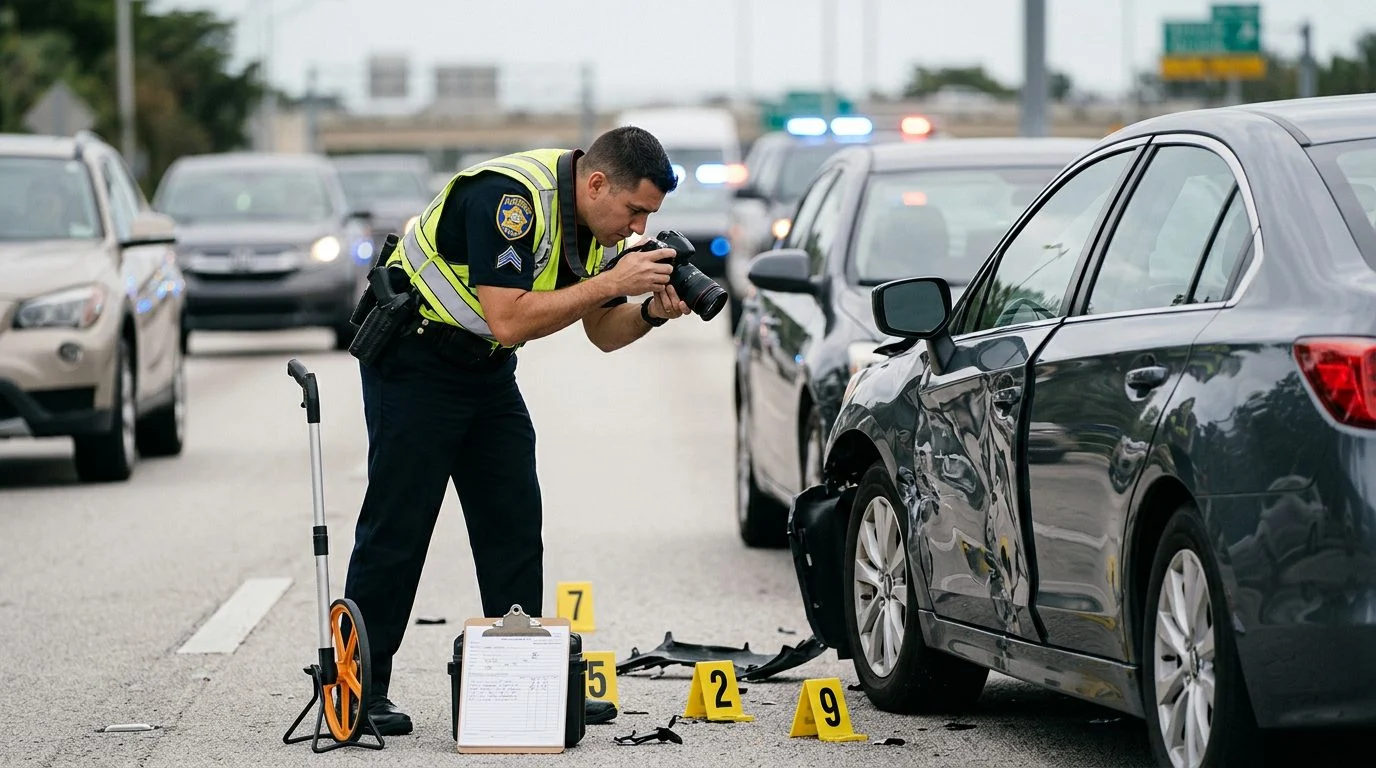
Prosecutors often rely on crash reconstruction, vehicle data, speed evidence, and witness accounts. These pieces show how the car was moving before the crash. They are often where the real dispute happens.
Is vehicular manslaughter worse than vehicular homicide in Florida?
Florida’s law uses the name vehicular homicide, not vehicular manslaughter. People often describe the accusation they face in their own words, and those words may not match the language in the paperwork they receive.
A crash death that involves alcohol or drugs may fall under a different statute. DUI manslaughter is covered by Fla. Stat. § 316.193. It is a separate offense with its own penalties.
So the question is less about which name is worse. The stakes turn on which statute the State charges and on the facts behind the charge.
How does the court set the actual jail or prison time?
The court starts with a Criminal Punishment Code scoresheet. That scoresheet sets the lowest permissible sentence, which is the minimum the judge may impose absent a valid reason for departure.
The court can still choose prison if it finds prison appropriate. Above 44 points, the lowest prison term is figured by subtracting 28 points and reducing the rest by 25 percent. Any sentence to state prison must be more than one year.
Under Fla. R. Crim. P. 3.704, the state attorney prepares the scoresheet. Defense counsel reviews it for accuracy after the prosecutor prepares it and presents it to defense counsel for review.
Plea agreements also shape the result. Under Fla. R. Crim. P. 3.171, defense counsel must advise the client of all plea offers and their likely results.
Mitigating factors can support a sentence below the lowest permissible range. Fla. Stat. § 921.0026 lists examples, such as an isolated incident committed in an unsophisticated manner, where the defendant has shown remorse.
Can you go to jail for accidentally killing someone in a car accident in Florida?
Yes. Under Florida’s vehicular homicide statute, § 782.071, a driver can face a second-degree felony charge and possible prison time when a death is caused by operating a motor vehicle in a reckless manner likely to cause death or great bodily harm. The charge becomes a first-degree felony if the driver knew, or should have known, that the accident occurred and failed to give information and render aid as required by § 316.062.
The word “accidentally” matters less than how the car was driven. Under § 782.071, the State must show reckless operation. A crash without reckless driving may lead to a different charge. Reckless driving is its own offense under Fla. Stat. § 316.192.
Speed alone can be part of the picture. Whether it meets the reckless standard depends on the facts, including the surrounding driving.
Conduct after the crash also matters. Under Fla. Stat. § 316.027, a driver in a crash that causes death must remain at the scene until the duties in § 316.062 are met.
How do DUI and leaving the scene change the sentence?
DUI is covered by Fla. Stat. § 316.193. It applies when a person drives, or is in actual physical control of a vehicle within Florida, while under the influence to the extent that normal faculties are impaired. Intoxication is not a mitigating factor for sentencing under § 921.0026, apart from one drug-court provision. It does not justify a downward departure.
Leaving the scene adds separate exposure. A driver who knew or should have known of the crash and failed to give information and aid can face a first-degree felony under § 782.071 when the crash involves a killing caused by the operation of a motor vehicle by another in a reckless manner likely to cause the death of, or great bodily harm to, another. A driver who willfully leaves the scene of a crash that causes death faces a first-degree felony with a mandatory minimum of 4 years in prison under § 316.027, though the defendant may move to depart from that minimum unless the violation was committed while driving under the influence.
Our pages on DUI and vehicular homicide in the same crash and leaving the scene of a fatal crash cover each charge in more detail.
Not sure what your next step is?
Talk it through with our team — the first consultation is free, confidential, and carries no obligation.
What to do if you are researching this for someone you care about
If you are reading this for a family member or friend, you are likely facing something you never expected. A sudden crash, a death, and an arrest can all arrive at once.
Early choices can shape what comes next. A lawyer can explain each charge, the scoresheet, and the timeline in plain terms. Job consequences matter too. U.S. EEOC guidance on arrest and conviction records says employers may consider a conviction, including how serious it is and whether it relates to the job.
Patrick Wilson Law, PLLC is a criminal defense firm in Miami. Patrick David Wilson is the responsible lawyer for this page. The firm focuses on DUI, vehicular homicide, and related charges for people across South Florida, from Broward County to the Florida Keys.
If someone you care about is facing this charge, call 786-761-1719, leave a message, or schedule a free consultation. The first consultation is free, confidential, and comes with no obligation to continue.
Is vehicular homicide a felony in Florida?
Yes. Under Florida law, vehicular homicide is a second-degree felony, and some versions are first-degree felonies.
Does a DUI add to a vehicular homicide sentence?
It can. DUI manslaughter is a separate offense with its own penalties, including a mandatory minimum term of imprisonment of 4 years.
How Patrick Wilson Law Can Help
Defense Focused on Traffic Homicide
Our practice focuses on criminal defense for vehicular homicide, DUI manslaughter, leaving the scene of an accident and related charges in South Florida.
Lawyers Who Know the Local Courts
Our lawyers, including Patrick David Wilson and Sahara Fonseca, represent clients in Miami-Dade, Broward County, Fort Lauderdale, Hialeah, Homestead and the Florida Keys.
Support for Licensed Professionals
A traffic homicide charge can threaten a license and career. We help professionals understand what is at stake and how to protect their future.
Free, Confidential First Consultation
Your first consultation is free, confidential and carries no obligation to continue.
Important: Speak With a Lawyer Before You Give a Statement
Ask for a lawyer before answering questions about the collision.
Common Questions About Vehicular Homicide Charges
Felony Classification
Florida law treats vehicular homicide as a serious felony, and certain versions are charged as first-degree felonies. The exact charge depends on the facts of the crash.
DUI Manslaughter Overlap
When alcohol or drugs are involved, prosecutors may also pursue DUI manslaughter, a separate offense with its own penalties.
Leaving the Scene
Leaving the scene of a crash involving death or injury can lead to separate felony charges. Those allegations need to be reviewed alongside the homicide charge.
Your Next Step
Write down what you remember and gather any records you have, then schedule a free consultation so a Miami lawyer can review the details of your case.

