
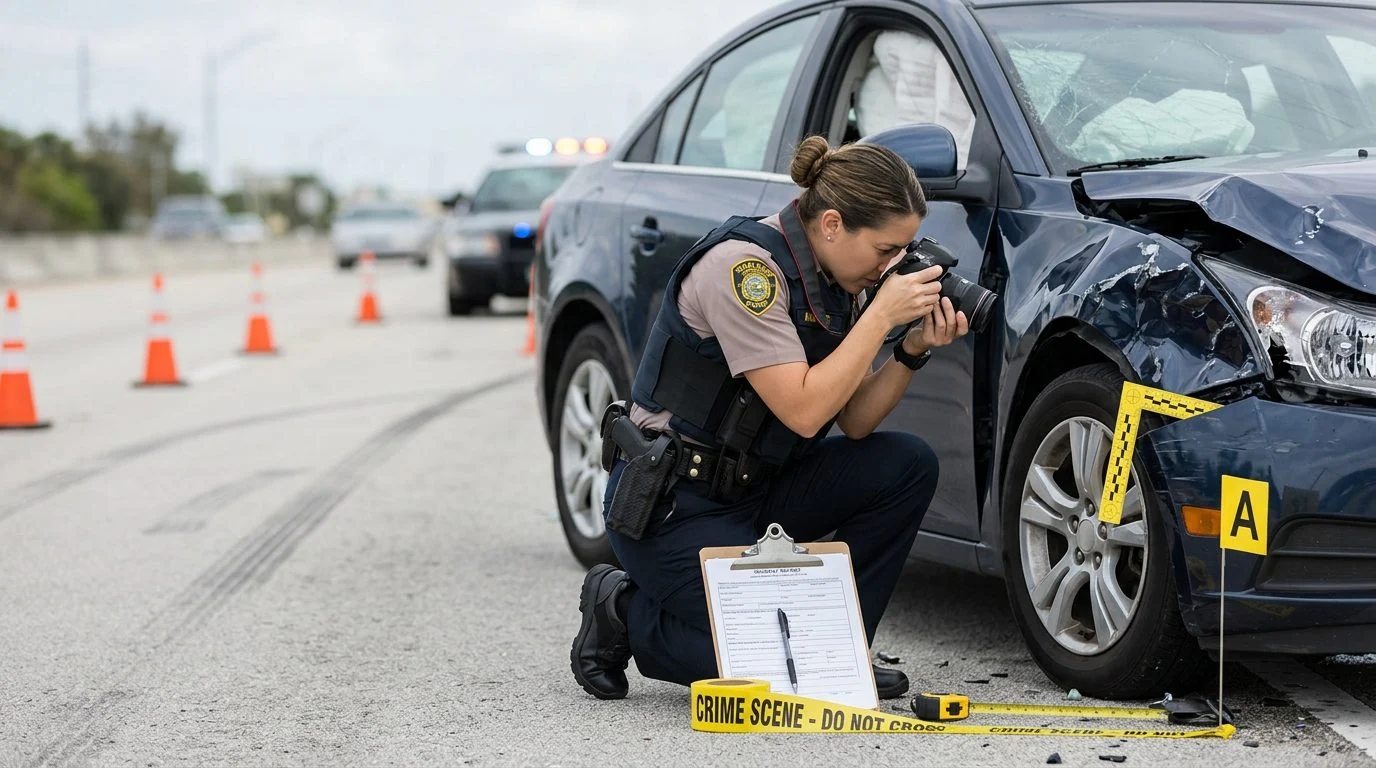
Leaving the Scene of an Accident · Miami-Dade & Broward
Not Sure What to Report After a Miami Crash?
Minor damage can still raise reporting questions under Florida law. Learn how the rules work, and talk with a Miami criminal defense firm before you answer questions or make a statement.
By Patrick David Wilson · Published October 31, 2026
In Florida, the answer to “how much damage do you have to report?” starts with a different question: was anyone hurt? Dollar amounts matter, but only for some duties. This guide explains the rules in plain terms. It comes from Patrick Wilson Law, PLLC, a Miami criminal defense firm that represents people across South Florida, from Broward County to the Keys.
Short answer: the threshold depends on whether anyone was hurt
Florida’s rules turn first on injury or death, then on the dollar amount of damage. A crash with an injury or death follows different duties than a crash with vehicle damage alone. Florida’s duty to give police notice of certain crashes is in Fla. Stat. § 316.065, the duty to stop and remain at the scene of a crash involving only property damage is in Fla. Stat. § 316.061, and the duty to give information and render reasonable assistance is in Fla. Stat. § 316.062. These are state laws. Insurance companies do not write them.
If a crash left someone hurt, or you're worried about your own role in one, our team at Patrick Wilson Law can talk it through in a free, confidential first consultation. Talk it through with our team — the first consultation is free, confidential, and carries no obligation.
When injury or death must be reported immediately
A driver in a crash that injures or kills someone must notify police right away. Under § 316.065, notice must go by the quickest means available. It goes to the local police department inside a city. Elsewhere, it goes to the county sheriff or the nearest Florida Highway Patrol office. Violating this notice duty is a noncriminal traffic infraction under chapter 318.
Notice is only part of the job. Under § 316.062, you must give your name, address, and registration number. You must show your license or permit to drive on request, if available. You must also give reasonable help to an injured person. That includes arranging transport to a doctor or hospital when treatment looks necessary.
Injuries often seem minor at the scene. A person can feel fine and get worse later.
The stakes rise fast with serious harm. Under § 316.027, a willful failure to stop and remain at a crash with injury is a felony. Under Fla. Stat. § 782.071, vehicular homicide is the killing of a human being, or of an unborn child by any injury to the mother, caused by the operation of a motor vehicle by another in a reckless manner likely to cause the death of, or great bodily harm to, another; it is a felony of the second degree, and it is a felony of the first degree if the person knew, or should have known, that the accident occurred and failed to give information and render aid as required by s. 316.062, or if the person has a prior conviction under this section or under the other statutes it lists.
Property-damage-only crashes and the $2,000 line
When no one is hurt, the $2,000 figure sets the police-notice duty. Under § 316.065, notice is required when damage to any vehicle or other property is in an apparent amount of at least $2,000.
Many drivers miss a key point. The duty to stop and stay does not use the $2,000 line. Under § 316.061, a crash causing only damage to a driven or attended vehicle or property requires you to stop and remain at the scene until you give your name, address, and registration number as § 316.062 requires. Violating it is a misdemeanor of the second degree. A court may also order a convicted driver who caused or otherwise contributed to the crash to pay restitution to the owner for the damage caused by the driver’s vehicle.
Hitting a parked car or a fence counts. Under § 316.063, if your vehicle damages unattended property, you must find the owner or leave a written note with your name, address, and registration number. You must also notify the nearest police authority without unnecessary delay.
Written reports come next. Under § 316.066, a long-form crash report is due within 10 days after the officer finishes an investigation. Long-form reports are required for crashes involving death, personal injury, or any indication of complaints of pain or discomfort, a violation of § 316.061(1) or § 316.193, or a vehicle that needed a wrecker, among other cases.
Why insurance thresholds and tax casualty losses are different questions
Insurers set their own rules for filing claims. Those rules can differ from Florida’s crash statutes. A claim denied as too small does not erase the reporting duty.
Tax questions are separate too. Whether a loss can be deducted on a tax return is a different issue. It does not answer whether you had to stop, give information, or notify police.
Check the two questions one at a time. Keep photos, the other driver’s details, and your notes in one place. That record helps with both questions later.

What not reporting can mean, and why to talk to a lawyer early
Giving information in a required crash report, knowing or having reason to believe that it is false, is a misdemeanor of the second degree under § 316.067.
Investigators may ask about the crash at the scene or days later. Early statements can shape what happens next. Whether a charge applies, and how serious it is, depends on the facts: the injuries, what the driver knew, and the record. No result can be promised.
Quick answers
Do I have to call police if I hit a parked car in Florida?
Yes, under § 316.063 you must find the owner or leave a written note, and notify police without unnecessary delay.
Is leaving the scene a felony?
It can be, when a driver willfully fails to stop and remain after a crash that causes injury, serious bodily injury, or death.
If a crash has left someone hurt, or you’re worried about your own role in one, you don’t have to sort out these rules alone. Patrick Wilson Law offers a free, confidential first consultation with no obligation to continue. Call 786-761-1719 or visit our contact page.
This page is the responsibility of Patrick David Wilson, Patrick Wilson Law, PLLC, Miami, Florida.
Don't Guess After a Crash
Leaving a crash scene before you have exchanged information or made the required reports can create criminal exposure, even when the damage looks small. Speak with our team before you give a statement.
Crash Situations We Hear About
Damage to a parked car
Hitting an unattended vehicle or property raises questions about who must be notified and what must be left behind.
Minor parking lot collisions
Low-speed contact in a lot can still lead to reporting questions and, in some cases, a leaving-the-scene allegation.
Crashes involving injury
When someone is hurt, the reporting duties and the criminal stakes are higher, and early decisions matter.
Hit-and-run accusations
A police report or a witness account may describe a crash you do not remember or do not believe you caused. Those facts deserve a careful review.
How Patrick Wilson Law Can Help
Defense focused on leaving-the-scene cases
Patrick Wilson Law, PLLC focuses on criminal defense across South Florida, including leaving the scene of an accident charges.
Free first consultation
Confidential, with no obligation to continue, so you can understand your options before you decide anything.
Serving Miami-Dade, Broward and the Keys
Clients from Miami, Fort Lauderdale, Hialeah, Kendall, Miami Beach, Homestead and the Florida Keys contact our team.
Attorneys who take your call
Our lawyers and staff work with first-time offenders and licensed professionals whose careers depend on how a crash case is handled.

