
Vehicular Homicide Defense · Miami
Facing a Vehicular Homicide Charge After a Motorcycle Crash?
Patrick Wilson Law, PLLC defends people charged in motorcycle crash deaths across Miami-Dade, Broward County and the Florida Keys. Talk to a criminal defense lawyer before you make any statement.
By Patrick David Wilson · Published October 23, 2026
This page covers motorcycle crash vehicular homicide defense in Florida. A driver charged after a fatal crash can face vehicular homicide or DUI manslaughter. The difference depends on whether the state claims reckless driving or impairment caused the death. Patrick Wilson Law defends these cases for motorcycle, scooter, bicycle and pedestrian deaths in Miami, Broward County and the Florida Keys. Here’s what the charges mean, what evidence usually matters, and how the defense works.
What Vehicular Homicide and DUI Manslaughter Mean in Florida
Vehicular homicide is a death caused by a driver’s reckless operation of a motor vehicle. Under Fla. Stat. § 782.071, the driving must be reckless in a way likely to cause death or great bodily harm to another. The base charge is a second-degree felony. It rises to a first-degree felony if the driver knew or should have known a crash happened and did not give information or render aid. A prior qualifying conviction also raises it to a first-degree felony.
DUI manslaughter starts from impairment. Under Fla. Stat. § 316.193, a person commits DUI when driving or in actual physical control of a vehicle within this state while under the influence of alcohol, a chemical substance or a controlled substance, when affected to the extent that the person’s normal faculties are impaired. The impairment must affect the person’s normal faculties.
They also hit licensed professionals whose careers depend on a clean record.
The question is whether the driver’s conduct caused the death. Our culpable negligence page explains that standard.
If you're under investigation after a crash that killed a rider or pedestrian, you don't have to face it alone, so reach out to our team for a free, confidential consultation. Talk it through with our team — the first consultation is free, confidential, and carries no obligation.
Which Crashes and Related Charges the Firm Defends
The firm handles motorcycle crash vehicular homicide defense Florida cases involving motorcycles, scooters, bicycles and pedestrians. Matters arise across Miami-Dade, Broward County, Fort Lauderdale, Miami Beach, Hialeah, Homestead, Kendall and the Florida Keys.
- Motorcycle and scooter collisions, including crashes at intersections and on highways.
- Bicycle deaths on city streets and county roads.
- Pedestrian deaths in crosswalks and along roadways.
Related charges often come with these cases. The same minimum applies if that willful violation happens while driving under the influence. Our leaving the scene page covers this pathway. Speed can also be part of the state’s case, and our super speeder page covers that pathway.
Impairment, speed, lane position and visibility may each matter in a rider or walker case. Which one matters most depends on the facts. Research from the Insurance Institute for Highway Safety on motorcycle crash risks and helmet use can be relevant when crash facts are described.
The Evidence That Usually Decides These Cases
The crash report, test results and video usually carry the most weight. Each one follows rules the state must meet.
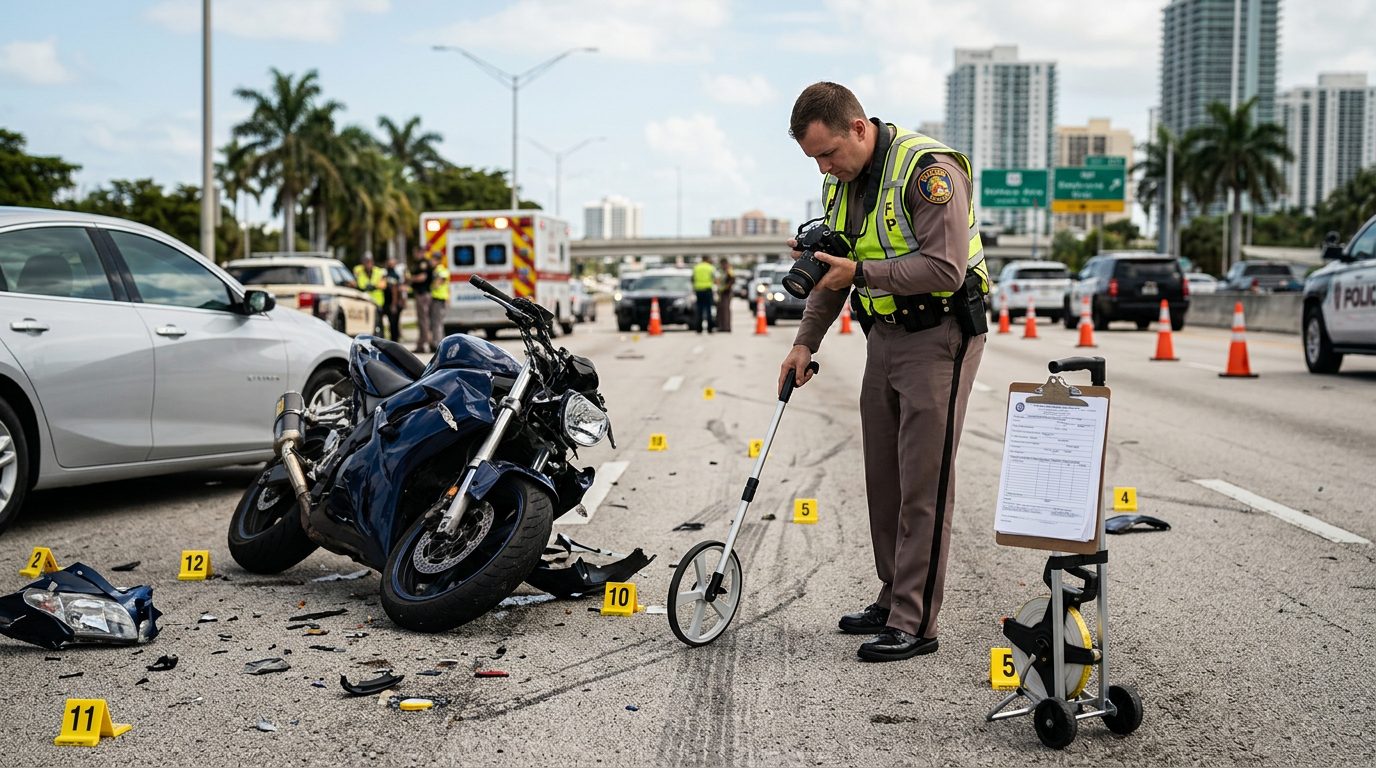
- Crash report. Under Fla. Stat. § 316.066, a long-form Florida Traffic Crash Report must be completed and submitted to the department within 10 days after the investigation is completed for a crash that resulted in death, personal injury, or any indication of complaints of pain or discomfort, or in other listed crashes. Measurements and diagrams should match the scene itself.
- Blood and breath tests. In a crash that causes death or serious bodily injury, Fla. Stat. § 316.1933 says an officer with probable cause that the driver was under the influence shall require a blood test. Fla. Stat. § 316.1933 reads: “If a law enforcement officer has probable cause to believe that a motor vehicle driven by or in the actual physical control of a person under the influence of alcoholic beverages, any chemical substances, or any controlled substances has caused the death or serious bodily injury of a human being.” Under Fla. Stat. § 316.1934, a reading of 0.08 or higher is prima facie evidence of impairment. Fla. Stat. § 316.1934 reads: “If there was at that time a blood-alcohol level or breath-alcohol level of 0.08 or higher, that fact is prima facie evidence that the person was under the influence of alcoholic beverages to the extent that his or her normal faculties were impaired. Moreover, such person who has a blood-alcohol level or breath-alcohol level of 0.08 or higher is guilty of driving, or being in actual physical control of.” A reading of 0.05 or less creates a presumption against impairment. To be valid, a test must have been performed substantially in accordance with methods approved by the Department of Law Enforcement and by an individual holding a valid permit issued by the department. Insubstantial differences from approved methods do not make the test invalid, so draw timing and lab handling get checked.
- Video and vehicle data. Dashcams, traffic cameras, phones and vehicle data can show speed, braking and timing. Reconstructing the seconds before impact shows what each driver could see and do.
- Witness statements. Statements taken at the scene and later get compared for conflicts.
- Scene conditions. Roadway, lighting, signs, debris and vehicle damage show how the crash unfolded.
Discovery is how the defense gets this material. Under Fla. R. Crim. P. 3.220, once the defense files a Notice of Discovery, the prosecutor must serve a Discovery Exhibit within 15 days, and must disclose information that tends to negate guilt as soon as practicable after charges are filed. The rule’s term “statement” includes police and investigative reports.
How Patrick Wilson Law Approaches the Defense
The defense starts with what the record already shows. Then it tests whether the state can prove each part of the charge.
- Early review. The team reads the arrest report, the crash report and any statement you gave police. Our talk to police guidance covers those early questions.
- Evidence review. The firm requests discovery and asks that video and vehicle data be preserved before it’s lost.
- Causation. The firm checks whether the state can connect the driver’s conduct to the death. It also checks whether any impairment test was obtained and handled properly.
- Negotiation and motions. Where the evidence supports it, the firm negotiates with prosecutors or files motions. Under Fla. R. Crim. P. 3.171, defense counsel must advise a client of all plea offers and their likely results. No plea agreement can be concluded without the client’s full and complete consent.
You stay informed at each stage.
What to Expect: Steps and Timeline
Most fatal-crash cases move through five stages. The timing changes with the charge, the evidence and court dates.
- Consultation. Your first consultation is free, confidential and comes with no obligation to continue. You review the crash facts, the charges and your options.
- Early assessment and release. Judges weigh factors that include the nature of the offense, the weight of the evidence, family ties, residence, immigration status, employment, financial resources, mental condition, past conduct and record, and the danger to the community. Fla. Stat. § 903.046 lists these factors.
- Evidence and discovery. Gathering records, test results and video can take months in serious cases.
- Pretrial motions and negotiation. Motions and talks follow the court’s schedule.
- Trial preparation. If the case doesn’t resolve, the team prepares for jury selection and presents the defense evidence.
Speedy trial rules add a clock. Without a demand, Fla. R. Crim. P. 3.191 requires trial within 175 days for a felony. The rule lists grounds that can extend that period. Timelines vary widely with the charge, the evidence and court schedules.
Why Clients Choose Patrick Wilson Law
Patrick David Wilson is the responsible lawyer for this page. The firm’s lawyers include Patrick David Wilson and Sahara Fonseca.
- The firm focuses its criminal defense practice on DUI, domestic violence, sexual battery, traffic homicide and related charges across South Florida.
- It is based in Miami and serves clients from Miami-Dade and Broward County to the Florida Keys.
- It works with licensed professionals whose licenses and careers are at risk. See criminal defense for licensed professionals.
- It works with first-time offenders facing serious charges for the first time. See first-time offender defense.
- It explains options and realistic possibilities in plain language. It does not promise any particular result.
Not sure what your next step is?
Talk it through with our team — the first consultation is free, confidential, and carries no obligation.
Frequently Asked Questions
Can I be charged if the rider or pedestrian was partly at fault?
Yes. The question is whether the driver’s conduct caused the death.
What’s the difference between vehicular homicide and DUI manslaughter?
Vehicular homicide centers on reckless driving. DUI manslaughter centers on impairment from alcohol or drugs.
Should I speak with police after a fatal crash?
Many people get legal advice before answering detailed questions. A lawyer can explain your options at a first consultation.
What happens at a first consultation?
The lawyer reviews the charges, the crash facts and any papers you have. Then the lawyer explains possible next steps.
Will my case be resolved quickly?
No one can say. Timelines vary widely with the charge, the evidence and court schedules.

Talk With a Miami Criminal Defense Lawyer About Your Case
If you were driving when a motorcyclist, scooter rider, cyclist or pedestrian died, and police are now investigating, the choices ahead can affect your record, your license and your job. Call 786-761-1719 or leave a message through our contact page to talk with Patrick Wilson Law about your situation.
How We Approach Motorcycle Crash Cases
Protecting you from the start
Early steps can shape a case. We focus on protecting your rights from the first call, including what you say to police and insurers.
Reviewing the evidence
We examine police reports, crash scene measurements, vehicle data, witness accounts and medical records to understand what actually happened.
Questioning the state's theory
We test how the State connects your conduct to the death and look for gaps in its reasoning.
Lawyers who listen
Our lawyers take time to learn your work, family and daily life so every decision reflects your priorities.
Before You Talk to Anyone
Do not give a recorded statement to police, an insurance adjuster or anyone else about the crash until you have spoken with a criminal defense lawyer.
Common Questions Clients Bring to Us
Can I be charged if the rider or pedestrian was partly at fault?
Shared fault does not end the analysis. The key question is whether the driver's conduct caused the death, and we examine that closely.
What is the difference between vehicular homicide and DUI manslaughter?
Vehicular homicide centers on reckless driving. DUI manslaughter centers on impairment from alcohol or drugs.
Will my license or career be affected?
For licensed professionals and commercial drivers, a charge can threaten a livelihood. We address those concerns as part of your defense.
What if this is my first arrest?
First-time offenders often face a charge they never expected. We explain each step in plain language so you can make informed decisions.

