

Seal and Expunge Criminal Records | Patrick Wilson Law
Understanding the Florida Expungement Process, Step by Step
Expunction and sealing are separate remedies with different requirements.
By Patrick David Wilson · Published October 16, 2026
What are the steps involved in the expungement process in Florida? In short, you check your eligibility, apply to the Florida Department of Law Enforcement (FDLE) for a certificate of eligibility, file a written petition with the court, and wait for the judge’s decision. Each step turns on the facts of your record and on applicable law. This guide walks through the sequence in plain language. It comes from Patrick David Wilson’s Miami criminal defense practice, which covers DUI, domestic violence, sexual battery, and record-sealing matters across South Florida.
Expungement and Sealing Are Not the Same Thing
Under Fla. Stat. § 943.0585, a person may petition a court to expunge a criminal history record only if the statute’s cumulative requirements are all met, and the paragraph that applies to the record is also satisfied. The statute has separate paragraphs for different situations, such as records in which no indictment, information, or other charging document was filed or issued in the case giving rise to the record, and records in which the charges were dismissed or resulted in an acquittal. Eligibility turns on the facts and applicable law, and whether a given record qualifies turns on those same factors. Sealing generally means that a record is kept from public view, while expunction generally means that the record is removed from the criminal history system, subject to the statute. Whether any petition is available depends on the facts and applicable law. Expungement generally means the agencies holding a record must physically destroy or obliterate it. The FDLE keeps one confidential copy. Expungement is governed by Florida law, and whether a particular record qualifies depends on the facts of the case and applicable law. Sealing is different. Whether a record can be sealed or expunged depends on the facts of the case and applicable law.
Some records may be sealed without a petition. Under Fla. Stat. § 943.0595, certain records are sealed automatically in some cases. Under section 943.0595, Florida Statutes, the exclusions include records that result from a charging document for a forcible felony, and records arising from a charging document for certain offenses cross-referenced to the sexual offender statute, section 943.0435, Florida Statutes; whether a given record falls within these exclusions turns on the facts and applicable law. The cases include those where no charging document was filed, charges were dismissed or nolle prosequi, or a not-guilty verdict or judgment of acquittal covered all counts. The statute has exceptions, so the details of the case matter.
Which path fits a record turns on that record and the law.
If you are working through a record you did not choose, or sorting out a family member's case, you don't have to map out every step alone. Talk it through with our team — the first consultation is free, confidential, and carries no obligation.
Checking Eligibility Before You Start
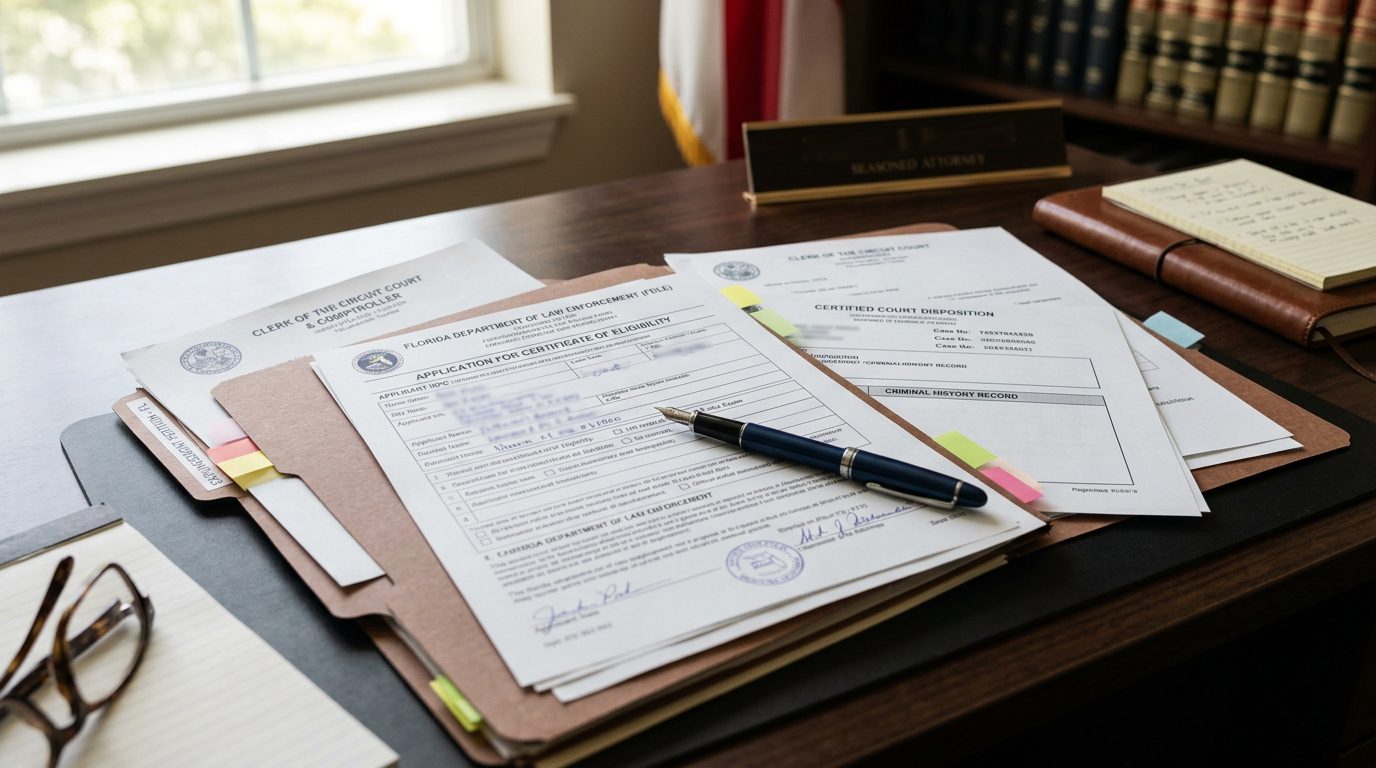
Eligibility turns on how the case ended and on the full history in the record. The expungement statute sets out criteria in paragraphs (a) through (h). Two are simple to check. A record may satisfy the statute’s requirement under the paragraph covering a case in which no indictment, information, or other charging document was filed or issued in the case that created it, but only if the other cumulative requirements are also met. Records in which charges were filed and later dismissed, nolle prossed, or ended in acquittal are addressed by a separate paragraph of the statute, depending on the facts and applicable law. Paragraph (h) of § 943.0585 applies where adjudication was withheld or not all charges were dismissed before trial, and in that case the person must already have held a sealing order for at least 10 years, subject to the exceptions stated in the statute; whether this applies depends on the facts of the case and applicable law. Under paragraph (f), you must no longer be under court supervision for the disposition of the arrest or alleged activity. Among the eligibility conditions listed in Fla. Stat. § 943.0585 is that the record a person asks the court to expunge is not one that s. 943.0584 makes ineligible for court-ordered expunction. Whether a particular record qualifies depends on the facts and applicable law.
Paragraph (h) addresses earlier sealings. It refers to a prior sealing of at least 10 years, where adjudication was withheld or not all charges were dismissed before trial. That 10-year requirement does not apply if no plea was entered, if all charges were dismissed before trial, or if a judgment of acquittal or not-guilty verdict was rendered.
Separate rules in Fla. Stat. § 943.0584 make some records ineligible. A record is ineligible if it is a conviction for a listed offense. The statute defines conviction to include a plea of guilty or no contest, even if adjudication is withheld. The list includes any offense defined in chapter 794, certain assault and battery offenses between family or household members, and felony battery. If your record includes a sexual battery or domestic violence charge, check the exact offense against that list.
Pull every arrest record and court disposition tied to the matter before you go further. Look at each one for a charging document, a dismissal, and any court supervision still in place. Timing questions also come back to the record details and the statute, not a general rule of thumb.
Step 1: Obtain a Certificate of Eligibility from FDLE
The first formal step is applying to FDLE for a certificate of eligibility before you file anything with a court. Under Fla. Stat. § 943.0585, a person seeking expunction must apply to the department before petitioning the court. FDLE issues the certificate, but the court decides whether to grant the petition, according to FDLE’s frequently asked questions.
The certificate has a limited life. It is valid for 12 months from the date stamped on it. Whether a new certificate is needed after that period turns on the facts and applicable law. Your status and the law in effect at renewal determine your eligibility then.
The application requires documents. FDLE’s instructions show that one requirement is proof that probation has ended. Read the full list before you submit anything, and match each item to your own case.
Step 2: Prepare and File the Petition with the Court
Filing a written petition with the clerk is required for relief sought under section 943.0585, Florida Statutes, and the petition must be accompanied by a valid certificate of eligibility issued by the Florida Department of Law Enforcement and a sworn statement by the petitioner. Fla. R. Crim. P. 3.692 lists these required pieces. The sworn statement says you satisfy the eligibility requirement and are eligible to the best of your knowledge. It also says no other petition to seal or expunge is pending before any court.
Because you sign the statement under oath, every answer must match your records. Gaps or errors in the packet can slow the process. Check the requirements of the clerk for the court that handled your case before you file. Keep copies of everything you send.
Step 3: Notice to Agencies and the Court’s Order
The prosecutor and the arresting agency receive the petition and may respond before the judge rules. Under Rule 3.692, the completed petition, sworn statement, and certificate must be served on the prosecuting attorney and the arresting authority. Those parties may respond, and the court may receive evidence on any factual issue.
The judge makes the final call. The rule says any request for expunging or sealing may be denied at the court’s sole discretion. The court also cannot order an agency to expunge a record until the petitioner has applied for and received a certificate of eligibility.
If the petition is granted, the court enters a written order naming the records and agencies it covers. The clerk certifies copies of the order to those agencies. Whether an expunged record is destroyed or obliterated depends on the facts of the case and applicable law. FDLE still keeps a confidential copy. An order that does not follow the statute may not be acted on, so accuracy matters at every stage. How long agency records take to update varies with the agencies involved and the order itself.
Costs and Fees in the Expungement Process
Costs come from several places. They include the FDLE application, the court filing, and certified copies of records. Under Rule 3.692, the petitioner bears the cost of certified copies unless the petitioner is indigent, meaning unable to afford them.
The amounts in any given case turn on the facts of that case and applicable law, so ask for current figures before you start. Attorney fees are a separate cost. Ask for the full list of expenses before you commit to any step. Keep receipts for every payment, and note that a renewed certificate after 12 months means another application.
Not sure what your next step is?
Talk it through with our team — the first consultation is free, confidential, and carries no obligation.
Timing, Checking Status, and Taking the Next Step
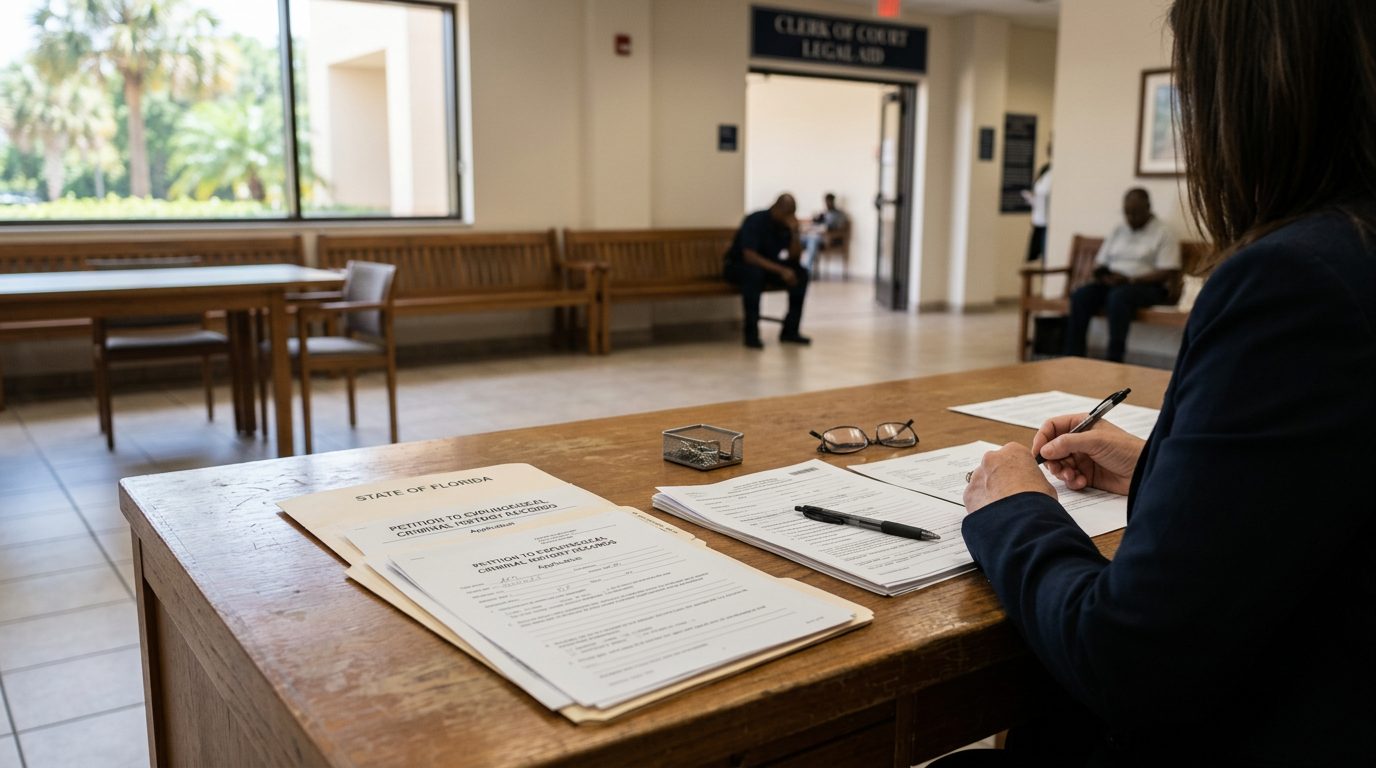
These are the main steps involved in the expungement process in Florida, and each one moves at its own pace. Track the FDLE application and the court filing separately. Keep copies of the certificate, the petition, every notice you receive, and the signed order. Those papers show where your matter stands at each point.
Frequently Asked Questions
Do I need a certificate of eligibility before filing?
Under Florida law, an FDLE certificate of eligibility is generally required before you petition a court for expunction, although other statutory paths may have different prerequisites.
How long is a certificate of eligibility valid?
It is valid for 12 months from the date stamped on it. After that, you must reapply.
Are some dismissed charges sealed automatically?
Some may be. Under § 943.0595, certain dismissed or not-guilty records may be sealed automatically if that statute’s conditions are met.
Can a judge deny an expungement petition?
Yes. A request for expunging or sealing may be denied at the court’s sole discretion.
If you are working through a record you did not choose, or sorting out a family member’s case, you don’t have to map out every step alone. You can talk through your facts with Patrick David Wilson in a free, confidential first consultation, with no obligation to continue. Call 786-761-1719 or send a message through the contact page.
The Process at a Glance
1. Review Your Record
Obtain your criminal history and the court file for each case. Confirm the charges, the dispositions and any sealing or expunction already entered.
2. Confirm Eligibility
Eligibility depends on the facts of your case, the outcome of the charge and applicable Florida law. Some records qualify for expunction, others for sealing, and some may not qualify at all.
3. Obtain a Certificate of Eligibility
For many expunction petitions, Florida requires a certificate of eligibility issued by the Florida Department of Law Enforcement before a court can act. Whether it applies to your case depends on the specific facts.
4. File the Petition
The petition is filed with the appropriate court, and the required agencies are notified. Filing requirements and fees can vary, so the exact steps depend on your case.
How Patrick David Wilson Can Help
Record Review
Reviewing your charges, dispositions and court files to identify which relief, if any, may apply to your situation.
Eligibility Analysis
Explaining the statutory requirements and how they apply to the facts of your case, so you can make an informed decision.
Petition Preparation
Preparing the paperwork and handling the filing steps, with each stage explained in plain language.
Clear Communication
Answering your questions at each step, with the outcome depending on the facts and applicable law.
Check Your Record Before You File
Eligibility depends on the facts of your case, the outcome of each charge and applicable Florida law. Do not assume a record qualifies for expunction or sealing. Review your official records and court paperwork with an attorney before taking any step.

