
Vehicular Homicide Defense | Miami, Florida
A Speeding Crash Doesn't Have to Become a Homicide Case
Patrick Wilson Law focuses on criminal defense across South Florida, from Miami-Dade and Broward to the Keys. If a fatal crash has you facing a vehicular homicide question, speak with us before you make any decisions.
By Patrick David Wilson · Published November 4, 2026
Speeding alone does not automatically make a crash a vehicular homicide case in Florida. The law asks whether the driver operated the vehicle in a reckless manner likely to cause death or great bodily harm. This guide explains how vehicular homicide Florida law works, what prosecutors must prove, and what gets reviewed in these cases. Patrick Wilson Law, PLLC is a criminal defense firm based in Miami, and Patrick David Wilson is the responsible lawyer for this page.
The Short Answer: Speed Alone Is Not the Whole Test
No. Speed by itself does not establish vehicular homicide under Florida law. The statute, Fla. Stat. § 782.071, describes the offense as a killing caused by a vehicle operated “in a reckless manner likely to cause the death of, or great bodily harm to, another.”
It asks how the vehicle was driven and whether that driving was likely to cause death or great bodily harm. Prosecutors still have to connect it to the driving and to the crash.
Under § 316.183, a driver may not go faster than is reasonable and prudent for the conditions. A violation of that section is a noncriminal traffic infraction. Speeding can be a ticket. It can also be part of a felony case. Those are not the same thing.
If a fatal crash has you or someone you love asking hard questions about speed, we're glad to talk it through in a free, confidential first consultation. Talk it through with our team — the first consultation is free, confidential, and carries no obligation.
What Florida Law Requires for a Vehicular Homicide Charge
A human being was killed. The death was caused by the operation of a motor vehicle. The operation was reckless in the way the statute describes. § 782.071 lays out those elements in its definition.
A driver can cause a crash without acting recklessly. Reckless driving can also happen without a death. Both pieces must line up for the charge to stand.
Reckless driving is its own offense. Under § 316.192, a person commits reckless driving by driving in “willful or wanton disregard for the safety of persons or property.” That phrase focuses on the driver’s choices, not only the result.
The statute also has a second path. Under § 316.192, reckless driving is driving any vehicle in willful or wanton disregard for the safety of persons or property; this section does not address whether the driver must know a crash caused injury or death.
How Speed Becomes Part of a Recklessness Case
Speed becomes evidence when investigators can measure it and tie it to one vehicle. Florida sets strict conditions for radar speed evidence in speed cases. Under § 316.1906, the officer must meet listed requirements. Those include radar training, an independent visual judgment that the vehicle is speeding, and audio Doppler engaged on the radar.
A person accused under the speed statutes can also ask to have the device operator testify. Under § 316.1905, that right applies upon oral or written motion. These rules show why the reliability of speed data matters.
A posted limit alone does not decide the question. It asks what speed is reasonable “having regard to the actual and potential hazards then existing,” and it also sets maximum speed limits that apply regardless of conditions: 30 miles per hour in business or residence districts, and 55 miles per hour at any time at all other locations. Investigators also look at the road, traffic, weather, lighting, and time of day. The facts decide which description fits.
Common Scenarios That Lead to These Charges
Charges like these usually involve extreme speed in a setting where other people were at risk. Scenarios discussed in these cases include excessive speed in congested areas, school or work zones, weaving through heavy traffic, and racing or challenging another driver.
Some speed cases fall under a different offense. Under § 316.1922, dangerous excessive speeding happens when a driver goes 50 mph or more over the limit. It also covers driving at 100 mph or more in a manner that threatens others. A first conviction carries up to 30 days in jail, a $500 fine, or both.
Each scenario turns on its own facts. Under § 316.1922, a driver 50 mph or more over the speed limit commits dangerous excessive speeding regardless of other drivers or road conditions; other drivers and road conditions matter only for the 100 mph prong, which requires driving that threatens others’ safety or interferes with vehicle operation. The number on the speedometer is only one part of the record.
Vehicular Homicide, Vehicular Manslaughter, and DUI Manslaughter
Florida’s statute is titled vehicular homicide, and it covers a killing caused by operating a motor vehicle in a reckless manner likely to cause the death of, or great bodily harm to, another. § 782.071 is the section that defines “vehicular homicide.”
Impairment is a different question. § 316.193 sets out the DUI offense.
So which is worse? The label does not settle it. The statute charged, the facts, and any prior record all matter. Charges tied to a death are serious under either statute.
Florida Penalties and How Sentencing Is Determined
Vehicular homicide Florida law makes the basic offense a second-degree felony. Under § 782.071, a prior listed conviction can raise it to a first-degree felony. The statute also lets a court order 120 community service hours at a trauma center or hospital, in addition to other punishment.
Fines have limits. Under § 775.083, a fine for a first- or second-degree felony conviction generally cannot exceed $10,000, though a higher amount equal to double the pecuniary gain or loss, or an amount a statute specifically authorizes, may apply.
Prison exposure runs through the sentencing scoresheet. Under § 921.0024, the lowest permissible sentence is the minimum a judge may impose without a valid reason to depart. Fla. Stat. § 921.0024 reads: “The lowest permissible sentence is any nonstate prison sanction in which the total sentence points equals or is less than 44 points, unless the court determines within its discretion that a prison sentence, which may be up to the statutory maximums for the offenses committed, is appropriate.” A scoresheet is prepared for each defendant. It goes to defense counsel for an accuracy review unless the judge directs otherwise. The Florida Department of Corrections explains this framework in its Criminal Punishment Code Report.
Families may also have a civil claim. Under § 782.071, a right of action for civil damages exists under s. 768.19 for all deaths described in the section. The sentence in any single case depends on the facts.
Not sure what your next step is?
Talk it through with our team — the first consultation is free, confidential, and carries no obligation.
Evidence and Defenses Reviewed in Speed-Related Fatal Crash Cases
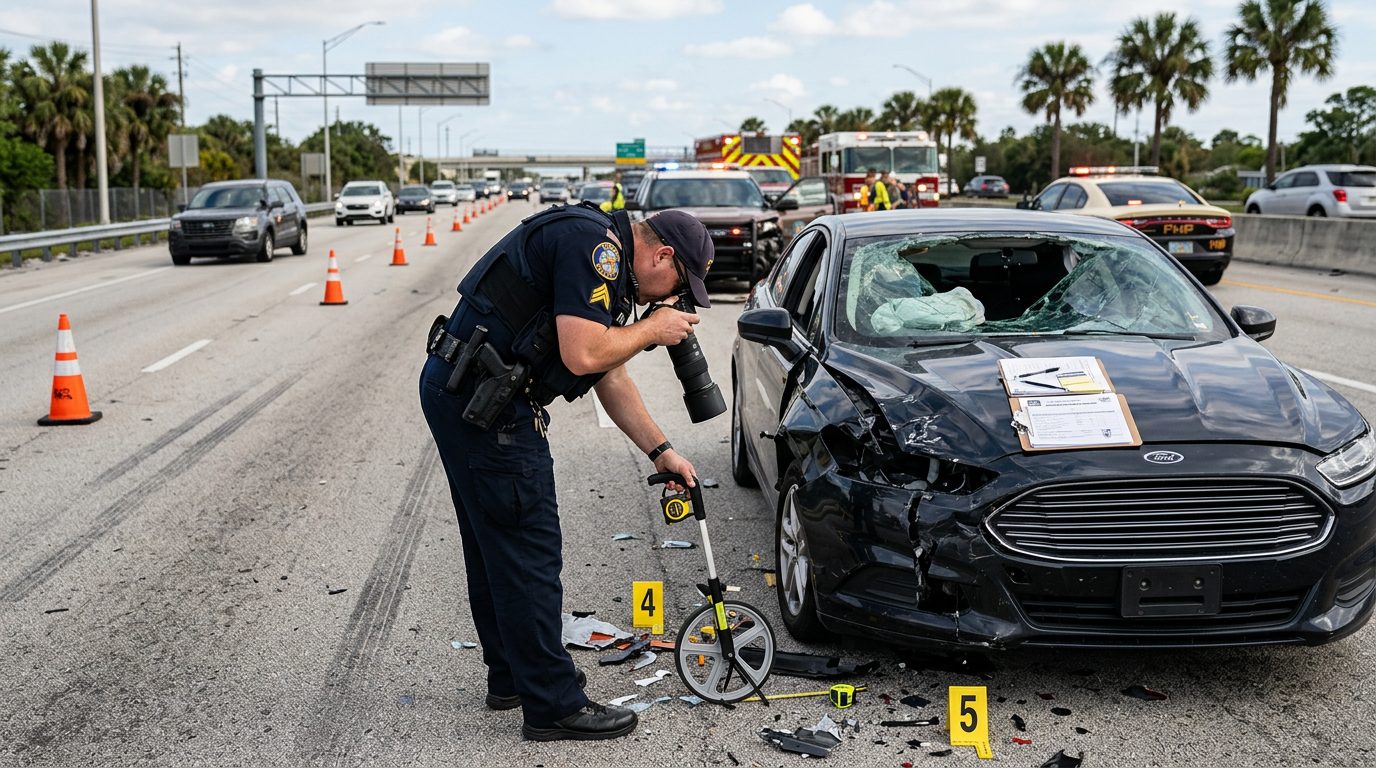
The most important evidence shows how the vehicle moved before the crash. Common sources include vehicle data downloads, dashcam and surveillance video, 911 records, witness statements, scene measurements, and vehicle inspection results. Each one can point toward or away from a reckless-driving theory.
Defense review usually asks a few direct questions. Is the speed estimate reliable? Did the driver face a sudden emergency or a mechanical problem? Did the roadway or another driver contribute? These questions tie back to the reckless-manner element, which the state must prove.
Speed data gets close review. Radar evidence must meet the device and officer conditions in § 316.1906. Fla. Stat. § 316.1906 reads: “(2) Evidence of the speed of a vehicle measured by any radar speed-measuring device shall be inadmissible in any proceeding with respect to an alleged violation of provisions of law regulating the lawful speed of vehicles, unless such evidence of speed is obtained by an officer who: (a) Has satisfactorily completed the radar training course established by the Criminal Justice Standards and Training Commission pursuant to s. 943.17(1)(b).” Every case turns on its own record, and no result can be promised from any review.
Miami-Dade and Broward Cases: Where These Charges Are Filed
Crashes in Miami-Dade and Broward counties are handled through the courts and prosecutors of those counties. A case often starts with a police investigation, an arrest, or a formal charging decision. Early steps shape how the case develops, including what evidence is preserved and what statements are made.
Patrick Wilson Law, PLLC focuses on criminal defense across South Florida. That covers Miami and Miami-Dade County, Broward County, and the Florida Keys. The firm also handles DUI, leaving-the-scene, and super speeder charges. For the full picture of this practice area, see our vehicular homicide defense page.
If a Fatal Crash Has Already Raised Questions for You or Someone You Care About
Many readers land here while a loved one is under investigation. Others are deciding whether to answer investigators’ questions. You might be the driver, a relative trying to understand a charge, or a friend worried about what comes next.
Our first consultation is free, confidential, and carries no obligation to continue.
Common Questions
Can speeding alone lead to a vehicular homicide charge in Florida?
Not by itself. The statute requires reckless operation likely to cause death or great bodily harm.
Is vehicular manslaughter the same as vehicular homicide in Florida?
Florida’s statute is titled vehicular homicide. “Vehicular manslaughter” is a common search phrase for a similar crash death charge.
Is a blood test required after a fatal crash in Florida?
If an officer has probable cause that impairment caused a death or serious injury, the officer must require a blood test. See § 316.1933.
If you’re weighing what to do next, call 786-761-1719 or send a message through our contact page. The conversation starts with our Miami office, and Patrick David Wilson is the responsible lawyer for this page.
How We Approach a Vehicular Homicide Case
Confidential first consultation
Our free first consultation is confidential and carries no obligation to continue.
Attention to the people involved
Drivers, families and licensed professionals each face different pressures, and our team takes those into account.
Clear communication
We explain each step in plain language so you know where your case stands.
Before You Talk to Investigators
Speak with a criminal defense lawyer before giving a detailed account.
Areas We Serve
Miami and Miami-Dade County
Criminal defense for crashes and charges across Miami, Kendall, Hialeah, Homestead and surrounding communities.
Broward County and Fort Lauderdale
Defense for vehicular homicide and related traffic matters in Broward County and Fort Lauderdale.
Miami Beach and the Florida Keys
Representation for clients in Miami Beach and throughout the Florida Keys.
Related Charges
We also handle leaving the scene of an accident, DUI, super speeder and white collar matters.

