
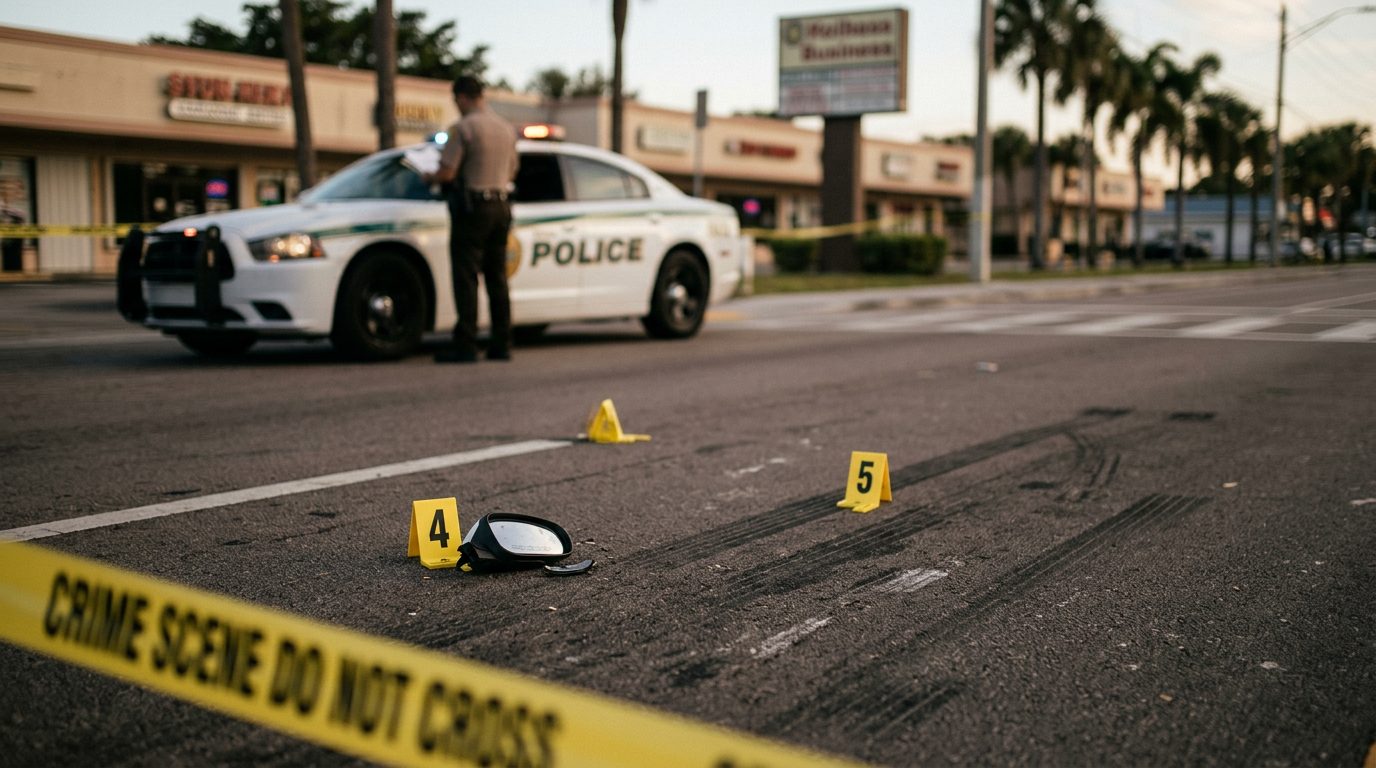
Leaving the Scene & Vehicular Homicide Defense · Miami-Dade
Facing a Fatal Hit-and-Run Charge in Miami-Dade?
Patrick Wilson Law focuses on leaving-the-scene and vehicular homicide cases for drivers across Miami-Dade County. Call 786-761-1719 for a free, confidential first consultation, with no obligation to continue.
By Patrick David Wilson · Published October 27, 2026
A fatal hit and run charge in Florida means a driver is accused of leaving the scene of a crash that caused a death. Florida law requires the driver to stop and stay, and a willful failure to do so is a felony. This guide explains the charge, what the state must prove, and how the case moves through court. It is written for drivers and families looking for a fatal hit and run defense attorney in Miami-Dade or Broward County.
What a Fatal Hit-and-Run Charge Means in Florida
A fatal hit-and-run charge is a felony case built on a crash that killed someone. Under § 316.027, a driver in that crash must stop at the scene, or as close as possible, and stay until the duties in § 316.062 are met. Those duties include giving your name, address, and registration number, and giving reasonable help to anyone hurt.
The charge turns on what the crash caused. Florida sets different felony levels for death, serious bodily injury, and lesser injury. A crash that damages only property falls under a different rule. There, a violation of § 316.062 is a noncriminal traffic infraction.
Knowledge matters for the higher vehicular homicide grade. The state does not have to prove the driver knew someone was hurt or killed. It does have to show the driver knew or should have known the accident occurred. § 782.071 sets out that rule.
If a crash has you or someone you love facing a fatal hit and run charge, you don't have to work out the next steps alone, and our team can talk it through with you. Talk it through with our team — the first consultation is free, confidential, and carries no obligation.
Charges and Penalties That Can Apply
A death-related hit-and-run can carry a first-degree felony. Prosecutors may also file several counts from the same crash.
- Leaving a crash that caused death. A willful violation is a first-degree felony. If a crash causes a death and the driver willfully fails to stop and remain at the scene, the offense is a first-degree felony with a mandatory minimum term of 4 years in prison under § 316.027. The defendant may move to depart from that minimum, and the court may grant the motion only if it finds that a factor, consideration, or circumstance clearly demonstrates that imposing it would constitute or result in an injustice; departure is not available when the violation was committed while the driver was under the influence. The mandatory minimum applies to a person convicted of DUI manslaughter under § 316.193: a mandatory minimum term of imprisonment of 4 years.
- Vehicular homicide. This charge covers a killing caused by reckless operation of a motor vehicle. It is a second-degree felony. It becomes a first-degree felony when the driver knew or should have known the accident occurred and did not give information and render aid, or if the person has a prior conviction under this section, s. 316.193(3)(c)3., s. 327.35(3)(a)3.c., or s. 782.072. See § 782.071. See § 782.071.
- DUI counts. When impairment is alleged, DUI manslaughter may be filed alongside the other counts.
License consequences follow too. A conviction for failure to stop and render aid after a fatal crash requires license revocation under § 322.26. A vehicular homicide conviction requires revocation for a minimum of 3 years under § 322.28.
For licensed professionals and non-citizens, the stakes reach past court. A conviction can affect a career or immigration status. Federal law lists classes of deportable noncitizens, including certain convictions. See 8 U.S.C. § 1227.
The sentence depends on the facts of the crash, the charges filed, and the person’s record.
What the State Must Prove and Where Cases Are Contested
In fatal crash cases, identity, willfulness, and causation are common points of dispute.
- Footage, vehicle records, and witness accounts must support that link.
- Willfulness. Leaving the scene requires a willful violation under § 316.027.
- Causation. Vehicular homicide requires a death caused by reckless operation of a vehicle. The crash sequence and physical evidence must support that link.
- Injury level. Serious bodily injury means a substantial risk of death, serious disfigurement, or protracted loss or impairment of a bodily function. That level changes the felony grade.
- Evidence. Footage, damage reports, phone and location records, and police reports need review. Reviewers look for gaps, timing errors, and chain-of-custody problems.
If Police Contact You About a Fatal Crash
If police contact you about a fatal crash, tell them you want a lawyer before you answer questions. Early words are often used later.
- You are not required to say anything. Anything you say may be used against you. The judge gives this warning at first appearance under the first appearance rule.
- At the scene, the duty to give information does not reach information that would violate your privilege against self-incrimination, where that duty is to make a report or give information to a law enforcement officer making a written report relating to a crash. See § 316.062. See § 316.062.
- Ask whether you are under arrest or free to leave.
- Don’t guess about speed, route, or timing, even with friends or online.
- Keep what you have, such as dashcam or phone video, insurance letters, and repair receipts. Don’t repair or sell the vehicle before your lawyer sees it.
- Write a private note of what you remember. Share it only with your lawyer.
How a Fatal Hit-and-Run Case Moves Through the Courts
A case usually moves from first appearance and bond to evidence review, then to resolution or trial. Timelines vary by case, court, and evidence.
- Consultation. The first consultation is free, confidential, and carries no obligation to continue. The facts, charges, and deadlines are reviewed.
- Investigation and charging. The police report, arrest affidavit, and filed charges are reviewed. A plan for talking with the prosecutor follows.
- First appearance and bond. The judge tells the defendant the charge and rights. A defendant with counsel gets reasonable time to contact them. Bond considers the offense, the penalty, and past record. Each crime charged gets its own bail amount under the pretrial release rule.
- Discovery and motions. The state’s evidence is gathered. Motions challenge unlawful searches or unreliable statements where the facts support them.
- Negotiation or trial. Charges and resolution are discussed with the prosecutor. Trial preparation continues if a fair result isn’t reached. Counts from one crash may be charged together under the joinder of offenses rule.
Who This Defense Is For and Where We Serve
This defense is for drivers and families facing a charge after a fatal crash in South Florida.
- Drivers accused of leaving the scene of a crash that caused a death, including first-time offenders facing a felony for the first time.
- Licensed professionals whose licenses or careers may be affected by a pending charge or conviction.
- Non-citizens who need to understand how a felony charge could affect their status.
- Families trying to understand what a charge means for a loved one in custody or under investigation.
Patrick Wilson Law, PLLC is a Miami criminal defense firm. It serves clients across Miami-Dade and Broward Counties, including Fort Lauderdale, Hialeah, Kendall, Miami Beach, Homestead, and the Florida Keys.
Not sure what your next step is?
Talk it through with our team — the first consultation is free, confidential, and carries no obligation.
Why Patrick Wilson Law for This Charge
Patrick Wilson Law concentrates in criminal defense in South Florida, including the charges on this page.
- Patrick David Wilson is the responsible lawyer for this page. The firm’s lawyers include Patrick David Wilson and Sahara Fonseca.
- The firm’s practice also covers DUI, domestic violence, sexual battery, vehicular homicide, white collar matters, and first-time offender cases.
- First-time offenders and licensed professionals are groups the firm focuses on. Planning looks at consequences outside court too.
- Crash cases often turn on footage, vehicle records, and phone data. Our team reviews those records closely before recommending a course of action.
- Non-citizens can ask how a felony charge may affect their status as part of that review.
Frequently Asked Questions
Is a hit-and-run with only property damage a felony?
No. Property-damage crashes fall under the noncriminal infraction rule in § 316.062.
Can a driver be charged if they did not know someone was killed?
The higher vehicular homicide grade does not require knowing about the injury or death. See § 782.071.
Does a criminal case decide a civil injury claim?
No. These are separate matters. Florida law provides a civil damages action for these deaths under § 782.071. A civil claim may need a different lawyer, since our practice is criminal defense.
Can a conviction affect my driver’s license?
Yes. A conviction for failure to stop and render aid after a fatal crash requires license revocation under § 322.26.
Can a non-citizen face immigration consequences?
Possibly. Federal law lists classes of deportable noncitizens, including certain convictions. See 8 U.S.C. § 1227. The result turns on the exact conviction.
If a crash has left you or someone you love facing a fatal hit and run charge, you don’t have to figure out the next steps alone. Call 786-761-1719 or send a message through our contact form to schedule a consultation.
How Our Firm Approaches a Fatal Crash Case
Defense Built Around the Facts
We examine the crash scene, the vehicle evidence, witness statements and the timeline before advising you on your options.
Early Attention to Your Case
Serious charges move quickly. We start reviewing your situation as soon as you contact us.
Attorneys Who Work Together
Our lawyers, Patrick David Wilson and Sahara Fonseca, and our team coordinate on every case so you have clear communication at each stage.
Serving Miami-Dade and Beyond
We represent clients in Miami, Miami Beach, Hialeah, Homestead, Kendall, Broward County and the Florida Keys.
Speak With a Lawyer Before Giving Statements
Anything you say to investigators, insurers or others about a fatal crash can be used later. Talk with a lawyer before making statements about what happened.
Charges We Defend in Fatal Crash Cases
Leaving the Scene of an Accident
Charges arising from a crash in which a driver leaves before providing required information or assistance, including cases involving injury or death.
Vehicular Homicide
Charges alleging that a death was caused by the operation of a motor vehicle, where the facts and driver conduct are central to the defense.
Crashes Involving Serious Injury
Cases in which the injury level changes the charges and penalties, and where the details of the crash require careful review.
First-Time Offender Cases
Defense for drivers with no prior criminal record who are facing serious charges for the first time.

