
Vehicular Homicide Defense · Miami, Florida
Charged With Vehicular Homicide Without Alcohol? Your Defense Starts Now.
Patrick Wilson Law, PLLC defends Miami-Dade, Broward and Monroe County drivers charged after a fatal crash where no alcohol or drugs were involved.
By Patrick David Wilson · Published October 22, 2026
Many people ask whether vehicular homicide without alcohol Florida charges are possible. Alcohol is not part of the offense. The question is whether the driver’s operation of the vehicle caused a death in a reckless manner likely to cause the death of, or great bodily harm to, another.
Short Answer: Can a Sober Driver Be Charged With Vehicular Homicide in Florida?
Yes, a sober driver can be charged. Florida’s vehicular homicide statute does not mention alcohol or drugs. The charge centers on how the vehicle was driven. The statute describes the offense as a killing caused by the operation of a motor vehicle by another in a reckless manner likely to cause the death of, or great bodily harm to, another.
In a sober-driver case, the question is driving conduct. A crash alone does not automatically lead to a charge. Each case depends on its own facts.
Not sure what your next step is?
Talk it through with our team — the first consultation is free, confidential, and carries no obligation.
What Florida Vehicular Homicide Requires
The elements a prosecutor must prove depend on the specific charge. There must be a death. The death must be caused by the driver’s operation of a vehicle. And the driving must have been reckless. It is not enough that a crash happened or that someone died. Prosecutors have to connect the death to the way you drove.
The base grade is a second-degree felony. Florida sorts felonies into degrees, and each degree carries its own range of penalties under Florida’s felony classification statute.
The grade can rise. A first-degree felony applies if the driver knew or should have known the accident occurred and failed to give information and render aid. That rule does not require proof the driver knew anyone was hurt. A prior conviction under certain listed statutes also raises the grade.
The charge can apply to a driver who was not impaired. Reckless manner is the test, not intoxication.
What Reckless Driving Means in Florida
Reckless driving means driving in willful or wanton disregard for the safety of persons or property. Florida’s reckless driving statute covers that conduct. It does not require alcohol. Fleeing a law enforcement officer in a motor vehicle counts as reckless driving on its own.
A first conviction carries up to 90 days in jail, a fine of $25 to $500, or both. If reckless driving damages property or a person, the offense is a first-degree misdemeanor. If it causes serious bodily injury, it is a third-degree felony.
The main difference is the result. Vehicular homicide requires a death caused by reckless operation. Reckless driving can be charged without a death. The same driving facts can lead to different charges depending on what the crash caused.
Driving Conduct Prosecutors May Point To Without Any Alcohol
Prosecutors may describe several kinds of driving as reckless, even when the driver was sober. The specific charge determines which statute applies and what must be proven.
Dangerous excessive speeding applies when a driver goes 50 mph or more over the limit, or drives at 100 mph or more in a way that threatens safety. See dangerous excessive speeding. Our super speeder defense page covers this area in more depth.
Following too closely is judged by what is reasonable and prudent, given speed, traffic, and road conditions. See following too closely.
Aggressive careless driving means committing two or more listed acts at the same time or one after another. This section covers following another vehicle more closely than is reasonable and prudent. See aggressive careless driving.
Racing and street takeovers fall under their own rules, found in racing on highways. Speed can be weighed against posted limits and road conditions. The facts of each crash decide how the conduct is described.
Evidence That Often Matters in a Sober-Driver Crash Case
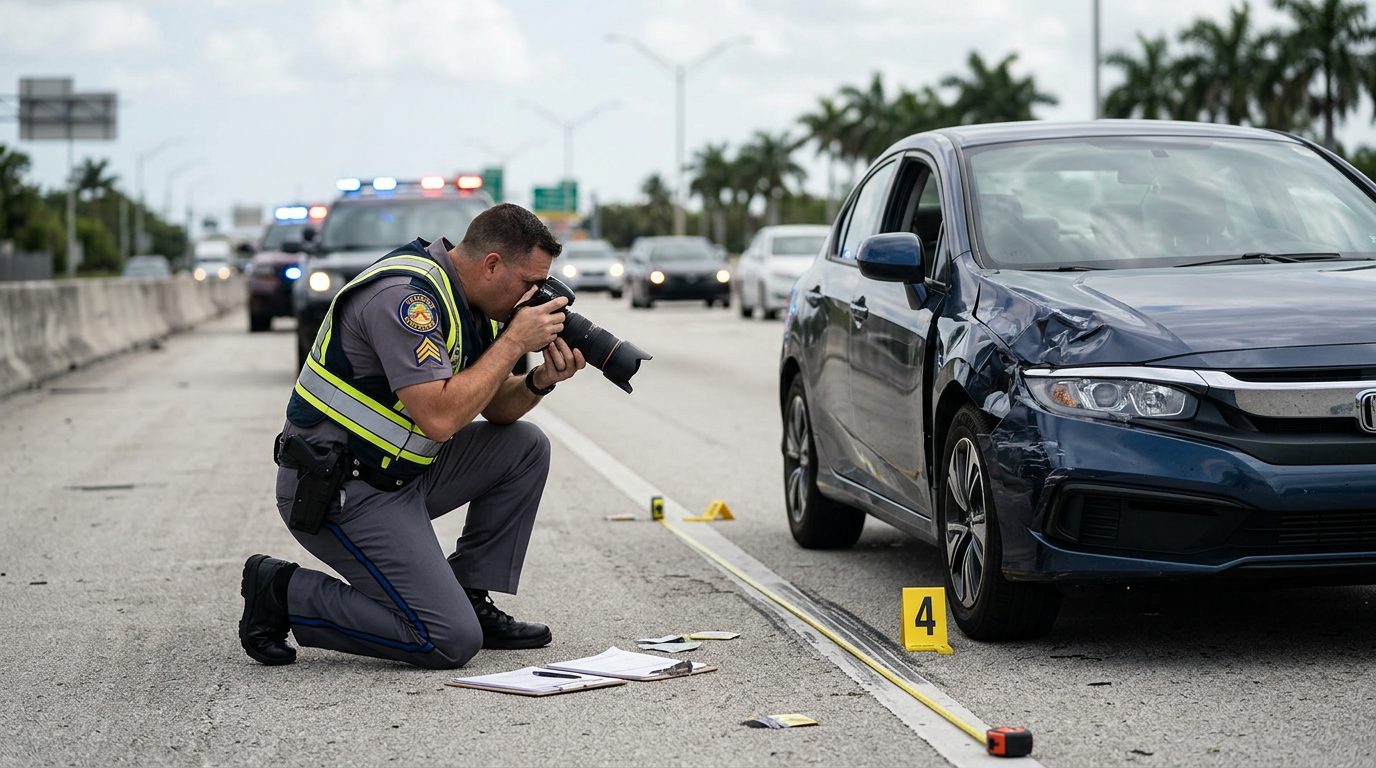
Speed, braking, and the sequence of the crash often decide these cases. Investigators may use crash reconstruction, scene measurements, skid marks, and vehicle damage patterns to estimate those facts.
Vehicle event data recorders, dashcam footage, and traffic camera video can show speed and braking before impact. Witness statements and 911 records help build the timeline. The defense examines the state’s reconstruction rather than accepting it.
Toxicology results matter even in a sober case. A negative result means the case turns on driving conduct alone. Blood testing after a crash is governed by Florida’s blood test statute: if a law enforcement officer has probable cause to believe a motor vehicle driven by or in the actual physical control of a person under the influence of alcoholic beverages, chemical substances, or controlled substances has caused the death or serious bodily injury of a human being, the officer must require the driver to submit to a blood test.
Under speed-measuring device rules, radar speed evidence is admissible only if the officer meets set conditions, such as radar training and an independent visual check. Self-test logs and annual calibration results for automated speed detection systems are admissible in citation proceedings under s. 316.1895 or s. 316.183 enforced under s. 316.1896.
Talk With a Miami Criminal Defense Lawyer Before Making Statements
Talk with a criminal defense lawyer before you give a detailed statement after a fatal crash. Statements to investigators can become part of the case, so timing matters.
Florida law sets a strict duty at the scene. In a crash that results in death, the driver must stop and remain there until the required steps are done. Under Fla. Stat. § 316.191(2)(a), a person may not drive in a street takeover, stunt driving, race, speed competition or contest, drag race or acceleration contest, test of physical endurance, or exhibition of speed or acceleration, or for the purpose of making a speed record, on any highway, roadway, or parking lot. Under Fla. Stat. § 316.191(4)(b), a person who is a spectator at a prohibited race, drag race or street takeover commits a noncriminal traffic infraction, punishable by a fine of $400. See crash involving death or personal injuries.
Preserve records now. Keep photos, repair estimates, and any dashcam footage. Write down what you remember while it is fresh, and share it with your lawyer.
Patrick Wilson Law, PLLC is a Miami criminal defense firm. It handles vehicular homicide matters across Miami-Dade County and Broward County, from Fort Lauderdale to the Florida Keys. Patrick David Wilson is the lawyer responsible for this page.
Frequently Asked Questions
Can you be charged with vehicular homicide if you were not drinking?
Yes. Florida’s statute does not require alcohol or drugs. The question is whether the driving was reckless.
Is vehicular homicide a felony in Florida?
Yes. The base grade is a second-degree felony, and certain facts raise it to first degree.
What is the difference between vehicular homicide and reckless driving?
Vehicular homicide requires a death caused by reckless driving. Reckless driving can be charged without a death.
Does a negative toxicology result help?
It removes the alcohol question. The case then centers on how the vehicle was driven.
If you were driving sober and a crash has left someone dead, the worry about a homicide charge can feel overwhelming. Reach out to our team at 786-761-1719 or send us a message to talk through your situation in a free, confidential first consultation with no obligation to continue.
How Patrick Wilson Law Approaches These Cases
Early Review of the Crash Record
We review the police report, crash data, witness statements and any available video to understand what the State is likely to argue.
Focus on the Facts of Driving
Because impairment is not the only issue, we examine speed, road conditions, visibility, vehicle condition and the actions of other drivers.
Protecting Your Future
A charge can affect your job, your license and your record. We work to limit those consequences from the first conversation.
Support for Licensed Professionals
Nurses, pilots, teachers and other licensed professionals face added risk to their careers. We account for those stakes in every decision.
Important: Be Careful What You Say
Statements made to investigators, insurance adjusters or on social media can be used later in your case. Speak with a criminal defense attorney before giving a detailed account of the crash.
Key Issues in a Vehicular Homicide Case
Charging Decisions
Not every fatal crash leads to a charge that holds up.
Crash Reconstruction
Physical evidence, skid marks, event data and timing can tell a different story than the initial report. We test those findings carefully.
Felony Exposure
Vehicular homicide is a felony in Florida. We explain the possible penalties and how the facts of your case may affect them.
First-Time Offenders
If you have no prior record, we work to present your background and character clearly to the prosecutor and the court.

