
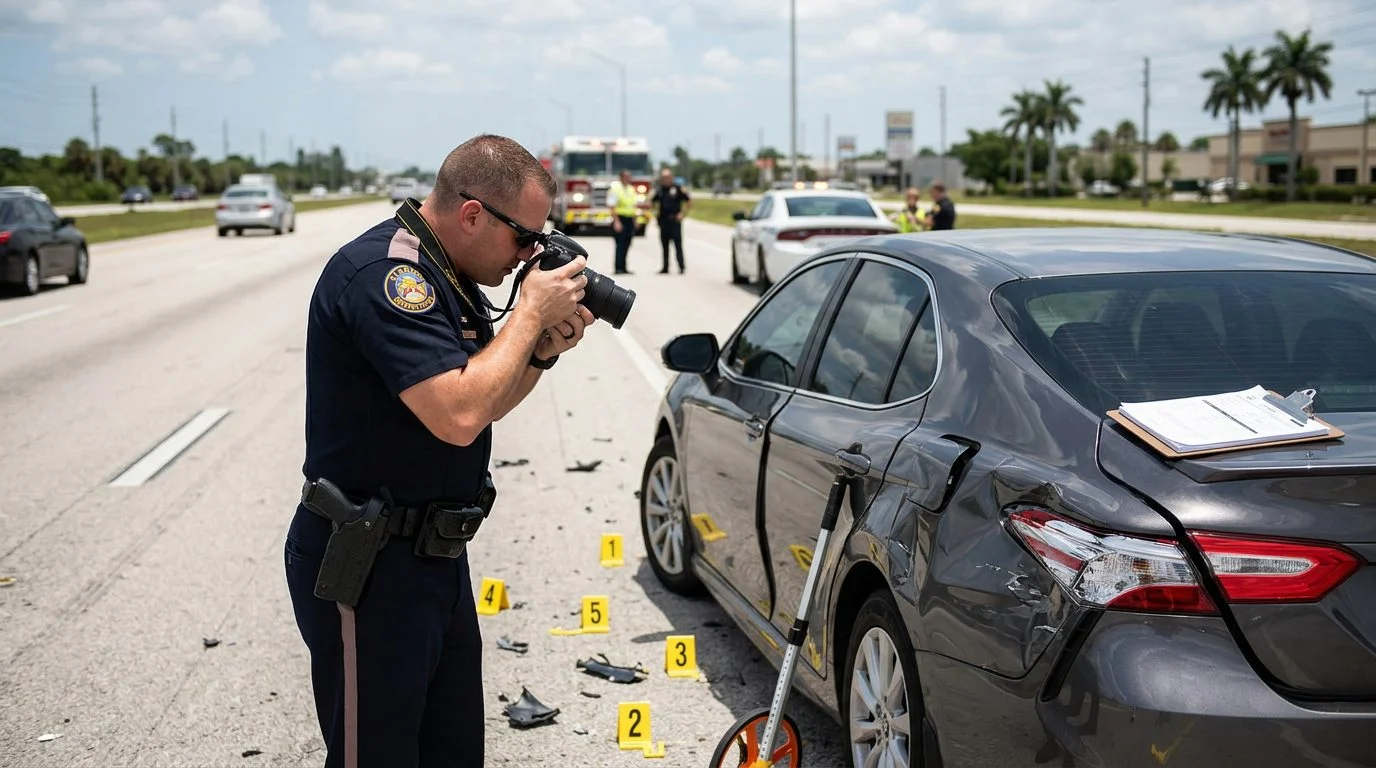
Vehicular Homicide Defense | Miami and South Florida
Charged After a Fatal Crash While Your License Was Suspended?
Patrick Wilson Law, PLLC defends drivers across Miami-Dade, Broward and the Florida Keys when a crash with a death leads to serious criminal charges.
By Patrick David Wilson · Published November 18, 2026
If you are facing a charge and need clear answers, the information on this page comes from Patrick David Wilson, the responsible lawyer at Patrick Wilson Law, PLLC in Miami, Florida.
A fatal crash with a suspended license usually leads to more than one charge. The suspension does not create the crash charges on its own. But it can add a separate count to the same crash, and each count has its own elements and penalties.
This page explains how those counts fit together. It covers vehicular homicide, driving while license suspended (DWLS) causing death, and related counts such as leaving the scene. It is written for South Florida drivers and their families who need to understand the charges before deciding what to do next.
The short answer: a suspension plus a death usually means more than one charge
A fatal crash with a suspended license often leads to several separate charges. Florida sentences separate offenses from one episode separately when each one requires proof of an element the other does not. Florida’s rules of construction set that rule.
The state can also file those offenses together. Offenses based on the same act, or on connected acts, can be charged in separate counts. Florida’s joinder rule covers that step.
Three groups matter here. They are the base homicide charge, the suspended-license charge tied to the death, and overlapping counts from the same crash. For the broader practice area, see our vehicular homicide defense page.
If a fatal crash happened while your license was suspended, you don't have to sort out these charges alone. Our team can talk through your options with you. Talk it through with our team — the first consultation is free, confidential, and carries no obligation.
The base charge: vehicular homicide under Florida Statute 782.071
Vehicular homicide is a killing caused by reckless driving. Florida’s vehicular homicide statute defines it as the killing of a human being, or the killing of an unborn child by any injury to the mother, caused by the operation of a motor vehicle by another in a reckless manner likely to cause the death of, or great bodily harm to, another.
The base offense is a second-degree felony. It carries up to 15 years in prison and a fine of up to $10,000.
The charge is also a first-degree felony if the driver has a prior conviction under this statute or certain DUI and vessel homicide laws. Prior history can change the felony level before the case even reaches trial.
The state’s proof centers on how the person drove and whether that driving caused the death. The statute’s definition does not mention license status. That is one reason a suspension is charged as its own count. A right of action for civil damages exists under s. 768.19, under all circumstances, for all deaths described in this statute.
Driving while license suspended under Florida Statute 322.34
Florida’s driving-while-suspended statute makes it an offense to drive on Florida highways while a license or driving privilege is canceled, suspended, or revoked. The criminal offense requires that the driver knew of the cancellation, suspension, revocation, or suspension or revocation equivalent status, and it does not apply to a habitual traffic offender as defined in s. 322.264.
Under s. 322.34(1), driving while suspended is a moving violation when the person is not a habitual traffic offender. Section 322.264 defines a habitual traffic offender by convictions within a 5-year period and does not itself make the death version a felony.
The statute also sets a minimum of 10 days in jail for a third or later conviction, with exceptions in other paragraphs. Repeat drivers face a much harder case than first-time drivers.
The DWLS count is separate from vehicular homicide. Each one has its own elements, so the state can bring both from the same crash. The reason for the suspension also matters. Early review of the suspension record shows which version of the statute the state may use.
How the charges stack from a single crash
Several counts can come from one crash. Each count is judged on its own elements. Driving with suspended license fatal crash Florida cases often involve this kind of layering.
Take a crash that kills a pedestrian. The state may bring vehicular homicide and leaving the scene. If it alleges impairment, it may also bring DUI manslaughter.
DUI manslaughter ties to Florida’s DUI law. Florida’s DUI statute reaches a driver who is under the influence to the extent that normal faculties are impaired.
Leaving the scene is another count. Florida’s crash-involving-death statute requires a driver to stop at the scene. The same statute also requires revocation of the driver license for at least 3 years.
Separate counts can each carry their own sentence. The judge decides whether those sentences run at the same time or one after another.

How sentence exposure is calculated
The statutory maximum for each count is not the sentence a judge must impose. Sentencing starts with the Criminal Punishment Code scoresheet. Florida’s Criminal Punishment Code statute explains how the worksheet adds up sentence points.
If total points are 44 or fewer, the lowest permissible sentence is any nonstate prison sanction, unless the court determines within its discretion that a prison sentence is appropriate. If points exceed 44, the lowest permissible prison sentence is calculated by subtracting 28 points and reducing the remainder by 25 percent. If the primary offense or any additional offense is ranked in level 8, level 9, or level 10 and the offender has one or more prior serious felonies, a single assessment of 30 points is added, regardless of how many prior serious felonies there are. A prior serious felony is a level 8, 9, or 10 offense for which the offender was serving a sentence, or whose release date was within 3 years before the current offense.
Each count, prior record, and victim injury can change the point total. So the final sentence depends on the facts in each case.
The knowledge element: what the state must show about the suspension
Under the DWLS statute, the state must prove the driver knew the license was suspended. The statute requires that the driver act knowing of such cancellation, suspension, revocation, or suspension or revocation equivalent status.
A rebuttable presumption can be challenged with evidence.
Notice rules also matter. Florida’s notice statute for license suspensions allows orders to be given by personal delivery, by first-class mail to the last known address furnished to the state, or by e-mail if the driver authorized it. Failing to receive the order does not stop the suspension from taking effect.
That rule covers when a suspension starts. It does not remove the state’s duty to prove knowledge under the DWLS statute. A common mistake is assuming an old address does not matter. Under the mail rule, the last address the driver gave the state is the address that counts.
Not sure what your next step is?
Talk it through with our team — the first consultation is free, confidential, and carries no obligation.
Early steps that protect your position
The first steps are to limit statements, keep records, and confirm the suspension. Each step matters because the state builds its case from what it can find.
- Speak with a lawyer before any recorded statement. Investigators and prosecutors may ask questions soon after a crash.
- Keep every notice and envelope about your license. Dates and mailing addresses drive the notice questions.
- Keep records from the day of the crash. That includes phone records, receipts, and trip details.
- Watch the vehicle deadline. If the vehicle was impounded or immobilized, the owner may file a complaint within 10 days after learning where it is. The complaint is filed in the county where the owner lives.
- Review the charging papers early. Identify which counts the state filed and which counts it may add later.
Talk with Patrick Wilson Law about a fatal crash case in Miami or Broward
Patrick Wilson Law, PLLC focuses on vehicular homicide and related criminal defense in South Florida. The firm’s office is in Miami, and it handles driving with suspended license fatal crash Florida matters across Miami-Dade and Broward County.
Can I be charged with DWLS if I didn’t know my license was suspended?
The DWLS statute makes knowledge an element, so the state must prove it. Notice records and the driver’s address on file are the key facts to examine.
Can one crash lead to both vehicular homicide and DWLS causing death?
Yes, the state can file separate counts from one crash. Each count has its own elements under Florida law.
Do sentences for several counts run at the same time?
The judge decides whether sentences run concurrently or consecutively. Florida’s sentencing rules govern that choice.
If your crash led to a death while your license was suspended, and you are weighing what to say to investigators or a prosecutor, you don’t have to face that alone. Our team can talk through the charges with you. The first consultation is free, confidential, and carries no obligation to continue. Call 786-761-1719 or use our contact page.
Why Drivers Call Patrick Wilson Law
Defense Focused on Your Case
The firm focuses on criminal defense, including vehicular homicide and related driving charges. Patrick David Wilson leads each defense and reviews the facts of your case personally.
Careful Review of the Record
Notice records, driving history, the crash report and the license file often matter. We examine them closely from the start.
South Florida Courts
Based in Miami, the firm represents clients in Miami-Dade, Broward County, Fort Lauderdale, Hialeah, Kendall, Homestead, Miami Beach and the Florida Keys.
Strategy From the First Call
Every defense is planned around the charges, the evidence and your goals, with clear explanations at each stage.
Speak to a Lawyer Before Giving Statements
Police, insurers and other parties may ask you about the crash. Before you give a recorded statement, sign a form or post about the accident online, speak with a criminal defense lawyer.
How We Work With You
1. Contact Us
Call 786-761-1719 or leave a message. We will respond to your request promptly.
2. Confidential Review
We listen to what happened, review the charges and explain the questions that matter most in your case.
3. A Defense Plan
We outline the next steps, the evidence we need and the decisions ahead, so you know where things stand.
4. Steady Representation
Patrick David Wilson and the firm's lawyers keep you informed at every stage of the case.

