
Vehicular Homicide Defense | Miami, Florida
Facing a Vehicular Homicide Charge in Florida?
Patrick Wilson Law focuses on criminal defense for clients across South Florida, from Miami-Dade and Broward to the Florida Keys. Start by telling us where your case stands.
By Patrick David Wilson · Published November 14, 2026
If a fatal crash has left you facing a charge, or someone you love is facing one, you want clear answers about the sentence. Vehicular homicide is a felony in Florida, and the penalty depends on the felony level, any prior conviction, and a scoresheet the judge uses.
It’s general information for drivers and families who are still deciding what to do next. Patrick Wilson Law, PLLC is a Miami criminal defense firm that serves South Florida.
What Florida Law Calls Vehicular Homicide
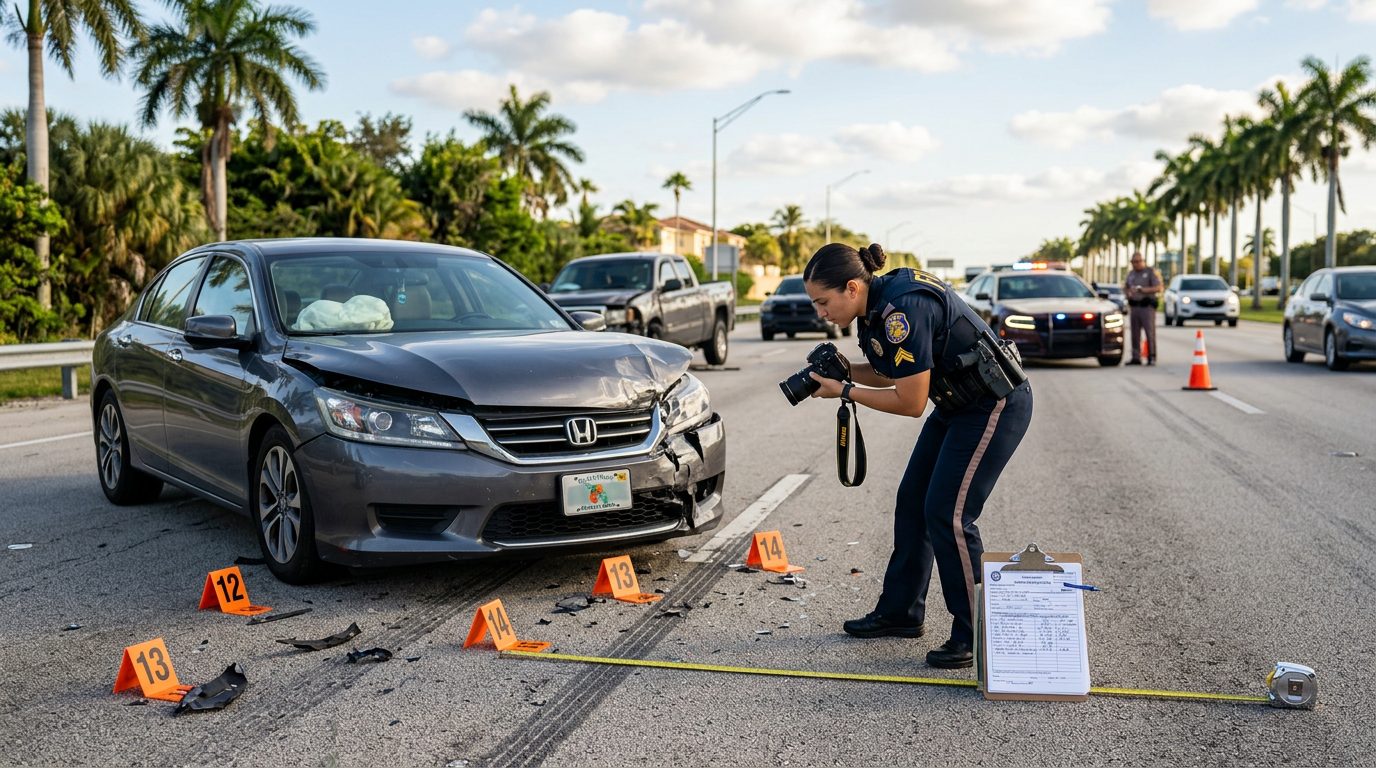
Florida treats a reckless crash death as vehicular homicide under Fla. Stat. § 782.071. The statute defines it as the killing of a human being, or the killing of an unborn child by any injury to the mother, caused by the operation of a motor vehicle by another in a reckless manner likely to cause death or great bodily harm to another.
Many people search for “vehicular manslaughter.” That is the common name. The statute’s title is vehicular homicide, so use that term when you read the law.
Impairment can also be part of the case. Under § 316.193, a person driving or in actual physical control of a vehicle within this state commits DUI if the person is under the influence of alcoholic beverages, a chemical substance listed in s. 877.111, or a substance controlled under chapter 893 to the extent that normal faculties are impaired, or if the person has a blood- or breath-alcohol level of 0.08 or more.
This charge arises in fatal crashes across Miami-Dade and Broward Counties, including Miami, Fort Lauderdale, Hialeah, Kendall, Homestead, Miami Beach and the Florida Keys. First-time drivers and licensed professionals often worry most about what a conviction could cost them. It can mean a license, a job, or a career, not just time.
If a crash has left you or someone you love facing this charge, you don't have to sort out the sentencing questions alone. Our team offers a free, confidential first consultation. Talk it through with our team — the first consultation is free, confidential, and carries no obligation.
What the State Must Prove at Trial
The main parts are these:
- The defendant was operating the motor vehicle at the time of the crash.
- The operation was reckless in a way likely to cause death or great bodily harm.
- A human being died, and the death resulted from that operation.
Recklessness is often the hardest point for the state to prove. Prosecutors rely on crash reports, video, vehicle data and witness accounts to show how the driver acted. A defense looks at whether that evidence shows a reckless act or a fast, unexpected event.
If the state relies on impairment, the case turns to chemical testing. That issue comes up again in the pretrial section below.
Sentence Exposure Under Florida’s Vehicular Homicide Statute
Vehicular homicide is a second-degree felony under § 782.071. Under the statute, the offense is a felony of the first degree if:
- The driver knew or should have known the crash occurred and failed to give information and render aid as required by § 316.062.
- The driver has a prior conviction under the statutes the section lists.
Fines for a first- or second-degree felony are generally capped at $10,000 under § 775.083, though a higher amount equal to double the pecuniary gain or loss, or an amount specifically authorized by statute, may apply.
Leaving the scene is different. A willful violation of § 316.027 that causes death carries a four-year mandatory minimum, but the defendant may move to depart from it unless the violation was committed while driving under the influence, and the court may grant the motion only if it finds that a factor, consideration, or circumstance clearly demonstrates that imposing the mandatory minimum would result in an injustice.
The judge’s sentence is set through the scoresheet under § 921.0024; separately, under § 316.027, a listed offense is ranked one level above its usual ranking for sentencing under chapter 921 and gain-time eligibility under chapter 944 when the victim was a vulnerable road user. Under § 921.0024, total points of 44 or less allow a nonstate prison sanction as the lowest sentence. Fla. Stat. § 921.0024 reads: “The lowest permissible sentence is any nonstate prison sanction in which the total sentence points equals or is less than 44 points, unless the court determines within its discretion that a prison sentence, which may be up to the statutory maximums for the offenses committed, is appropriate.” Above 44 points, the lowest prison term is the total minus 28, reduced by 25 percent. The range runs from that lowest sentence up to the statutory maximum.
How a Vehicular Homicide Case Moves Toward a Jury Trial
A case usually moves from arrest to first appearance, then discovery, pretrial motions, plea talks and trial. Timelines vary, and each step can change the strategy.
- First appearance and bail. The judge weighs factors including the offense, the weight of the evidence, family ties, length of residence, immigration status, employment history, financial resources, mental condition, past conduct and any danger to the community, under § 903.046.
- Blood testing. When an officer has probable cause that an impaired driver caused a death or serious bodily injury, the officer must require a blood test. The officer may use reasonable force if needed, under § 316.1933.
- Who draws the blood. Only specific medical and laboratory personnel may draw blood at an officer’s request. Insubstantial differences in the testing process do not make a result invalid, so the defense focuses on problems that matter.
- Discovery. Both sides exchange the crash report, video, vehicle data and lab records.
What a Jury Trial Defense Covers
A trial defense tests each part of the state’s case against the evidence. Our lawyers look at several areas:
- Crash reconstruction. Speed, distance, visibility and the order of events.
- Toxicology. Timing of the test, how the sample was collected and stored, and the lab’s procedures.
- Digital and roadway evidence. Phone records, vehicle event data, signals and road conditions.
- Witness statements. Comparing what witnesses said with the physical evidence.
- Testimony. Whether the defendant testifies is a choice the client makes after reviewing the evidence with the lawyer.
A jury trial ends in a verdict. If there is a felony conviction, a digitized scoresheet is prepared for each defendant to set the permissible sentencing range; the state attorney prepares it, defense counsel reviews it, and the sentencing judge approves and signs it.
Plea Versus Trial: How the Decision Is Made
The choice between a plea and a trial belongs to the client, after the lawyer explains each offer. Defense counsel may not conclude a plea agreement without the client’s full and complete consent, under Fla. R. Crim. P. 3.171. Counsel must also advise the client of all plea offers and their likely results.
A prosecutor may drop other charges, recommend a sentence, or agree to a specific sentence. Under the same rule, a recommendation is not binding on the trial judge.
The factors include how strong the causation and recklessness evidence is, the sentencing range, and the client’s record and circumstances. Leaving-the-scene and DUI charges can arise alongside a fatal crash, and the firm handles both areas.
Not sure what your next step is?
Talk it through with our team — the first consultation is free, confidential, and carries no obligation.
Why Patrick Wilson Law, PLLC for This Charge
Patrick Wilson Law, PLLC is a Miami criminal defense firm. Patrick David Wilson is the responsible lawyer for this page, and Sahara Fonseca is also a lawyer at the firm. Our team supports the firm’s lawyers and clients.
- The firm focuses its criminal defense practice on DUI, domestic violence, sexual battery, traffic homicide, white collar matters, and record sealing and expungement.
- The firm defends first-time offenders, non-citizens and licensed professionals.
- The firm serves Miami, Miami-Dade County, Broward County, Fort Lauderdale, Kendall, Hialeah, Miami Beach, Homestead and the Florida Keys.
Frequently Asked Questions About Vehicular Homicide Sentences in Florida
How long do you go to jail for vehicular manslaughter in Florida?
The sentence falls within a range set by the scoresheet, from a lowest permissible sentence up to the statutory maximum. The judge decides where in that range the sentence lands.
A first-degree felony applies only in the situations the statute lists.
How long do you stay in jail for vehicular homicide?
Time before trial depends on bail, which the court sets under the criteria in § 903.046. After a conviction, the sentence follows the scoresheet range.
Can you go to jail for accidentally killing someone in a car accident in Florida?
The statute requires reckless operation, so a crash without a reckless element does not fit its definition. Leaving the scene can create separate exposure.
Talk Through Your Situation With Our Team
If a crash has you or someone you love facing this charge, you don’t have to work out the sentence and next steps alone. The first consultation is free and confidential, with no obligation to continue.
Call 786-761-1719, or leave a message through our contact page.
Why Clients Contact Patrick Wilson Law
Focused criminal defense
Our practice focuses on criminal defense, including vehicular homicide, DUI, domestic violence and leaving the scene of an accident.
A free, confidential first consultation
Your first consultation is free, confidential and comes with no obligation to continue.
Serving South Florida
We represent clients in Miami, Miami-Dade County, Broward County, Fort Lauderdale, Kendall, Hialeah, Miami Beach, Homestead and the Florida Keys.
Attorneys and staff who take your call
Our team works with you from the first call through each stage of your case.
Be Careful About What You Share
Avoid posting about the crash, the charge or your condition on social media, and do not discuss the case with anyone other than your attorney.
What Shapes a Vehicular Homicide Case
The charge itself
The specific charge depends on the facts of the crash and on what the State can prove about how it happened.
Evidence from the scene
Crash reports, vehicle data, witness statements and physical evidence can all affect how a case is built and challenged.
Sentencing decisions
Sentencing involves a scoresheet and the judge's discretion, so the details of your record and the circumstances matter.
Your next steps
Early decisions about bail, statements and communication with investigators can shape the rest of your case.
Talk with a Miami Criminal Defense Attorney Today
Related practice areas
- Vehicular Homicide Defense Attorney in South Florida

