
Vehicular Homicide Defense | Miami-Dade, Broward and the Keys
Vehicular Homicide Scoresheet Florida: How Points Add Up
Patrick Wilson Law, PLLC focuses on criminal defense across South Florida. Here is how the Florida Criminal Punishment Code scoresheet works, and why every point on it matters.
By Patrick David Wilson · Published October 23, 2026
A vehicular homicide scoresheet in Florida turns the charge and the defendant’s prior record into points. The total sets the lowest permissible sentence, which is the minimum a judge can impose without a valid legal reason to go lower. This guide explains the vehicular homicide scoresheet Florida courts use, line by line, in plain English.
How a Florida Vehicular Homicide Scoresheet Produces a Sentencing Range
Florida scoresheets add up points from the offense and the defendant’s record. The total determines the range a judge works within. The scoresheet is a calculation tool, not a sentence.
The state uses the Criminal Punishment Code, found in Chapter 921 of the Florida Statutes. The worksheet computes a subtotal and a total of sentence points. The total sentence points are used to determine the lowest permissible sentence.
The permissible range runs from that lowest sentence up to the statutory maximum for the offenses before the court. One scoresheet covers all the offenses pending in the case, so every charge gets counted together, except that if the defendant is before the court for sentencing for more than one felony and the felonies were committed under more than one version or revision of the guidelines or the Criminal Punishment Code, separate digitized scoresheets must be prepared. Points set the floor. They do not set the final number.
If your scoresheet totals don't match what you were told after a fatal crash, we can walk through each line with you and answer your questions. Talk it through with our team — the first consultation is free, confidential, and carries no obligation.
Where Vehicular Homicide Sits on the Offense Severity Chart
Every felony gets a level on the offense severity ranking chart, and that level starts the scoring. The chart has 10 levels, from level 1, the least severe, to level 10, the most severe (Fla. Stat. § 921.0022).
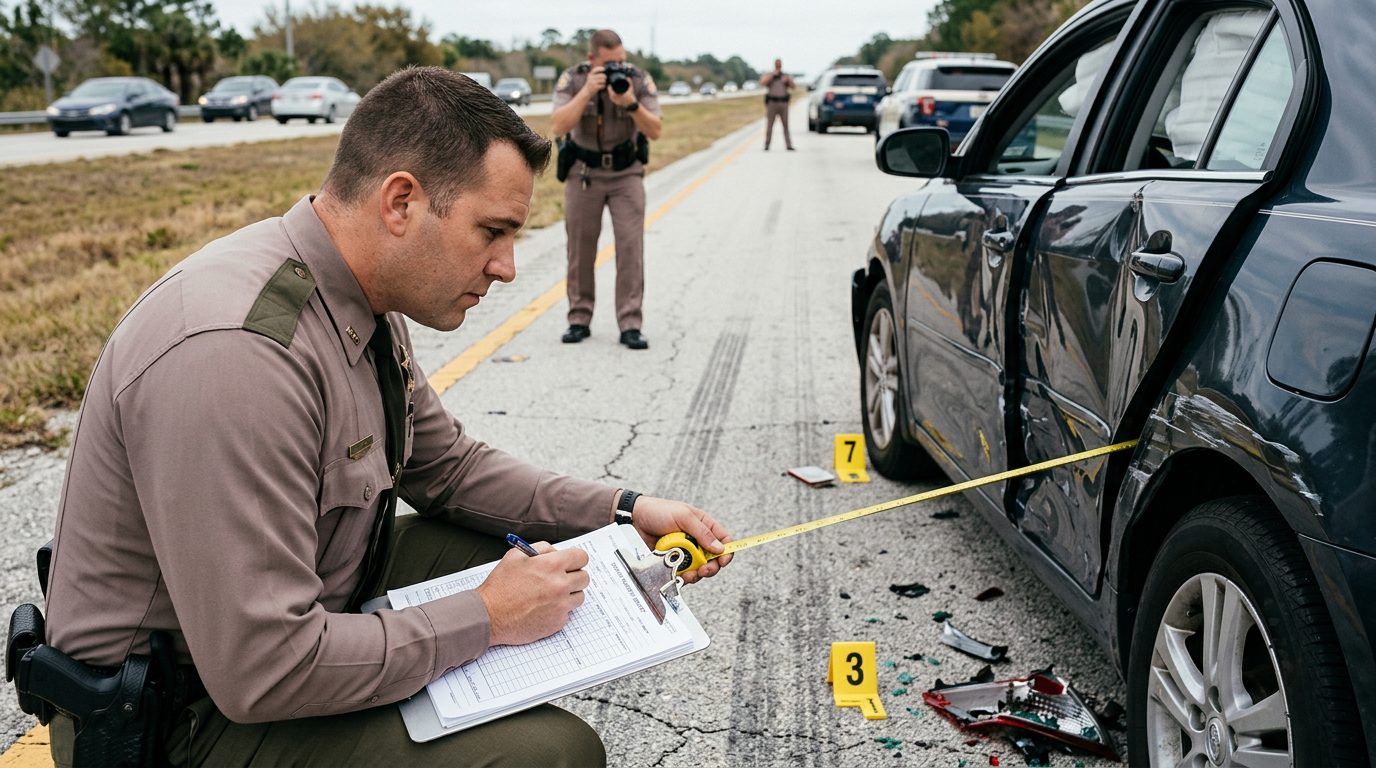
Vehicular homicide is the killing of a human being, or the killing of an unborn child by any injury to the mother, caused by operating a motor vehicle by another in a reckless manner likely to cause death or great bodily harm (Fla. Stat. § 782.071). The base offense is a second-degree felony. It becomes a first-degree felony in two situations. The first is when the person knew or should have known the accident occurred and failed to give information and render aid. The second is when the person has a qualifying prior conviction.
The degree matters because it affects the case. For a prior conviction scored as prior record, when the degree of felony is ambiguous or the severity level cannot be determined, the Rule says that conviction must be scored at severity level 1 (Fla. R. Crim. P. 3.704). Check the charging language closely.
Prior Record Points and How They Add to the Total
Prior record points come from prior convictions, not arrests. The Rule says arrests without a conviction, and dispositions other than conviction, must not be scored (Fla. R. Crim. P. 3.704).
A prior serious felony adds more weight. If the primary offense or an additional offense ranks at level 8, 9, or 10, and the defendant has a prior serious felony, a single 30-point assessment is added. A prior serious felony is a level 8, 9, or 10 offense in the offender’s prior record for which the offender is serving a sentence of confinement, supervision, or other sanction, or whose release date falls within 3 years before the new offense (Fla. Stat. § 921.0024).
A defendant with no prior convictions has no prior record points. The total then comes mostly from the offense itself. That is why two cases with the same charge can produce very different totals. If the parties disagree about a prior entry, the sentencing judge resolves the dispute (Fla. R. Crim. P. 3.704).
Victim Injury and Other Additional Points
The subtotal adds several categories together. These include primary offense points, additional offense points, victim injury points, prior record points, and any legal status points (Fla. R. Crim. P. 3.704).
Victim injury points cannot be scored for an offense the defendant was not convicted of. A rare multiplier also exists.
The state attorney prepares the digitized scoresheet. One wrong count, offense level, or prior entry changes the total. That changes the floor.
From Total Points to the Lowest Permissible Sentence
If total sentence points are 44 or fewer, the lowest permissible sentence can be a nonstate prison sanction. A judge can still choose a prison sentence within the court’s discretion.
Above 44 points, the math changes. Subtract 28 from the total. When total sentence points exceed 44, subtract 28 points from the total and decrease the remaining total by 25 percent to get the lowest permissible sentence in prison months. For example, a hypothetical total of 60 points becomes 32 after subtracting 28. A 25 percent reduction leaves 24 months.
Any sentence to state prison must exceed 1 year. A judge may go below the lowest permissible sentence only when circumstances reasonably justify it. Examples of mitigating circumstances that may justify a downward departure include a legitimate, uncoerced plea bargain and an isolated, unsophisticated offense for which the defendant has shown remorse.
Intoxication matters in these cases. Substance abuse or addiction, including intoxication at the time of the offense, is not a mitigating factor. It does not justify a downward departure, apart from one narrow drug-court provision (Fla. Stat. § 921.0026).

Talk Through Your Scoresheet With a Miami Criminal Defense Lawyer
If the numbers on a scoresheet don’t add up, a defense lawyer can check each line. Here are three common questions.
Is vehicular homicide a felony in Florida?
Yes. Under Fla. Stat. § 782.071(1)(b)-(c), vehicular homicide becomes a first-degree felony if, at the time of the accident, the driver knew or should have known that the accident occurred and failed to give information and render aid as required by s. 316.062, or if the driver has a prior conviction for vehicular homicide, DUI manslaughter, BUI manslaughter, or vessel homicide.
Can a judge sentence below the scoresheet range?
Only with a reason the law allows, such as a legitimate, uncoerced plea bargain.
Who prepares the Florida scoresheet?
The office of the prosecuting attorney prepares the scoresheets and presents them to defense counsel for review as to accuracy.
If you’re holding a vehicular homicide scoresheet Florida prosecutors prepared after a fatal crash in Miami-Dade, Broward, or the Keys, and the totals don’t match what you were told, Patrick David Wilson can review it with you. Patrick David Wilson is the responsible lawyer for this page at Patrick Wilson Law, PLLC in Miami. Call 786-761-1719 or leave a message. Your first consultation is free and confidential, with no obligation to continue.
Why clients contact Patrick Wilson Law
A focused practice
Patrick Wilson Law, PLLC focuses on criminal defense, including vehicular homicide, DUI, domestic violence and sexual battery cases.
Serving South Florida
We represent clients from Miami-Dade and Broward Counties to Fort Lauderdale, Miami Beach, Hialeah, Homestead and the Florida Keys.
Confidential first step
The initial consultation is free, confidential and without obligation to continue.
Attorneys who work together
Our team, including Patrick David Wilson and Sahara Fonseca, reviews each case with the client from the start.
Do not assume the number is final
Each point on a scoresheet can change the sentencing range. Prior record, victim injury and the charge level all feed into the total, so an estimate made without the full facts can be misleading. Bring every detail to the consultation.
What shapes your scoresheet
The offense level
The primary offense sets the starting point, and the scoring rules attached to it determine how much weight the rest of the case carries.
Prior record
Prior convictions are scored separately, so an older or unrelated record can still add points to the total.
Victim injury
How severe the injuries were and how many people were hurt can add points under the scoresheet, which is why the facts of the crash matter.
Your next step
Bring any police reports, court papers and past records to a free consultation so the calculation can be reviewed with you.

