

Criminal Defense for Licensed Professionals | Miami, FL
A Fatal Crash Charge Can Reach Your License. Get Answers Early.
Patrick Wilson Law represents licensed professionals across South Florida facing vehicular homicide and related charges, with a focus on protecting both the case and the career.
By Patrick David Wilson · Published November 18, 2026
A charge alone does not start the 30-day written reporting clock under Florida’s licensing statutes. That clock starts with a conviction, a finding of guilt, or a plea. This page is the responsibility of Patrick David Wilson of Patrick Wilson Law, PLLC, in Miami, Florida. It explains what to check before you answer a board.
The Short Answer: Whether You Must Report Depends on Your License
The written reporting duty under Florida law is tied to a conviction, a finding of guilt, or a plea, not to an arrest. Under Fla. Stat. § 456.072, failing to report in writing within 30 days is a ground for discipline. Which rules apply to you depends on your profession and your board.
A pending case also doesn’t pause the board. So staying silent while your case is open is not a safe default.
For background on the charge itself, read our vehicular homicide overview.
If a fatal crash charge has put your license in question, you don't have to sort out the board's rules alone. Our team can talk through your situation with you. Talk it through with our team — the first consultation is free, confidential, and carries no obligation.
Why a Fatal Crash Charge Can Reach Your License
Boards act on conduct, and they act on how a licensee answers questions. Vehicular homicide is the killing of a human being, or of an unborn child by injury to the mother, caused by the operation of a motor vehicle by another in a reckless manner likely to cause the death of, or great bodily harm to, another. Under Fla. Stat. § 782.071, it is a second-degree felony. It becomes a first-degree felony in some cases, such as when the driver knew or should have known the crash occurred and did not stop to give aid.
A board can also act on a settlement. Florida law says a licensing authority’s acceptance of a relinquishment, stipulation, or consent order, offered in response to or in anticipation of charges, counts as action against the license. A quick deal can carry licensing consequences of its own.
Leaving the scene adds risk. Under Fla. Stat. § 316.027, a willful violation in a fatal crash is a first-degree felony with a mandatory minimum of 4 years, though the defendant may move to depart from that minimum unless the violation was committed while driving under the influence. The driver’s license is also revoked for at least 3 years. Many applications and renewal forms ask about arrests, charges, and convictions. That question can reach you on paper before anyone calls the board.
What to Check in Your Board’s Rules and Forms
Start by finding the board that issued your license and reading its current rules on criminal matters. Look for three things: the trigger, the deadline, and the method. Under Fla. Stat. § 316.027, the driver of a vehicle involved in a crash on public or private property that results in injury to or the death of a person has to stop immediately at the scene, or as close to it as possible, and stay there until he or she has met the duties set out in s. 316.062, although the section does not apply to crashes during a motorsports event or at a closed-course motorsport facility.
Read every form question slowly. Under Fla. Stat. § 456.072, misleading or fraudulent representations related to your profession are grounds for discipline. An inaccurate answer can create a separate problem, even if the charge itself is resolved.
Know what a board can do. A licensing board may refuse to certify an application, certify it with restrictions, issue a reprimand, or place a licensee on probation with conditions. Keep a dated log of every form you complete and every message you send to the board.
How the Stage of Your Case Changes the Question
Each stage of a case can be recorded differently, so your answer may change as the case moves. A court may not withhold adjudication for a first-degree felony. For a second-degree felony, it may withhold only if the state attorney requests it in writing or the court makes written findings that withholding is reasonably justified based on circumstances or factors in accordance with those set forth in s. 921.0026, and never if the defendant has a prior withholding of adjudication for a felony that did not arise from the same transaction, under Fla. Stat. § 775.08435. Our withhold of adjudication page explains how a withhold can affect the record.
Sealing and expunction are not a clean reset. Under Fla. Stat. § 943.0584, a vehicular homicide conviction makes a record ineligible for sealing or expunction. Expunction can apply in other situations, such as a dismissal or an acquittal, under Fla. Stat. § 943.0585. Even then, the state still discloses an expunged record to listed licensing entities for licensing purposes. Fla. Stat. § 943.0585 reads: “I of the State Constitution, except that the department shall disclose the existence of a criminal history record ordered expunged to the entities set forth in subparagraphs (b)1. and 4.-9. for their respective licensing, access authorization, and employment purposes and to criminal justice agencies for their respective criminal justice purposes.” Fla. Stat. § 943.0585 reads: “It is unlawful for any employee of an entity set forth in subparagraph (b)1., subparagraph (b)4., subparagraph (b)5., subparagraph (b)6., subparagraph (b)7., subparagraph (b)8., or subparagraph (b)9. to disclose information relating to the existence of an expunged criminal history record of a person seeking employment, access authorization, or licensure with such entity or contractor, except to the person to whom the criminal history record relates or to persons having direct responsibility for employment, access authorization, or licensure decisions.” Our expungement page covers the limits.
A victim family’s position is a separate question. Our victim family page explains how it can come up. No result can be promised.
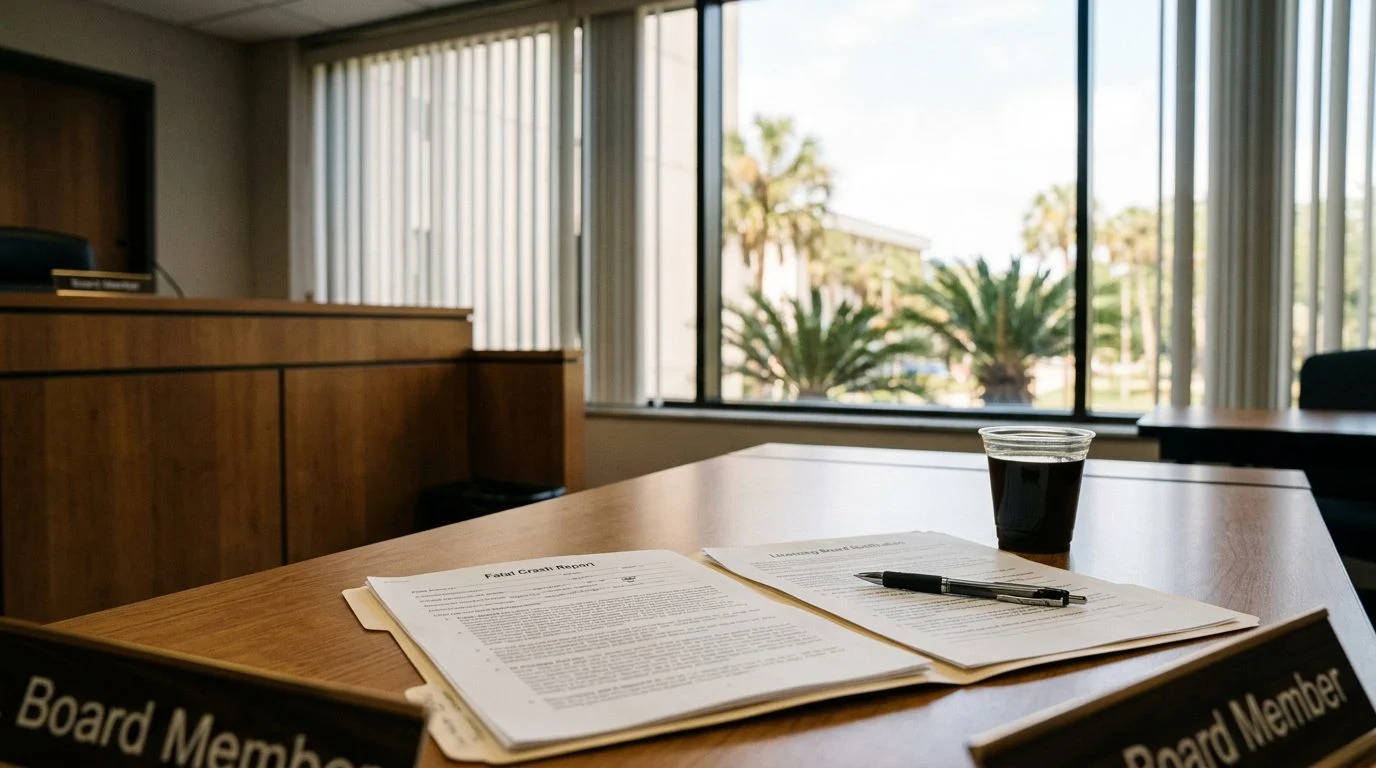
Where the Crash Report Fits In
The crash report is the investigating agency’s written record of the crash. It is one document in your case file, and it does not tell a board what you must disclose. Under Fla. Stat. § 316.066, a long-form report for a crash involving death or injury must be submitted within 10 days after the investigating officer completes the investigation.
The parties and their legal representatives can access the report. Access requires a valid driver license or other photographic identification, proof of status, or identification that demonstrates your qualifications, and a written sworn statement for each report requested. Florida law, Fla. Stat. § 316.068, requires every crash report made in writing to be on the form approved by the department and to include, unless not available: the date, time, and location of the crash; a description of the vehicles involved; the names and addresses of the parties involved and of all drivers and passengers in the motor vehicles involved; the names and addresses of witnesses; the name, badge number, and law enforcement agency of the officer investigating the crash; and the names of the insurance companies of the motor vehicles involved in the crash.
Ask the agency that investigated for your copy. Keep it with any citation, charging document, and court notice you receive. A board may ask to see them.
Mistakes That Can Create Licensing Problems
Licensing problems often come from timing and wording, not only from the charge. Watch for these common errors:
- Answering from memory. Check the case documents before you answer any form question.
- Missing the deadline. Once a conviction, finding of guilt, or plea occurs, the 30-day written clock runs under Fla. Stat. § 456.072.
- Sending a statement too early. Understand how a written statement may be used in the criminal case first. Anything you write can become part of the record.
- Assuming an arrest never needs mention. The statute’s trigger is a conviction, but your board’s form may ask about arrests.
- A licensing authority’s acceptance of a relinquishment of licensure, stipulation, consent order, or other settlement, offered in response to or in anticipation of the filing of charges against your license, is construed as action against your license.
Not sure what your next step is?
Talk it through with our team — the first consultation is free, confidential, and carries no obligation.
Talk Through Your License and Your Case
If a fatal crash charge has put your license in question, you don’t have to sort out the board’s rules alone. Here are two common questions.
Is a charge enough to require a board report in Florida?
Under Florida’s licensing statutes, the 30-day written duty is tied to a conviction, a finding of guilt, or a plea. Check your board’s forms, because they may ask about charges too.
Can a board act while my criminal case is still open?
An open criminal case can raise licensing questions as well as court questions.
Can a vehicular homicide record be sealed or expunged?
Under Florida law, a vehicular homicide conviction makes a record ineligible for sealing or expunction.
Patrick Wilson Law, PLLC serves clients across South Florida, from Broward County to the Keys. The first consultation is free, confidential, and carries no obligation to continue. Call 786-761-1719 or send us a message to talk about your license and your case.
How We Approach These Cases
Case and License Together
A criminal charge and a licensing inquiry can move on different timelines. We look at both so that decisions in one do not undercut the other.
Careful Review of Board Forms
Licensing boards often ask detailed questions about charges, arrests and pleas. We help you understand what each form asks before you answer it.
Support for Professionals
Our team works with clients whose careers depend on how a case is handled, keeping communication clear and practical at every stage.
Serving South Florida
Patrick Wilson Law, PLLC is based in Miami and represents clients in Miami-Dade, Broward County, Fort Lauderdale, Kendall, Hialeah, Miami Beach, Homestead and the Florida Keys.
Do Not Answer Board Questions Alone
A licensing form can ask about charges, not only convictions. Answers given without legal review can create new problems. Speak with a criminal defense attorney before you sign or submit anything to your board.
Questions to Bring to Your Consultation
What exactly was charged?
Bring the charging document and any notices you received. The exact charge affects both the court case and how it may be described to a board.
What does my board ask?
Bring copies of any licensing correspondence or forms. We can review the wording and discuss how to respond accurately.
How will the criminal case affect my work?
Tell us about your job duties, your employer and any reporting obligations you have, so we can address your practical concerns.
What are my next steps?
We will explain the options available in your situation and what each may involve, so you can make informed decisions.

